
Like all developed economies, Singapore has a central retirement fund called the Central Provident Fund (CPF), managed by the CPF Board. CPF is a mandatory employment based savings scheme with defined contributions from both employees and employers, each paying a set percentage of the employee’s wages into the fund.
⚡ Quick Answer
CPF is Singapore’s mandatory retirement savings scheme, split across Ordinary, Special, Medisave, and (from age 55) Retirement accounts. NRIs who worked in Singapore as citizens or Permanent Residents can withdraw their full CPF balance once they’ve formally given up PR status and left Singapore permanently, after clearing all tax liabilities. Transferring CPF proceeds to India isn’t taxed under the India-Singapore DTAA, though any interest or investment income the money earns afterward in India becomes taxable there.
The primary goal of CPF is to help Singapore’s working population, both citizens and Permanent Residents (PRs), fund their healthcare, retirement, and housing needs.
Singapore CPF – What NRIs Should Know
Must Read: 10 Best NRI Investment Options
Types of Accounts in Singapore CPF
Under the Central Provident Fund Act, employees and employers make regular monthly contributions, allocated across three accounts.
Ordinary Account (OA)
Builds the corpus for housing, insurance, investment, and educational needs.
Special Account (SA)
Built for old age, invested specifically in retirement related financial products.
Medisave Account (MA)
Covers approved medical insurance and hospitalization needs.
Retirement Account (RA)
Not a separate contribution account, but formed when you turn 55, when your OA and SA balances combine into the RA. It’s used to fund monthly payouts (annuities) to meet basic needs post retirement.
Must Check: Mr. NRI, How Much Retirement Corpus Is Enough
CPF Contribution Rates
As of 2026, employees aged 55 and below contribute 20% of wages, with employers adding a further 17%, for a combined 37% of monthly wages. This applies on wages up to the Ordinary Wage ceiling of SGD 8,000 a month. Contribution rates step down progressively for older workers, roughly 34% total for those above 55 to 60, tapering further through the 60s and 70s. This structure is reviewed periodically by the CPF Board, so always check the current CPF rate table before relying on a specific figure for planning.
Must Check: 401k Plan Before Moving Back To India
Earnings on CPF
CPF interest rates are reviewed quarterly. As of 2026, the Ordinary Account earns a floor rate of 2.5% per annum, while Special, Medisave, and Retirement Account balances earn a floor rate of 4% per annum, a rate the government has extended through the end of 2026. Members also earn extra interest on the first portion of their combined balances (an additional 1% on the first SGD 60,000 for those under 55, and more generous extra interest for those 55 and above), which meaningfully boosts effective returns on smaller balances.
The Rates Change, Plan Around the Structure, Not the Numbers
CPF contribution rates, the wage ceiling, and even interest rate floors get revised by the Singapore government from time to time, most recently effective January 2026. Rather than anchoring your financial plan to today’s exact percentages, understand the structure: contributions split across OA, SA, and MA, an RA formed at 55, and a full withdrawal option once you permanently leave Singapore and give up PR status. The numbers will keep shifting. The structure won’t.
What Are Your Options?
Contributing to CPF isn’t optional for anyone working in Singapore as a citizen or PR. All Citizens and PRs must make monthly CPF contributions, whether working on contract, permanently, part time, or casually.
For the self employed, only Medisave contributions are mandatory, though voluntary contributions to all three accounts are allowed and follow the usual CPF allocation rates.
Check: NPS for NRI
Investment Options
CPF members can invest OA and SA balances beyond a minimum threshold under the CPF Investment Scheme (CPFIS-OA and CPFIS-SA). Confirm the current minimum balance thresholds directly with CPF Board, since these have shifted before and may again.
Specified assets include:
- Insurance
- Unit Trusts
- ETFs
- Fixed Deposits
- Government Bonds and Treasury Bills
- Shares on the Singapore Exchange
- Property Funds
- Gold
What to Do When Moving Back to India
If you’re surrendering your PR status and returning to India, settle all tax liabilities first. Your employer must notify Singapore’s Inland Revenue Authority (IRAS) for tax clearance, and ensure all taxes are paid before employment ends.
Once tax clearance is complete, you can apply for the full withdrawal of your CPF balances across all accounts.
Conditions of Withdrawal
NRIs (or their legal representatives) can withdraw CPF savings on these grounds:
- Renouncing PR status and leaving Singapore and West Malaysia permanently.
- Becoming certifiably, permanently unfit for work due to physical or mental incapacity.
- Upon death: in Singapore, the relevant public agency notifies the CPF Board directly. If the PR was residing overseas at the time of death, you must inform the CPF Board in writing with supporting documents, including the local death certificate and PR status documents.
Conditions of Withdrawal CPF Funds
Must check: Gift by NRI to Resident Indian
Process of Withdrawal
- Download and complete the CPF withdrawal form from the official CPF Board website, and review the current documentation requirements listed there directly, since these are updated periodically.
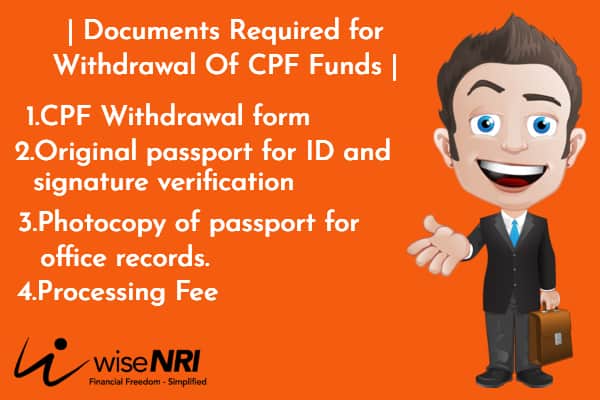
- If you’ve already left Singapore, non-original documents typically need certification by officials at a Singapore Mission. Schedule an appointment for signature attestation on the withdrawal form, and bring your original passport, a photocopy for office records, and the applicable processing fee.
- Forward the completed form directly to the CPF Board.
- If you have outstanding income tax liabilities, IRAS will use your CPF funds to settle them first. You’ll typically receive the remaining balances across your OA, SA, and MA accounts.
- For CPF Investment Scheme holdings, both OA and SA, the relevant bank or product provider gets notified by the Board to transfer the investments into your own name, which you can then liquidate.
The DTAA and Indian Tax Provisions
The DTAA between Singapore and India prevents your CPF income, already taxed in Singapore, from being taxed again in India. So transferring CPF money into your NRE account carries no additional Indian tax liability.
However, once that money sits in your NRE account and earns interest, or gets invested and generates income, that subsequent income becomes taxable in India.
If you receive annuity payments or pensions from former Singapore employers even after returning to India, those are taxable under your applicable Indian tax slab as “Income from Salary or Pension,” subject to DTAA relief where tax has already been deducted in Singapore.
Frequently Asked Questions
Can I withdraw my CPF while still living in Singapore?
Generally no. Full withdrawal requires renouncing PR status and leaving Singapore and West Malaysia permanently, becoming permanently unfit for work, or upon death.
Do I pay Indian tax on my CPF withdrawal when I move it to India?
No, not on the transfer itself, thanks to the India-Singapore DTAA. Tax applies only to income the money generates afterward, such as interest or investment returns earned in India.
Are CPF interest rates and contribution rates fixed?
No. Both are reviewed periodically by the CPF Board and the Singapore government, most recently with changes effective January 2026. Always check current rates directly with CPF Board rather than relying on older published figures.
Check our Retirement Planning Service for NRIs.
CPF is one of the more disciplined savings systems you’ll ever be forced into. Knowing exactly how to bring it home with you is what makes that discipline actually pay off.
💬 Your Turn
Have you navigated a CPF withdrawal after leaving Singapore? Share your experience or questions in the comments.


I moved from Singapore to the US. Now I want to close my CPF in Singapore and withdraw the funds. Is it better to transfer it to my account in the US or to an NRE account in India?
I worked in Singapore till 2020. Then I returned to India. At present, my CPF account earns interest on 31st December. The interest is added in the CPF account. My status in India for AY 2023-24 is Resident in India. So what should be tax treatment for the CPF interest earned in Singapore? How should I handle it in ITR2 form of income tax filing in India?
Hey Mansukh,
the CPF interest earned in Singapore would be taxable in India. You should report the CPF interest as foreign income in your Income Tax Return (ITR2) under the head “Income from other sources.” While filing the ITR2 form, you will need to provide the necessary details of the foreign income earned, including the amount of CPF interest and the country where it was earned (Singapore).
Hi Sunil, the CPF account in Singapore is like EPF account in India, where Employer and Employee contribute every month. As per rules for EPF contribution in India, the opening balance and interest on the opening balance are not taxed. Only the interest on the contributions in the previous year is taxed as per my understanding. As I retired and moved to India before 3 years, there is no contribution in my account in my CPF account and as the previous opening balance and interest on that balance are not charged in India, should I not claim benefits under exemption income?
Is there any kind of Tax Exemption available u/s income tax of India on such Singapore CPF interest income?
Is there any kind of Tax Exemption available u/s income tax of India on such Singapore CPF interest income?
After becoming resident Indian, i receive my CPF money in Singapore and transfer to India. How will this monies be taxed in India?
Hey Sunil,
The money will be subject to taxation in India. The transfer will be considered as foreign remittance, and any income component within the CPF amount will be taxable as per Indian tax laws. The taxation will depend on the nature of the income, such as interest or capital gains, and should be reported in your Income Tax Return (ITR) accordingly.
Is CPF earned in singapore taxable in India when one returns to india
Hello Poornima
Central Provident Fund (CPF) contributions made by an individual while working in Singapore are not taxable in India, as CPF contributions are made by the employee and the employer in Singapore to provide retirement and other benefits to the employee.
is the cpF earned in SIngapore taxable in india
Hello Jaydev
Central Provident Fund (CPF) contributions made by an individual while working in Singapore are not taxable in India, as CPF contributions are made by the employee and the employer in Singapore to provide retirement and other benefits to the employee.
Singapore CPF withdrwal is deposited to singapore bank account. Now if transfer to india resident savings account , is it taxable in india ?
Hi Abhishek,
As per my knowledge if you have paid tax in Singapore you don’t need to pay tax in India
Hi,
I am in India since 2013 and my pr expired in 2015. I have withdrawan cpf in 2022. If I transfer in my resident account in India, will it be taxable by India. I don’t hold any nre account
Hi Sunny,
Kindly consult with your CA.
Once an NRI returns to India permanently from Singapore and becomes resident, he cannot hold an NRE account and has to convert their NRE account to Resident account after a specified period of time. So, if the Singapore CPF amounts are fully withdrawn upon surrender of SPR, does it become taxable in India?
This is subject to the applicability of DTAA and is tax is already deducted by the employer in Singapore.
There is no tax liability on you for transferring CPF money to your NRE account.
However, as the money in the NRE account earns interest or is invested and income accrues on it, you will be liable to pay tax on that income earned in India.
For an OCI from Singapore, and resident in India, are CPF Retirement Account payouts taxable in India. Thank you
Hi Prathap,
As per my knowledge, the payouts are not taxable in India.
Gday Reet
Thanks yours..
Appreciate if you would please advise if it is specifically addressed under India Income Tax code.
Thank you
Prathap
My SG PR expired in 2020, have been in India since 2011, If I withdraw my CPF now, will I be charged income tax on withdrawal.
Hii Meghana Ji
The DTAA between Singapore and India prevents double taxation of income earned and taxed in Singapore from being taxed in India again. Therefore, there is no tax liability on you for transferring CPF money to your NRE account.
Transferring CPF money to resident india savings account is taxable ?
Hi Meghana,
I’m in a similar situation, not sure if I transfer from the CPF account to Resident Account in India is it taxable?
(I’m not NRI now and do not hold any NRE Account)
Please advise if you have figured it out.
Hi Shivakumar, I’m also in a similar situation. Did you find out? Please share. Thank you.
What will be transfer charges from cpf account to NRE ACCOUNT
Hii Mr. Ajay
As per my knowledge if you transfer it in foreign currency(SGD) their might be no charges but if you have converted it in INR then their may be foreign exchange charges
The article is well compiled. Thanks Hemant.
Thanks Yugan
Is there Tax Exemption available on accrued (Singapore) CPF interest to be reported in Indian ITR, by an Indian individual ?? (now Ordinary Resident of India, who was former Singapore PR)