
Nilesh (name changed) built a genuinely good life in San Francisco over three decades: a strong tech career, financial security, a settled family, close friends, weekends spent on the things he loved. By any normal measure, he had made it.
And yet, thinking about retirement, his mind kept drifting back to Ahmedabad, to childhood friends and family he saw once a year if he was lucky. “Should I return to India after retirement, or stay in San Francisco?” replayed in his head for months. He could not decide, and he is not alone. Deciding where to retire is one of the most personal financial decisions an NRI ever makes, and it deserves more than a gut call.
⚡ Quick Answer
NRIs are increasingly weighing a return to India for retirement because the cost of living is dramatically lower (roughly 3 to 7 times cheaper than cities like Singapore or London), healthcare access is faster even if less standardised, and household support and modern residential communities have genuinely improved over the last decade. The trade-off is air quality, public infrastructure, and fewer structured leisure options compared to the West. There is no universal answer; the right decision depends on where your emotional ties, financial corpus, and lifestyle expectations actually point, not on a cost comparison alone.

Must Read: Why Do NRIs Want To Return To India?
Cost of Living: The Number That Starts the Conversation
The cost of living in India for NRIs retiring after decades abroad is genuinely lower than in most developed markets. A well-built retirement corpus, invested efficiently over the years, stretches noticeably further in Indian cities and towns than in the countries most NRIs are writing to us from. Cost-of-living calculators consistently put Singapore at roughly 3 to 7.5 times the cost of a tier 1 Indian city, depending on schooling, healthcare, and area of stay. London runs about 3 to 5 times more expensive than a comparable tier 1 Indian city. That gap alone is why the retirement math changes so much once India enters the picture.
Healthcare: Faster Access, More Variable Quality
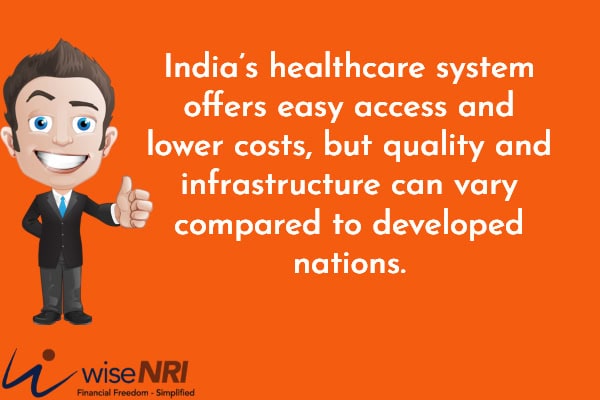
India offers noticeably more accessible and affordable medical care than many Western systems. Seeing a general physician, getting bloodwork done at home, or booking a specialist appointment happens quickly here. Compare that to the NHS in the UK, where a routine specialist appointment can genuinely take one to four weeks. The trade-off is consistency: quality and standards vary more across Indian regions than in more structured Western systems, and for certain advanced treatments, developed countries still have the edge. Neither system wins outright. What matters is which trade-off suits your specific health situation as you age.
Lifestyle Comfort: What Has Actually Changed
Household support, cooks, drivers, help with maintenance, remains easier and more affordable to arrange in India than in most Western countries, and increasingly, a lot of it can be booked with a few taps on a phone. Residential communities have genuinely moved on from a decade ago too. The newer developments come with modern amenities, sports facilities, and green spaces built specifically for returning NRIs who are used to that standard abroad.
Quality of Life: Where India Still Trails
Air quality, public space, traffic management, and public transport in Singapore, the UK, and much of Europe remain genuinely better than in most of India. As a developing country, there is real work still to be done here, and adjusting to it after years abroad takes time. Structured leisure and sporting infrastructure abroad is also more developed. None of this cancels out the cost and access advantages above, but it deserves an honest place in the retirement planning conversation.
Investment Access Has Widened, Not Just Costs
Post-retirement comfort depends heavily on where you invest and what you can access. As an NRI, most Indian investment products remain open to you, real estate included, aside from restrictions like agricultural land. You also retain access to global markets, something a resident Indian typically does not have to the same degree, though this gap is narrowing.
GIFT City, India’s International Financial Services Centre, has continued to mature as a genuine bridge for this. It now lets investors access global markets from within India, with lighter compliance and real tax advantages for structuring cross-border wealth, a meaningfully more developed option than it was even two or three years ago.
Starting a business follows a similar pattern in reverse: doing so abroad depends on your residency status and local regulations, while doing so in India as a resident is often more direct, though it comes with its own learning curve around local networks and regulatory processes that take patience to navigate.
The number most NRIs never actually calculate
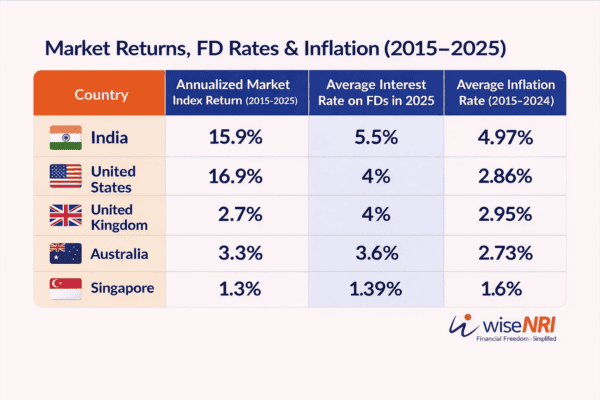
Most clients weighing a return to India compare monthly expenses. Very few compare currency exposure over the following 20 to 30 years. If your retirement corpus sits mostly in dollars, pounds, or dirhams and you plan to live in India, you are making a long-term currency bet whether you intend to or not. The rupee has historically depreciated 3 to 5% a year against major currencies, which actually works in your favour if your income stays in a stronger currency and your expenses are in rupees. Run this as an explicit calculation before deciding, not as a footnote after the decision is made.
A retirement decision made on emotional pull alone, without this currency math, is only half a decision.
Why This Decision Gets Delayed for Years
There is a specific behavioural reason so many NRIs, like Nilesh, sit on this decision indefinitely: status quo bias, the well-documented tendency to overweight the comfort of the current situation and underweight a genuinely better alternative, simply because change carries a perceived cost that inaction does not. Staying in San Francisco feels safe precisely because it requires no action. Moving to India feels risky precisely because it requires one. Neither feeling is actually a reliable guide to which choice serves your next 20 years better.
The way past this bias is not more information. Nilesh had plenty of information and was still stuck. It is a structured comparison, cost, healthcare, currency exposure, and family ties, mapped out side by side, so the decision is made on the actual trade-offs rather than on which option feels less uncomfortable this week.
Weighing whether to retire in India or stay abroad?
We help NRIs run the actual numbers, currency exposure included, before making a decision this permanent.
Questions Worth Sitting With Before You Decide
- What does your ideal retirement actually look like, day to day, not in theory?
- Where do your deepest relationships genuinely sit, not just your childhood memories?
- What trade-offs, financial and otherwise, are you genuinely willing to make?
India has changed meaningfully over the last decade, and it offers a genuinely comfortable retirement for those who plan for it properly. But uprooting a life built over decades abroad is no small undertaking either. Building new social networks, adapting to different systems, and finding stability again all take real time, money, and patience.
The right retirement city is not the one that costs less. It is the one where your life actually fits.
💬 Your Turn
If you are weighing a return to India for retirement, what is the one factor tipping the scale for you right now: family, cost, healthcare, or something else entirely?