
Legendary investor Warren Buffett once said he started building his snowball at the top of a very long hill, and the trick to having a long hill ahead is either starting very young or living to be very old.
You might wonder why we’re talking about snowballs and starting early. Is it that time of year for resolutions?
Well, yes and no. It’s not January, but it’s still a new year in India, on April 1.
India starts its financial year every April 1st. New rules and tax rates take effect from that date, and companies begin a fresh cycle of investment and planning.
⚡ Quick Answer
Starting financial planning early gives compounding more time to work, helps you beat inflation, allows a higher risk appetite while you’re young, and builds better financial habits before life gets more complicated. April 1st, the start of India’s financial year, is a genuinely useful anchor point for NRIs to revisit their financial plan annually, since new tax rules and investment cycles kick in from that date.
You can, and should, make financial resolutions for the coming year and revisit personal financial choices, habits, and investment portfolios around this time.

Read More: Financial Planning For NRI, How It’s Different and Complex
Being an NRI comes with genuine complexity, juggling taxes and financial commitments across two countries. With early planning, you can work toward both long and short-term goals, pay off liabilities, and build a real corpus, coming closer to financial independence one year at a time.
Benefits of Early Financial Planning for NRIs
We’ve all heard that the early bird catches the worm. Does that apply to long-term financial planning too? Let’s find out.
1. Benefit From Compounding
Albert Einstein reportedly called compound interest the eighth wonder of the world: those who understand it earn it, and those who don’t pay it.
A small pebble rolled down a snowy hill gathers snow and grows into a genuine snowball. That’s the essence of starting anything early, financial planning included. No one can guarantee how long you’ll stay invested or exactly what return you’ll earn, and sometimes the amount you can invest feels genuinely small. But starting early is entirely within your control, and even a modest sum, invested consistently over a long stretch, can grow into something meaningful.
Must Check: How NRIs Can Choose the Best Financial Planner in India
2. Beat Inflation
Like compound interest, inflation compounds too, it doesn’t simply add up year over year, it multiplies. Say something cost Rs 100 a few years ago, and inflation ran 5% one year and 7% the next. The price today isn’t Rs 112 (100+5+7), it’s Rs 112.35 (100×1.05×1.07).
That gap looks trivial on a single item, but scaled across your annual expenditure over many years, the compounding burden of inflation becomes genuinely significant. Starting to invest early puts you in a meaningfully better position to outpace this hidden tax over time.
3. A Higher Risk Appetite While You Have Time
Age genuinely shapes how much risk you can reasonably take. As retirement nears, preserving your nest egg matters more than chasing growth, even if that means lower-yield, more conservative holdings.
Younger investors can take a genuinely larger position in volatile assets like equities. With a long runway ahead, you benefit meaningfully from that exposure, and even if a downturn hits, there’s real time to recover.
4. Build Better Habits
Habits are hard to shake once formed, and they end up guiding your life on autopilot, for better or worse. Used deliberately, they’re a genuinely powerful tool.
Savings can become investments, but there has to be saving first. An early financial plan flips the order: save first, spend what’s left. Earmarking income toward fixed expenses, savings, and investment before anything discretionary builds the kind of habit that compounds right alongside your money.
5. Better Tax Planning
Every year, the run-up to India’s tax filing deadline fills newspapers and TV with last-minute tax-saving pitches from mutual fund houses, insurers, banks, and fintech companies alike.
In that rush, people often pick the most convenient option rather than the best one, driven by FOMO more than genuine analysis. Starting in April instead gives you real time to compare options properly, and advisors aren’t rushing either, so you tend to get more considered guidance.
A Quick Reality Check on Section 80C
Tax-saving investments under Section 80C only apply if you’re filing under the old tax regime. Since the new regime is now the default, confirm which one you’re actually under before planning around this deduction, since it may not apply at all depending on your filing choice.
6. Prepare for Contingencies
Ants store food for winter when nothing grows in the fields. Early saving and planning works the same way, an emergency fund built ahead of time means you won’t need to borrow when something genuinely unexpected hits.
7. Why April 1st Specifically?
Most organizations and individuals see meaningful shifts in their financial matters starting April 1st each year, with two things happening around this time: performance appraisals and budgetary implementation.

Must Check: Common Financial Mistakes of NRIs
8. Annual Increments
Most organizations schedule appraisal and increment cycles around this time, whether a one-time bonus or an ongoing salary increase. Rather than spending the bonus entirely, a lump-sum investment aligned with your actual goals puts it to real use. A meaningful share of any increment is also worth directing toward increasing your recurring SIP contributions.
9. The Budget Effect
Most budget announcements, particularly income tax slabs, rates, and deductions, take effect from April 1st. That means you can plan your investments and deductions with fresh, current information rather than working off assumptions from the prior year.
How Can NRIs Actually Do Early Financial Planning?
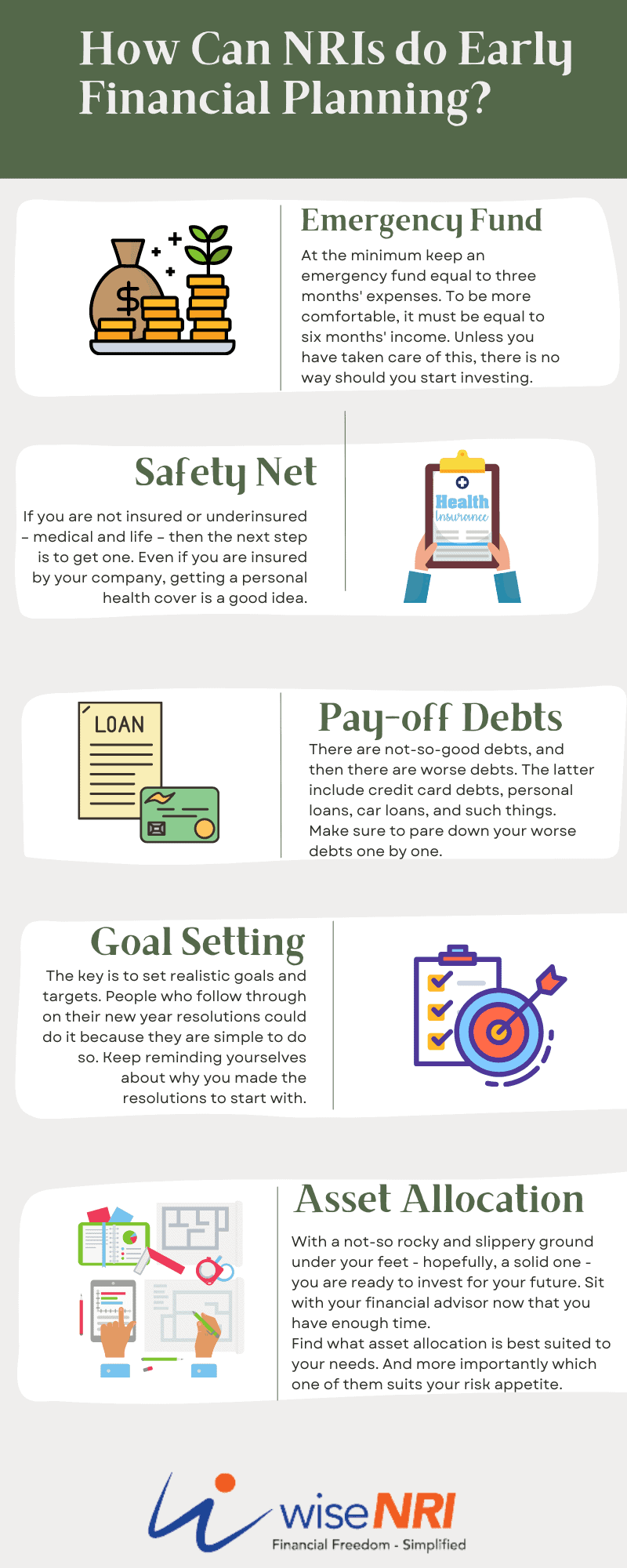
1. Build an Emergency Fund
At minimum, keep an emergency fund equal to three months’ expenses, ideally closer to six months’ income for real comfort. Until this is genuinely in place, investing beyond it isn’t the right next step.
2. Put a Safety Net in Place
If you’re not insured, or underinsured, medical and life cover should be the next priority. Even with employer coverage, personal health insurance is genuinely worth having, since you never know when you’ll leave that employer, potentially without cover exactly when you need it most.
Must Read: Health Insurance for NRI in India
3. Pay Off Debt
Some debt is manageable, some is genuinely corrosive. Credit card balances, personal loans, and similar high-interest debt fall into the latter category, and paring them down deliberately, one at a time, matters. Build the habit of spending only what you’d genuinely be comfortable paying in cash, and if impulse control is a real struggle, consider cutting up the cards.
4. Set Realistic Goals
The people who actually follow through on resolutions tend to keep them simple. Revisit why you set a given goal in the first place, regularly, to keep the motivation genuinely alive.
5. Get Asset Allocation Right
With the fundamentals in place, emergency fund, insurance, debt under control, you’re genuinely ready to invest for the future. Sit down with a financial advisor while you have real time to plan properly, and work out the asset allocation that actually fits your needs and risk appetite.
Frequently Asked Questions
Is April really a better time to plan than January?
For India-linked financial matters, generally yes, since new tax rules, budget changes, and investment cycles all take effect from April 1st, giving you current information to plan around rather than stale assumptions.
How much should an NRI keep in an emergency fund?
A minimum of three months’ expenses, with six months’ income as a more comfortable target, adjusted for your specific job stability and family circumstances.
Should tax-saving investments be the starting point of a financial plan?
No. Emergency fund and adequate insurance come first. Tax planning matters, but only after those fundamentals are genuinely in place, and only if you’re actually filing under a regime where 80C applies.
Taking care of your financial wellbeing on the first day of the new financial year is a genuinely solid first step. Why not start planning the year as it begins, rather than scrambling backward as it ends?
The snowball doesn’t care how big it started. It only cares how long it’s been rolling.
Ready to actually start your financial plan?
Let’s talk through where you stand and what genuinely comes first.
💬 Your Turn
What’s one financial habit you wish you’d started earlier? Share it in the comments.


As a NRI, should I need to pay tax in Uk if I earn more than 1lakh in my NRO account?
My both children abroad , my wife expired . I went to meet children. They got GC for me . I am 67 , not earning anything except interest & a mere pension all put together only about 2 laks per annum. I thought of going & coming every six months . This NRo status, mere pension or 1000/- , kly advice
Do you arrange office accommodatiion in Bangalore Sarjajapur area