
Meera and her husband started a family “swear jar” of sorts, except instead of swearing, it filled up every time they skipped eating out. Six months in, their kids were the ones asking to cook at home more, just to watch the jar grow toward the vacation they’d all agreed on. (name changed)
⚡ Quick Answer
NRIs can save more creatively by involving family in money decisions, gamifying savings goals, automating “paying yourself first,” shopping with cash for discretionary spending, using credit cards strategically rather than reflexively, cooking more at home, and claiming DTAA relief to avoid double taxation. None of it requires a joyless, frugal lifestyle, just a bit of structure around spending that would otherwise happen by default.
Money matters occupy most people’s minds at some point, whether they’re earning it, spending it, saving it, or investing it. The conventional wisdom is simple enough: spend within your income, stick to a budget, live within your means.
NRIs face real added pressure here. Beyond taxes in their country of residence, many owe tax in India too. Most countries with large NRI populations also carry a genuinely higher cost of living, education, and healthcare.

Must Read: 6 Ways NRIs Should NOT Spend Their Money
Many NRIs also carry real responsibility for dependents back home, plus property maintenance, travel costs, and hosting family who visit. All of that adds up against savings and financial plans, and it can genuinely feel like saving money is all NRIs think about.
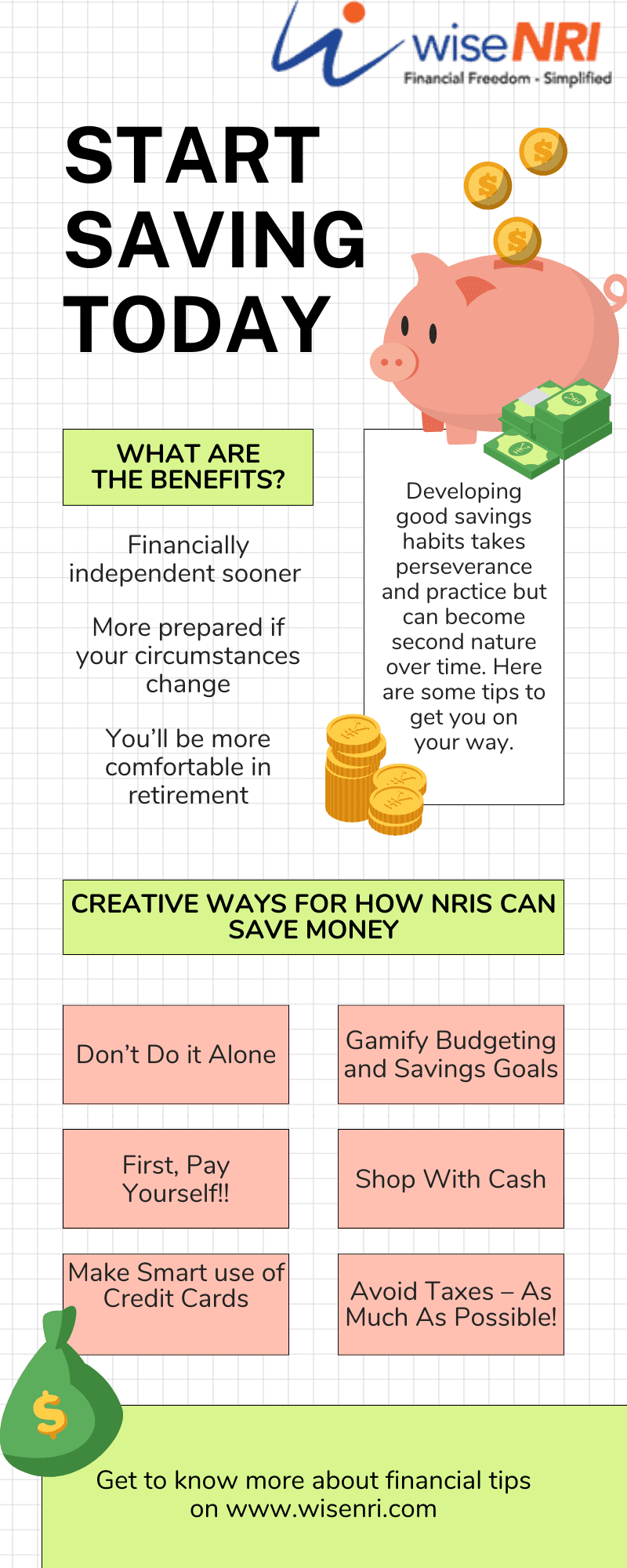
It doesn’t have to be that grim. Saving with real intention doesn’t mean giving up a life full of laughter, and it’s not all work with no play. Here are seven genuinely creative ways to build the habit without it feeling punishing.
1. Don’t Do It Alone
Think about the most memorable things you’ve done, the best experiences you’ve had. Did you celebrate them alone, or did you share them?
We’re social by nature, and we thrive on the validation and support of people close to us. Family and friends share our joys and struggles, so why not make them equal partners in the journey toward financial stability too?
That doesn’t mean revealing everything to everyone. But sharing decisions with your most trusted people, spouse, parents, older children, close friends, means gaining their perspective while sharing yours. It’s also a genuinely good way to involve your family in one of life’s most important areas, without sacrificing time together to do it.
Must Read: Financial Tools NRIs Must Use
2. Gamify Budgeting and Savings Goals
Once family is involved, make it easy to understand and genuinely fun to follow through on. If fitness goals and calorie counts can be gamified, so can budgeting.
Set a monthly target for eating out expenses, for instance. Come in under it, and everyone gets a reward, an ice cream trip, or a low-key movie night at home. Simple, attainable targets, with clear upside for hitting them, work as a real motivator for kids and adults alike.
Frame it so every rupee saved moves the family closer to a real goal, a trip, a gadget, whatever’s actually motivating. Along the way, you’re teaching delayed gratification and goal-based investing without ever calling it that.
3. Pay Yourself First
Once expenditure categories are clear, bucket them: necessary (rent, utilities, tuition, insurance, groceries), good-to-have (casual eating out, small vacations), can-be-delayed (home renovation, a new car, a big trip), and avoidable.
The avoidable category is usually the hardest to hold the line on, the latest phone your teenager insists they need, for instance. Help them see the real tradeoff: every dip into savings for something avoidable is a dip into long-term financial wellbeing too.
The practical fix, for adults and teenagers alike: pay yourself first, meaning the future version of yourself. Automate savings so a chunk of every paycheck moves straight into term deposits or mutual funds the moment it lands. A thinner savings account balance genuinely makes it psychologically harder to spend more.

Must Read: 6 Tips to Help NRIs Boost Their Retirement Savings
4. Shop With Cash for Discretionary Spending
A genuinely old-school but effective trick. Cards make spending feel weightless, and many well-off NRIs carry multiple cards, some with add-ons for family members too.
Forcing yourself to withdraw and hand over physical cash registers far more strongly with the brain, especially for big-ticket or impulsive purchases. People who’ve switched from cards to cash for discretionary spending consistently report spending less on non-essentials.
5. Use Credit Cards Strategically, Not Reflexively
This isn’t an anti-credit-card argument. Used well, cards genuinely help you save:
- While traveling, a card is safer than carrying cash, which can’t be hotlisted the moment it’s lost or stolen.
- For necessary payments like insurance or bills, using a card simply defers the debit, as long as you pay the full balance off, not the minimum.
- Never revolve the balance. Minimum payments quietly compound into real debt.
- Use reward points, cashback, and offers for purchases you’d have made anyway, not as a reason to spend more.
6. Cook More at Home
Genuinely one of the higher-leverage habits on this list. Many NRIs, especially those living alone or in dual-income households, default to ordering in or eating out.
That’s costly on two fronts: health and wealth. Home-cooked food typically runs a fraction of restaurant or delivery costs, and it also avoids the long-term medical costs that come with a diet leaning heavily on processed or fast food. Turning cooking into a shared family activity makes the habit stick, and adds genuine quality time on top.
7. Minimize Double Taxation Where Legally Possible
NRIs face a real tax burden: potentially paying tax on the same income in both their country of residence and India. If you live in a country with a DTAA in force with India, you can meaningfully reduce that burden, provided you disclose the relevant details accurately in both countries’ tax returns.
To reduce tax on Indian income specifically, look at small savings schemes, tax-saving investments, insurance premiums, and other eligible deductible expenses paid from Indian income.
Frequently Asked Questions
Does gamifying savings actually work long term, or does the novelty wear off?
It works best when the rewards stay genuinely meaningful and the targets stay realistic. Refresh the specific goal periodically rather than repeating the same reward indefinitely, so it doesn’t lose its pull.
How much can DTAA relief actually save an NRI?
It varies by country and income type, but it can mean the difference between paying full tax twice on the same income versus once, which is often a substantial saving. Confirm the specific relief mechanism for your country of residence.
Is shopping with cash still practical in an increasingly cashless world?
For discretionary spending specifically, yes, even a partial cash approach for categories like eating out or shopping helps. It doesn’t need to replace digital payments for everything.
Bottom Line
These habits help you save more while genuinely spending more real time with family, and they pass on financial habits your kids will carry forward. Living within your means doesn’t have to be boring after all.
The jar filling up matters less than what everyone learns while watching it fill.
💬 Your Turn
What’s your own creative way to save money as an NRI? Share it in the comments.


Money transfer fee from July 2023 to outside of India
SHOP WITH CASH….Withdraw your entire household budget for the month in cash (since currencies abroad are strong you will not have to store a very thick wad of notes). This way as every day of the month passes you can see the cash pile shrinking. If anything remains at the end of the month go out for a nice family meal or splurge it on something else. Credit card points constitute approximately 0.7% of your spending amount. To benefit from 0.7% is it it really worth spending 100% ?
Thanks Mr Rao for sharing 🙂