
Rekha wrote to me last month from Abu Dhabi. She had run the numbers herself – twice. Her retirement calculator said she had already crossed her Financial Freedom number. “I should feel relieved,” she said. “Instead I feel more anxious than when I started.” (name changed)
This happens more often than you’d think. Financial Freedom sounds like a finish line. For most NRIs who actually reach it, it doesn’t feel like one.
⚡ Quick Answer
Financial Freedom for NRIs isn’t just about the size of your corpus – it’s the balance between your nest egg and your expenses, and whether you’ve built a life you don’t need to escape from. Many NRIs who cross their number financially still don’t feel free, because the number was never the real goal.
When we started the wiseNRI journey we did a survey to understand the aspirations of our NRI readers, one term kept resonating loudly – Financial Freedom. It became clear this idea stood at the center of what they wanted, which shaped our focus going forward. Even our punchline came from it – “Financial Freedom – Simplified”

Must Read- Five Financial Tips for NRI
The Truth About Financial Freedom for NRIs
For years, Financial Freedom has been romanticized – retire early, sip on piña coladas, watch cricket matches all day. After more than two decades in the financial field, I’ve come to realize the reality is far more nuanced. Let me walk through a few common misconceptions.
Misunderstanding Financial Freedom for NRIs:
Many equate Financial Freedom solely with early retirement, picturing a life of leisure and passive income. But this overlooks the importance of purpose and engagement in daily life. Anything used sparingly tends to depreciate – your body, your mind, even your finances.
Starting from a Negative Space:
Often, the pursuit of Financial Freedom starts with job-related stress, and people begin to see it as an escape route. But using rising job stress as the reason to chase this goal only feeds the same dissatisfaction it’s meant to solve.
Partial Focus on the Equation:
Financial Freedom comes down to two things – the size of your nest egg and your monthly or annual expenses. Building wealth feels like the hard part, but controlling expenses is fully within your grasp. Yet most people fixate only on accumulating wealth and overlook how their lifestyle choices affect their financial goals.
The Two-Number Problem Nobody Talks About
I ask every client the same question before we even discuss investments: which number are we solving for – your corpus, or your expenses? Most NRIs spend years optimising the first and ignoring the second. Here’s the maths that changes minds: cutting monthly expenses by Rs 20,000 has roughly the same effect on your Financial Freedom number as adding Rs 60 lakh to your corpus, assuming a conservative 4% withdrawal rate. Nobody chases the Rs 20,000. Everyone chases the Rs 60 lakh.
Financial Freedom has two levers. Most people only pull one.
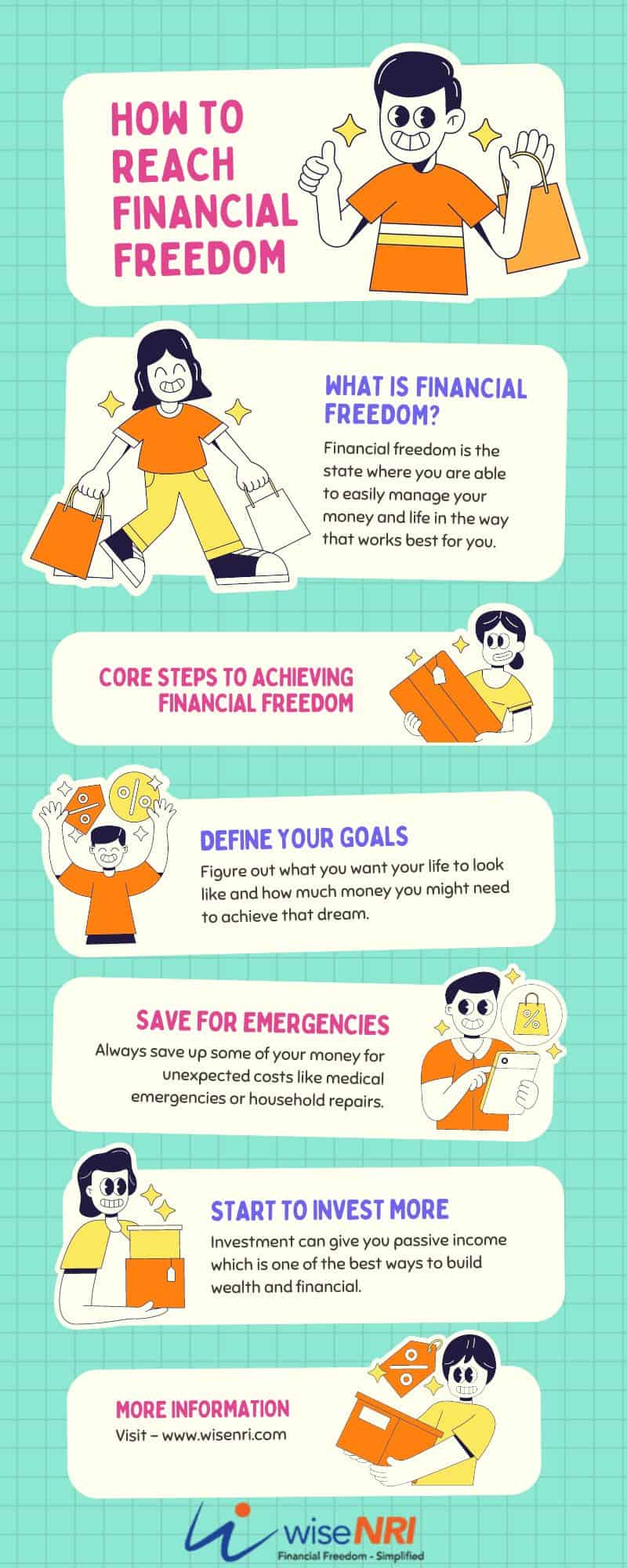
Must Check – Financial Planning For NRI
Financial Freedom as a Feeling:
Even NRIs who cross their numerical Financial Freedom target often stay anxious and uncertain. Despite having enough, many can’t embrace a slower pace of life – they stay tied to the same routine of chasing the next financial milestone. Rekha was one of them.
Why Reaching the Number Doesn’t Feel Like Winning
There’s a name for what Rekha felt: the Arrival Fallacy – the belief that hitting a goal will finally deliver lasting satisfaction, and the letdown when it doesn’t. Psychologist Tal Ben-Shahar coined the term after watching high achievers reach major milestones and feel strangely empty within weeks.
For NRIs, the Arrival Fallacy shows up in a specific way. The corpus was never really the goal – the goal was permission. Permission to slow down, to move back to India, to stop living for a future date. When the number arrives and none of that permission feels real, the anxiety doesn’t go away. It just changes shape.
The fix isn’t a bigger number. It’s separating the financial milestone from the life milestone, and building both on purpose.
The Complexity of Financial Freedom
Financial Freedom is appealing, but reaching it isn’t simple. It takes a balance between sound financial planning and accepting life’s uncertainties. As NRIs navigate this journey, it helps to separate the myths from the reality.
Hit your number and still not sure what’s next?
A second opinion on your Financial Freedom plan often reveals gaps a calculator can’t see.
Sacrifices and Trade-offs:
Many NRIs give up personal relationships and experiences in India to pursue Financial Freedom abroad. That pursuit has a cost – a loss of connection with loved ones and a sense of belonging. As you chase financial milestones, it’s worth evaluating the trade-offs and prioritizing what truly matters.
The Role of Financial Literacy:
Financial literacy is what makes the rest of this possible for NRIs. Understanding investment strategies, managing debt and expenses – these give NRIs the tools to make informed decisions and navigate market volatility with confidence.
Shifting Perspectives on Work and Retirement:
The traditional idea of retirement is evolving. More NRIs are choosing phased retirements or second careers after reaching Financial Freedom, rather than stopping altogether. Work becomes less about the paycheck and more about purpose-driven pursuits that align with their passions and values.

Exploring Paths to Financial Freedom for NRIs:
Getting there takes a holistic approach – financial and emotional well-being both. Here are a few strategies worth considering:
- Diversify Income Streams: Instead of relying solely on passive income, explore diversifying through investments, freelancing, or entrepreneurship.
- Focus on Long-Term Sustainability: Avoid chasing short-term gains. Build a plan that accounts for market fluctuations and unexpected expenses.
- Prioritize Personal Fulfillment: Financial security matters, but so does personal fulfillment. Invest in experiences, relationships, and activities that bring joy and meaning.
- Seek Professional Guidance: Consult with financial advisors to develop a customized plan tailored to your goals, risk tolerance, and time horizon.
Check – How much retirement corpus is enough for NRIs
Many of our Clients already achieved Financial Freedom – sharing 2 stories.
Story: Mr. GJ’s Journey to Financial Freedom:
Mr. GJ, a retired HR CXO (Middle East) residing in Delhi, is a good example of pursuing Financial Freedom with purpose. Despite enjoying a life of leisure and travel post-retirement, Mr. GJ stays actively engaged as a consultant for Small & Medium Enterprises – indulging his love for travel while contributing his expertise to budding entrepreneurs.
Example: Mr. JJ – Redefining Retirement in Singapore:
Mr. JJ, a 40-year-old NRI based in Singapore, achieved Financial Freedom through disciplined investing. Rather than retiring early, he continues to work while also sharing his knowledge as a university lecturer – a version of retirement fueled by passion and purpose, not just a number in a bank account.
Frequently Asked Questions
What does Financial Freedom actually mean for an NRI?
It means your nest egg can cover your expenses indefinitely without depending on active income, whether you continue working or not. For most NRIs, this needs to be planned across two countries and two currencies, not just one.
How much corpus do I need to achieve Financial Freedom?
There’s no universal number. It depends on your monthly expenses, expected returns, inflation, and how many years the corpus needs to last. A common starting benchmark is 25 times your annual expenses, but your actual number should come from a proper cash-flow based plan, not a rule of thumb alone.
Should I stop working once I hit my Financial Freedom number?
Not necessarily. Many of our clients who cross their number choose to keep working in some form, not because they have to, but because purpose and engagement matter as much as the money – as Mr. GJ and Mr. JJ’s stories above show.
Does Financial Freedom guarantee a smooth return to India?
No. Financial Freedom is necessary but not sufficient. Returning to India well also needs planning around taxation, healthcare, family dynamics, and lifestyle – the financial number is only one part of the picture.
Rekha didn’t need a bigger number. She needed permission to believe the one she already had.
It’s not a Numbers Game – it’s a Mind Game.
Not sure if your number is the right number?
We help NRIs stress-test their Financial Freedom plan before they act on it.
💬 Your Turn
Have you hit your Financial Freedom number – and does it actually feel the way you expected? Tell us in the comments.

