
An NRI reader in the Middle East once wrote to me with a question I still think about: how do you build a steady investment plan when you have no real clue how long your job, your visa, or even your next payslip will actually hold? He wasn’t wrong to ask. For NRIs, “everything is an emergency,” and that constant footing makes long-term saving feel almost impossible, even for people earning well.
His letter is the reason this post exists. If you’ve ever wondered whether you’re actually going to retire, where, or with enough, this is for you.

Must Check- How Much Retirement Corpus Is Enough
Current: Income – Expenses = Savings
New: Income – Savings = Expenses
It’s not an easy switch. It’s also the single change that matters most, and it starts today, not once your job situation feels stable, because for most NRIs, it never fully does.
Four Real Reasons to Plan Early, and What to Actually Do About Each
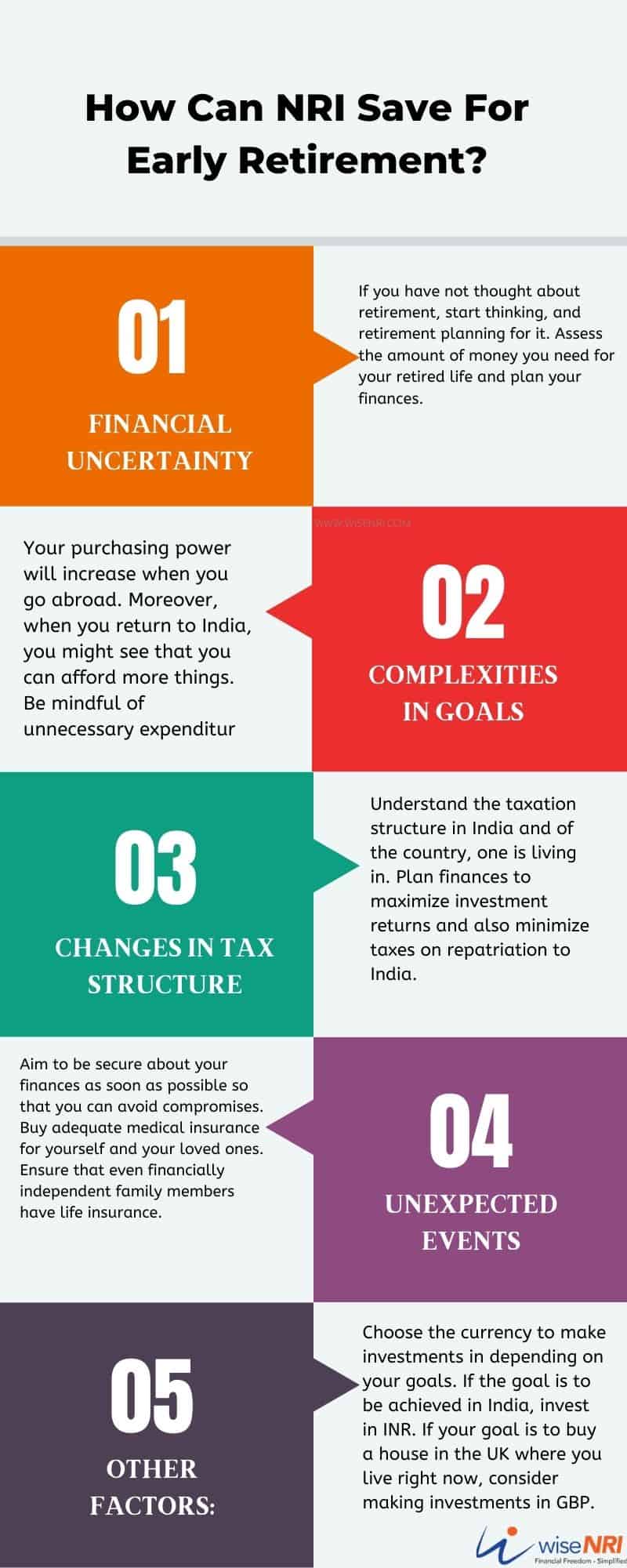
1. Financial and Job Uncertainty
Rising localisation policies, visa-tied employment, and economic cycles all shorten the “guaranteed” runway abroad more than most NRIs plan for. Assume your career abroad could end sooner than expected, not later.
Do this: Calculate your real retirement number now, cut expenses aggressively, and diversify investments so no single shock wipes out the plan.
Read – Planning For Retirement in India – 5 Easy Steps
2. Genuinely Conflicting Goals
Lifestyle upgrades abroad compete directly with saving. Children’s schooling, uncertain contract timelines, and visa restrictions on job-switching all add real friction to any plan you try to lock in years ahead.
Do this: Stay mindful of lifestyle creep specifically, since purchasing power abroad tempts overspending fastest here. Build a corpus that’s genuinely inflation-beating, and think concretely about post-retirement income sources, consulting, ad hoc project work, anything that keeps you engaged and earning on your own terms.
Must Check – How can NRI retire early using the FIRE Method?

Read – Best Investment Options in India
3. A Tax Structure That Keeps Shifting
NRI taxation gets revised virtually every Budget, sometimes favourably, sometimes not, and which investment avenues are even open to NRIs changes right along with it.
Do this: Understand both India’s tax rules and those of your country of residence, and structure your portfolio so a single unfavourable Budget can’t undo years of saving.
4. Genuinely Unexpected Events
Disability, critical illness, or the loss of a loved one can force retirement well before you’re financially ready for it, and this risk compounds the longer real protection is deferred.
Do this: Get adequate medical and life insurance in place early, including for financially independent family members, and build your portfolio around your actual risk profile now, not the one you’ll wish you had after something goes wrong.
Check – Pension Plan For NRI in India
The structural shift nobody accounts for
There’s no old-age social security net waiting for most NRIs, and the joint family safety net that supported earlier generations has genuinely thinned with nuclear households becoming the norm. Longer life expectancy means a corpus needs to stretch further too. None of this is meant to alarm, it’s meant to explain why “I’ll start saving properly once things settle down” rarely works for an NRI the way it might for a resident with a pension and family close by.
Choose the currency you invest in deliberately, based on where each specific goal will actually be spent, INR if it’s an India goal, the local currency if it’s tied to your country of residence. Save soon, save more, and put savings and bonuses into instruments that genuinely beat inflation rather than just feeling safe.
Ready to flip your own savings equation?
We help NRIs build a plan that survives job uncertainty, shifting tax rules, and the unexpected, not just the good years.
Long-term job security is largely a memory now. Long-term financial security is still entirely something you can build.
💬 Your Turn
Which of these four factors, job uncertainty, conflicting goals, shifting tax rules, or unexpected events, worries you most right now? Tell us where you stand.


What does nri stand for?
Nri should keep all funds in FCNR . as most of other products for Nri are not guaranteed returns. when calculating rupee deprivation you loose value than gain.
Don’t trust any of foreign Banks there are charges on closure of FCNR even on maturity.
Hi Sunil,
Thanks for sharing your views but my suggestion is it’s important to have diversification.
Dear Sir,
I am an NRI for the past 30 years and planning to retire in Mar 2021.I hold a joint NRE account with my wife and she is house wife.After retiring I would like to split the amount held in NRE account and make separate resident savings accounts for me and my wife to park the funds to invest independantly and file returns separately.Am I allowed to do this?
Regards,
Kumar
Dear Kumar,
If she had some earnings when you people were outside India – you can do that. Else clubbing provision will apply in India.