
A new year always brings the question: have you thought about your resolutions? Do money goals make it onto that list?
There’s something genuinely motivating about the fresh-start feeling a new year, or a birthday, brings. Your mind treats it as a clean slate and gives you an initial burst of momentum. But turning that momentum into lasting change takes real discipline, willpower, and support.
Quick Answer
Six financial resolutions worth setting as an NRI each year: define your short, medium, and long-term financial goals, build and stick to a real budget, create a genuinely diversified investment portfolio suited to NRI rules, stay on top of recurring financial tasks, start retirement planning early rather than late, and make sure you’re adequately insured. A good financial planner can help with each of these, but the resolution itself starts with you.

Financial Resolutions for NRIs
Here’s an honest look at what these financial resolutions actually involve, and how a financial planner can genuinely help you follow through on them.
Must Read: What can a mandate holder do?
Set Your Financial Goals
Clear financial goals genuinely underpin financial security. Setting short, medium, and long-term goals helps you actually manage your finances rather than just react to them.
A good financial planner will ask questions that force real clarity, things like:
- ✓Do you plan to buy a house in India or abroad?
- ✓Where are you planning to eventually retire?
- ✓Will your children study in India or abroad?
- ✓What lifestyle changes do you want right now?
- ✓What lifestyle do you envision for yourself after retirement?
Your answers shape the actual plan. If you want a genuinely comfortable house in India after retirement, your finances need to be managed with that specific target in mind, and a planner can give you a real picture of what you can afford and when the right time to buy actually is.
Resolution: Set your short, medium, and long-term financial goals with your advisor, and review them each year to see what needs adjusting.
Planning for Retirement in India, check this
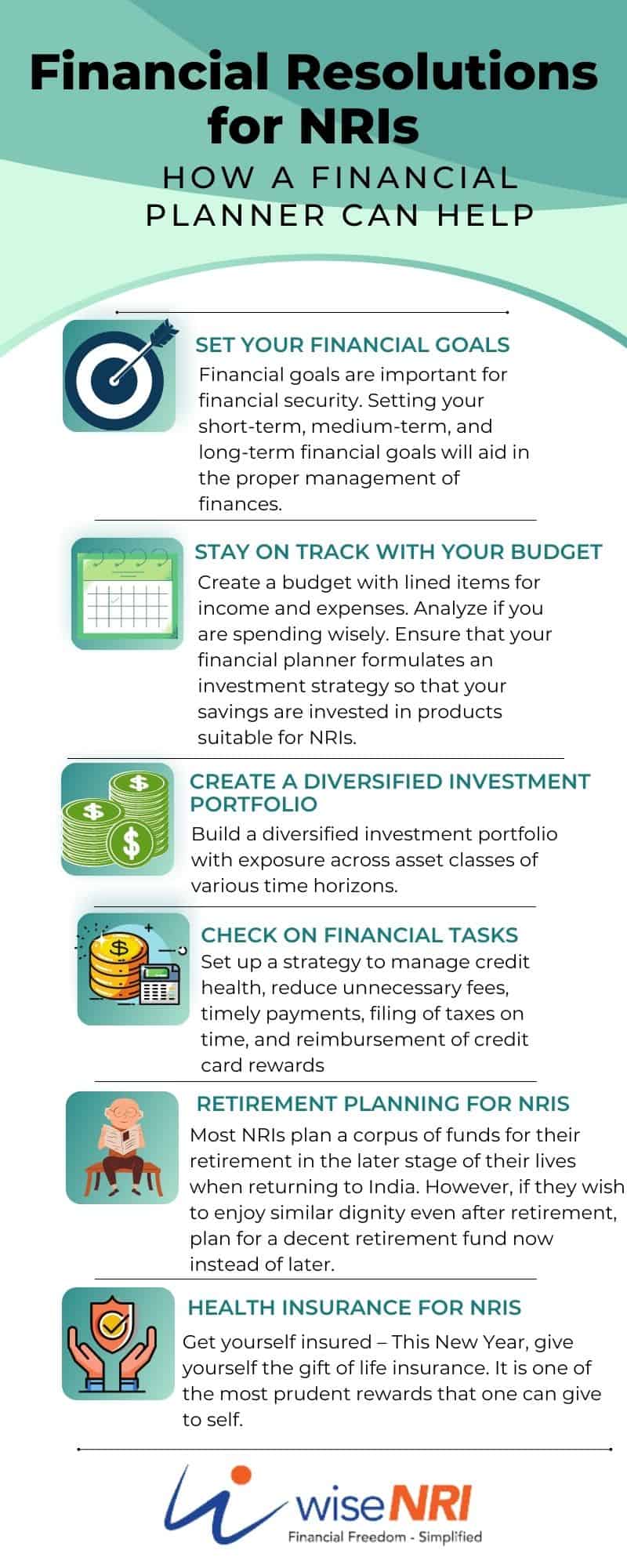
Stay on Track With Your Budget
It’s genuinely easy to overspend, whether on holiday or while buying gifts for family and friends back home.
A planner will help you actually build a budget, listing total income, expenses, and the small recurring items like groceries, dining out, and subscriptions, to see clearly what’s actually left to save.
A real budget helps in several ways:
- ✓Understand total income, expenditure, and savings clearly.
- ✓Identify genuinely unnecessary expenses.
- ✓Calculate your realistic potential investment amount.
- ✓Compare estimated versus actual expenses.
- ✓Spot exactly when and where you tend to splurge, so you can address it directly.
Resolution: Build a real budget with line items for income and expenses, and make sure your planner’s investment strategy actually places your savings into products suited to your NRI status.
Read: How Can NRIs Avoid Lifestyle Inflation
Build a Genuinely Diversified Investment Portfolio
NRI investment rules genuinely differ from resident rules in specific ways. PPF, for instance, is a strong tool for residents, but NRIs cannot open a fresh PPF account. NRIs living in the US and Canada face additional restrictions on mutual fund investments too.
Many NRIs stay genuinely unclear on their own strategy, unsure where they’ll actually settle long-term or which products truly suit them. This leads to under-investment alongside surplus idle cash, where too little goes toward genuine wealth building, and too much simply loses value sitting uninvested.
In an attempt to “do something,” people often copy a friend’s strategy or act on generic advice from TV or websites, which rarely serves their specific situation well.
“A competent financial planner will ensure the portfolio is genuinely diversified and customised for your status as an NRI.”
A financial planner understands your status and goals and builds a portfolio genuinely suited to them, keeping the strategy aligned so that:
- ✓There’s no long-term exposure to illiquid Indian assets if you plan to stay abroad for a long stretch.
- ✓No investments sit in instruments that aren’t actually allowed for NRIs, since these rules genuinely shift over time and need active tracking.
- ✓Global investments get suggested where appropriate, based on your real understanding, risk tolerance, and risk capacity.
Resolution: Build a genuinely diversified investment portfolio with exposure across asset classes and time horizons.
Check: Best Investment Options for NRIs in India
Stay on Top of Recurring Financial Tasks
Tracking financial transactions across multiple countries is genuinely difficult for an NRI. A financial planner helps with these smaller but important tasks:
- ✓Setting reminders for premium payments, interim investments, and tax filing deadlines.
- ✓Arranging tax filing.
- ✓Running regular portfolio reviews and flagging when changes are genuinely needed.
- ✓Helping manage bank accounts and credit cards, including advice on unused accounts, too many cards, and paying off high-interest debt like card balances.
- ✓Advising on payment automation so due dates never slip through.
Resolution: Build a real strategy for credit management, reducing unnecessary fees, timely payments, on-time tax filing, and actually claiming credit card rewards.
Start Retirement Planning Early
Most NRIs only start seriously planning their retirement corpus late in their career, often around the time they consider moving back to India. If you want to genuinely maintain your current lifestyle after retirement, building that fund early in your career, not later, is what actually makes the difference.
Resolution: Aim to increase your income, save more and spend less, and make genuinely smart investments specifically toward retirement.
Read More: Retirement Planning for NRIs

Get Genuinely Insured
Uncertainty is inevitable, and taking real steps to protect your long-term financial budget against it matters. A range of NRI-specific insurance options exist, including NRI health insurance and NRI life insurance, among others.
Resolution: Get yourself genuinely insured. It’s one of the most prudent things you can give yourself.
Financial planning is essential for managing both your present and future finances. As an NRI, it matters even more to track your status across both your home country and your country of residence. A good financial planner helps maximise your savings once your resolutions are set, and gets you the appropriate advice to actually follow through on them.
“Financial matters are complex, more so if you are an NRI. But managing them is not impossible.”
Ready to set your own financial resolutions?
Let’s talk about your financial plan and turn these resolutions into an actual roadmap.
Share your own financial resolutions in the comment section.

