
Non-Resident Indians have historically played a real role in shaping Indian politics. The most well known example is Mahatma Gandhi, who returned from South Africa after studying in England and changed the country’s course entirely. Muhammad Ali Jinnah was also an NRI barrister in London, for a very different chapter of that same history.
⚡ Quick Answer
NRIs have been eligible to vote in Indian elections since 2011, but only in person at their registered constituency, no proxy, postal, or online voting exists yet. Registration surged to over 118,000 for the 2024 general election, a 65% jump from 2019, but actual turnout collapsed to under 3,000 votes cast, since the requirement to travel to India remains the single biggest barrier. Registration itself is done through Form 6A via the Election Commission’s Voter Portal.
Must Read: NRI Checklist
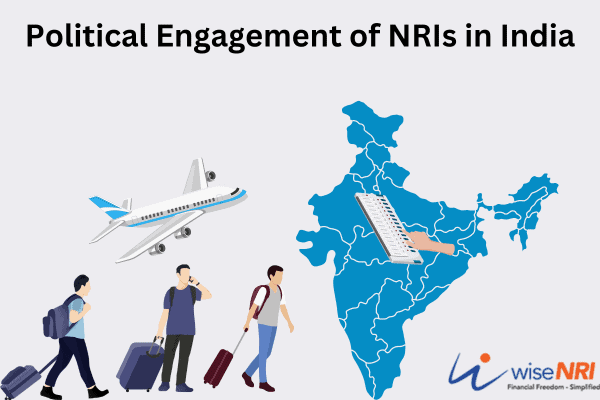
Despite being away, NRIs stay genuinely politically engaged, some would argue more so than many resident Indians. With growing clout overseas, NRIs carry real potential to influence Indian policy and decision-making.
How NRIs Engage Politically
NRIs maintain a strong emotional connection to their roots and often want to contribute to positive change, whether through voicing opinions, supporting causes, or backing political parties and development projects financially. Beyond that, NRIs act as informal cultural ambassadors abroad, and increasingly bring outside perspective into policy conversations back home.
Major Indian political parties now maintain dedicated overseas wings, and political leaders actively engage NRI communities at events abroad, seeking both opinion and support.
Political Fundraising and Campaigning
NRI political engagement extends well beyond voting. Many contribute funds to preferred parties or candidates, and some travel to campaign in person during elections, in their home constituency, their state, or occasionally elsewhere in India entirely.
Influencing Policy in India and Abroad
NRIs also lobby to influence policy, participating in political and economic debates through social media and online forums, sharing opinions, raising awareness, and building networks of politically engaged people both in India and overseas.
This engagement isn’t limited to India either. Many NRIs actively participate in the politics of their country of residence too, sometimes supporting lawmakers of Indian origin who take positions more favorable to India’s interests.
Must Check: 5 Financial Lessons from Superheroes
NRI Voting Rights in India
The Representation of the People Act, 1950 was amended in 2010, granting NRIs voting rights starting in 2011. That legislative step opened the door, but real, inclusive participation still faces genuine structural obstacles.
The Registration and Turnout Gap
Overseas voter registration has grown meaningfully. For the 2024 general election, over 118,000 overseas Indians registered to vote, a 65% jump from roughly 99,844 in 2019, and a dramatic rise from just around 13,000 in 2014.
Registration Is Rising. Turnout Isn’t.
Registration numbers make for an encouraging headline, but actual votes cast tell a very different story. In 2019, just over 25,600 of roughly 100,000 registered NRI voters actually cast a ballot. In 2024, despite registration surging past 118,000, only around 2,958 votes were actually cast, with nearly 90% of those from Kerala alone. The requirement to physically travel to your registered constituency in India remains the single largest reason for this gap, and it hasn’t moved in over a decade of policy discussion.
While NRIs hold the right to vote, several genuine obstacles stand in the way of exercising it.
The Logistical Barrier
Limited polling access, a genuinely complex registration process, and the absence of absentee ballots all work against participation. Overseas electors must register within a specified window and provide eligibility documents, but the core obstacle remains unchanged: physical presence at your registered polling booth is mandatory.
The Election Commission has no current provision for proxy, postal, or online voting for registered NRI voters. An e-postal ballot mechanism has been discussed for years as a potential fix, but hasn’t yet been implemented.
Limited Awareness
Despite periodic attention to the topic, the Election Commission doesn’t run large-scale outreach specifically targeting eligible overseas electors, which leaves many NRIs unaware of their rights or unclear on the actual registration process.
What Low Turnout Means
Many NRIs stay politically active in other ways, donating, campaigning, engaging in policy debate, even while voting itself remains rare. When NRIs don’t vote, that’s a missed opportunity to shape outcomes directly, and it can leave NRI-specific concerns underrepresented in the policy conversation.
NRI Voter Registration Process
Registering as an NRI voter involves a defined set of steps, and while the process has genuinely improved over the years, it still takes some patience to work through.
Must Read: NRIs Moving from One Foreign Country to Another, Checklist
Steps to Register
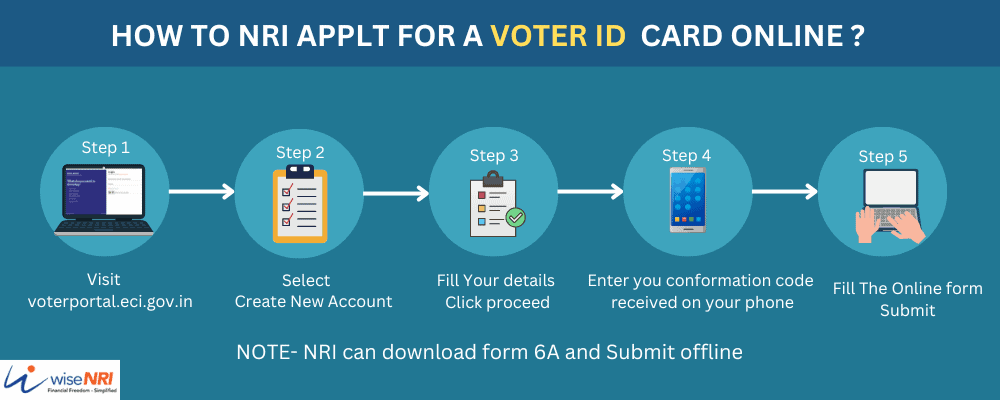
- Use the “Find my polling station” feature on the ECI’s Voter Portal, and note the contact details for your local Election Officer there.
- Complete Form 6A online and upload the required documents, also available on your state’s Chief Electoral Officer website.
- Alternatively, download Form 6A, fill it out in duplicate, and attach the necessary documents by hand.
- Form 6A is available free of charge at Indian Missions abroad and from Booth Level Officers at every polling station.
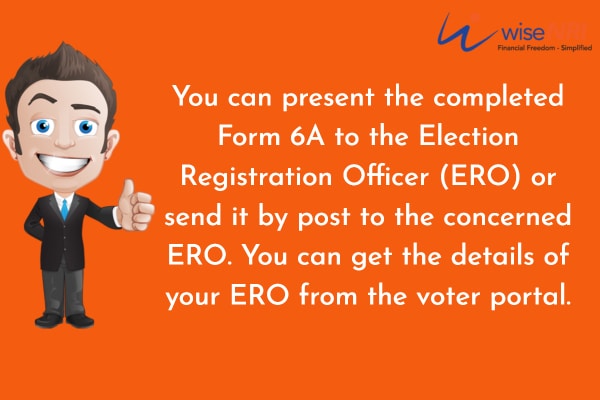
- Submit the completed form to your Election Registration Officer directly, or by post. Find your specific ERO’s details through the voter portal.
Documents Required
- A recent passport-size photograph on a white or light background.
- Form 6A details matching your valid Indian passport exactly.
- The form’s declaration removing you from the “General Electors” roll and cancelling any existing Voter ID card.
- Self-attested photocopies of the relevant passport pages: photo, Indian address, and valid visa endorsement.
Verification Process
- If submitted in person, your passport is checked on the spot and returned immediately.
- A Booth Level Officer visits the residential address on your passport to verify details.
- If no one is available to verify in person, documents get routed to the local Indian Mission instead.
- Confirmation of successful registration goes to your Indian address and by SMS to your registered Indian mobile number, and the official electoral roll updates to reflect the change.
To change any registered detail later, Form 8 handles updates to the overseas electoral roll.
Frequently Asked Questions
Can NRIs vote online or by postal ballot?
Not currently. Registered NRI voters must be physically present at their constituency’s polling booth. An e-postal ballot system has been discussed for years but hasn’t been implemented.
Why did NRI voter registration rise so much between 2019 and 2024?
Registration jumped 65%, from roughly 99,844 to over 118,000, though the exact drivers, growing diaspora political engagement, easier registration awareness, or election-specific mobilization, aren’t fully clear from available data.
Which states have the most registered NRI voters?
Kerala accounts for by far the largest share, roughly three-quarters of all registered overseas electors, followed at a distance by Andhra Pradesh, Maharashtra, Tamil Nadu, and Telangana.
NRI political engagement is genuinely multifaceted: voting rights, financial contributions, lobbying, and cross-border political participation all play a part. The involvement reflects real commitment to India’s direction, even with the distance and logistical friction that comes with it.
A right that’s genuinely hard to exercise is still a right worth registering for, even if the trip to actually use it doesn’t happen every cycle.
💬 Your Turn
Have you gone through the NRI voter registration process, or considered it? Share your experience in the comments.

