
⚡ Quick Answer
Before moving from one foreign country to another, NRIs need to sort bank accounts, credit cards, digital payment apps, investments, loans, tax obligations, and healthcare in the country they’re leaving, then set up equivalents in the new one. The biggest risk is treating this like a simple relocation when it’s really a full financial transition that needs its own checklist, separate from anything related to India.
Moving to yet another foreign country? Whether it’s for a new job, business, or retirement, getting your financial life sorted matters just as much as it did when you first left India. You may have fewer things to handle in India this time, but every loose end in your current country of residence needs tying up before you start the next chapter.

Check: Financial Planning for NRIs
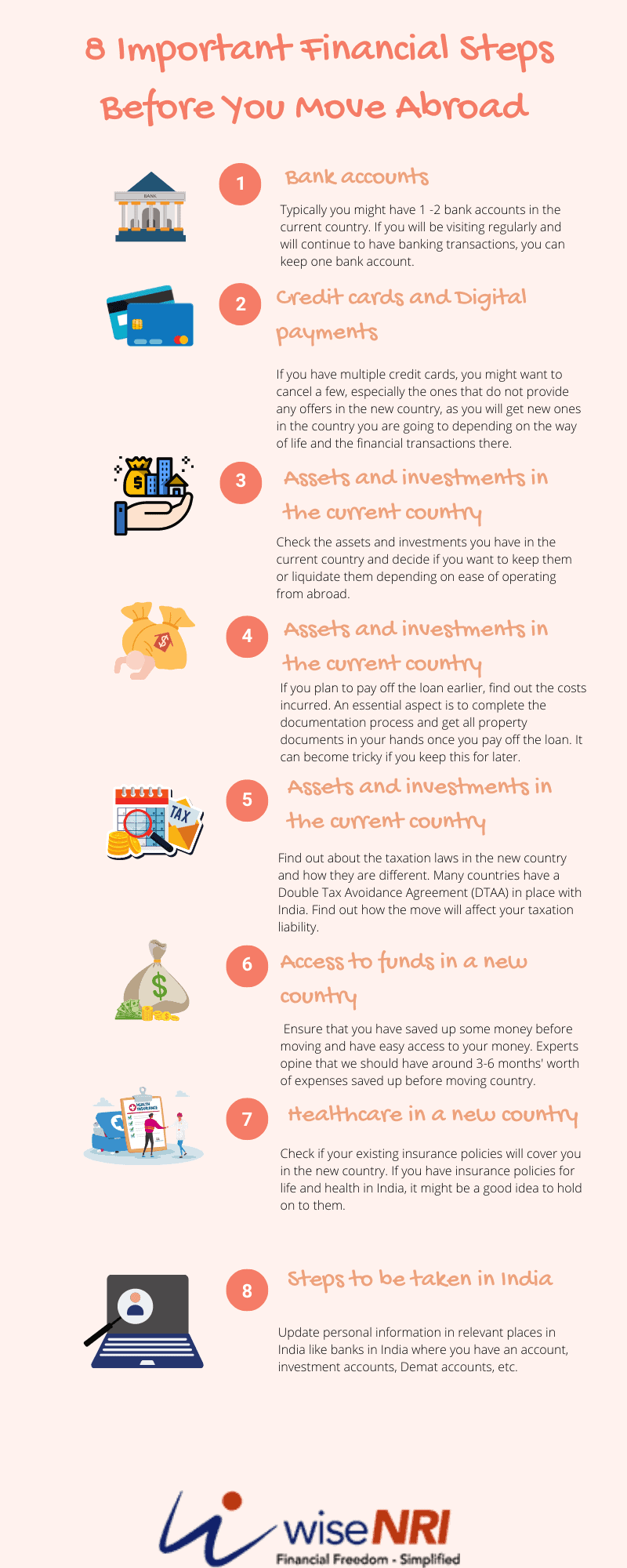
8 Important Financial Steps Before You Move Abroad Again
1. Bank Accounts in Your Current Country
Most people carry one or two accounts in their current country. If you’ll visit regularly and keep transacting there, keep one account open. Close the rest. If you’re not coming back, transfer or withdraw your funds and close everything.
2. Credit Cards and Digital Payments
Notify your card issuer of the move so purchases in the new country aren’t flagged. When I relocated to a country with a less developed banking and card system about a decade ago, none of my Indian cards worked there, and it led to a few genuinely awkward moments. If you’re carrying multiple cards, consider cancelling the ones offering nothing useful in your new location. You’ll pick up new ones suited to how things actually work there. Close down local digital payment apps too. Money left sitting in them can get stuck.
Must read: What kind of Issues NRIs Face With Their Banks in India?
3. Assets and Investments in Your Current Country
Review what you hold and decide what’s worth keeping versus liquidating, given how hard it’ll be to manage remotely. Bonds, for instance: check how easily you can access proceeds at maturity, and what early redemption actually costs.
Real estate is the harder case. Managing maintenance bills, utilities, property tax, and EMIs remotely takes real coordination. A property management firm, or trusted friends and relatives, can help. If it’s rented or appreciating well, holding on may make sense. If you’d rather cut ties cleanly, selling before you leave often saves headaches later. Either way, understand the local tax and process rules for non citizens before deciding.
4. Liabilities in Your Current Country
How will you service any outstanding loans? Are you even allowed to leave the country while loans are active? Are they tied to your visa status? Answer these before you plan your exit. If you want to pay off early, find out the actual cost of doing so. And critically, get all your property documents released into your hands once a loan is cleared. This gets much harder to sort out from another country later.

Must read: NRI Checklist
5. Taxation in the New Country
Learn the new country’s tax rules and how they differ from what you’re used to. Many countries have a Double Tax Avoidance Agreement with India, but that doesn’t automatically cover income earned in your previous country of residence. If you’ll still earn returns there after leaving, confirm exactly how to pay any tax owed and manage the paperwork while you’re no longer physically present.
6. Access to Funds in the New Country
A move brings a mix of excitement and anxiety, plus new expenses you didn’t plan for. Prices won’t match what you’re used to, and it takes time to learn the real cost structure. Save up before you go. Most advisors suggest 3 to 6 months of expenses set aside ahead of a move.
Check whether your current bank has branches or partnerships in the new country, and whether online banking will cover you there in the meantime. Open a local account as early as possible once you land.
7. Healthcare in the New Country
Check whether your existing insurance covers you in the new location. Life and health policies held in India are often worth keeping regardless, since they’ll matter again if you eventually move back, and most health policies come with waiting periods you don’t want to restart unnecessarily. You’ll also need cover in the new country, whether through your employer, the government there, or a policy you buy yourself.
8. What to Update in India
Once you have identification and address proof in your new country, update your KYC in India. Skipping this can stall financial matters back home. Update your personal details wherever relevant too: bank accounts, investment accounts, and Demat accounts in India.
Frequently Asked Questions
Do I need to close all bank accounts in the country I’m leaving?
Not necessarily. If you’ll visit regularly and keep transacting there, one account can stay open. Close anything you won’t realistically use again.
Does DTAA between India and my old country still apply once I’ve moved elsewhere?
Not automatically to income from your previous country of residence. Check the specific tax treaty and rules that apply once you’ve relocated again. DTAA coverage depends on your current residency, not your history.
Should I sell property in my current country before moving again?
It depends on rental yield, appreciation potential, and how much hassle you’re willing to manage remotely. If you want a clean break, selling before you leave is usually simpler than managing it from a third country.
Moving countries again is a genuinely life changing event, and planning it properly, tying up every loose end methodically, is what makes the transition smooth instead of stressful.
Every move gets easier when the previous one was closed out properly, not left half finished.
Planning a move to a new country?
We help NRIs think through the financial transition properly, not just the visa and the flight.
💬 Your Turn
If you’ve moved between two foreign countries as an NRI, what step caught you off guard? Share your experience in the comments.


I am o.c.i holder,I have moved to india.Want to know what to do regarding my n.r.e. accounts and fcnr deposit?
If I become Resident Indian for one year and then the following year go abroad and become nri
Regarding RNOR status