
Rohan called me three days before his flight to Frankfurt. New job, visa sorted, bags half-packed. “I’ve handled everything,” he said. Then I asked about his PPF account, his mutual fund KYC, and his bank lockers. Long pause. “I hadn’t thought about any of that.” (name changed)
That’s the pattern. NRIs plan the move abroad in detail and leave the India side to sort itself out later. It doesn’t sort itself out – it just gets messier the longer you wait.
⚡ Quick Answer
Before becoming an NRI, convert resident bank accounts to NRO, open an NRE account, update KYC on your mutual funds and PPF, review insurance continuity, and confirm your PIS setup for direct equity. Your NRI status under FEMA and the Income Tax Act kicks in based on your days in India, not your visa date – so the sooner you fix the paperwork, the fewer notices and blocked transactions you’ll face later.
The status of an NRI is different from a resident Indian under the Foreign Exchange Management Act (FEMA) and the Income Tax Act, and you have to take certain steps to transition smoothly to the new status.
Must Check – NRI Questions and Answers
NRI Checklist: 8 Must Things to Complete Before Becoming NRI
What are the important things to be taken care of before becoming an NRI?
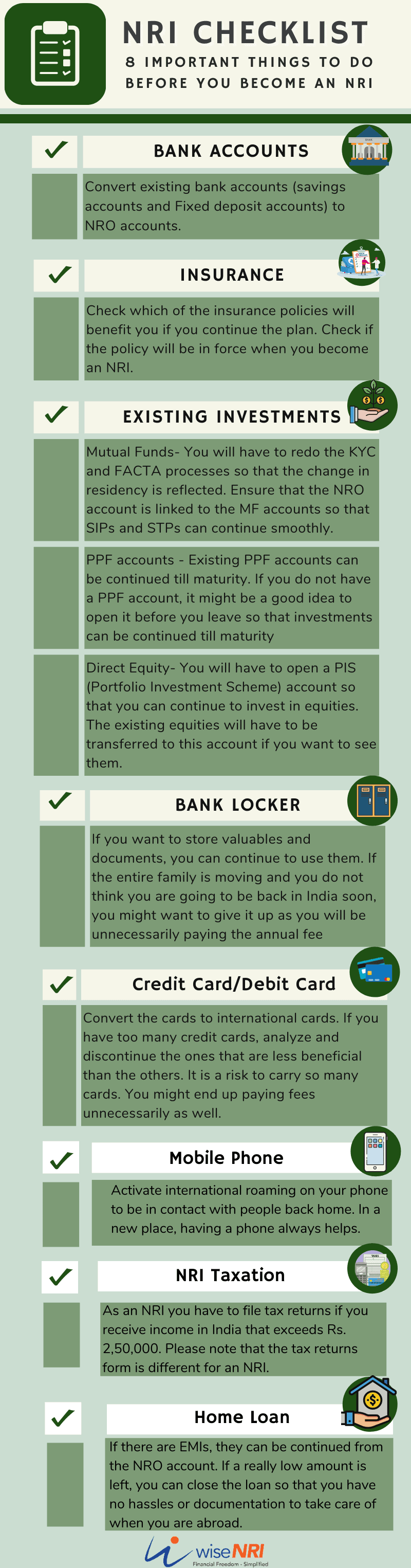
1. Bank Accounts
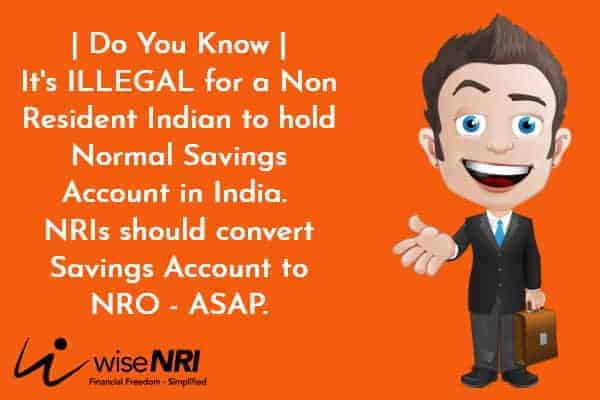
Convert existing bank accounts (savings accounts and Fixed Deposit accounts) to NRO accounts.
It might be better to consolidate many accounts into a few and then convert them to NRO accounts, since managing too many from another country gets difficult fast. NRO accounts can be used for transactions in India such as receiving dividends, rent, or paying EMIs.
An NRE account can be opened to deposit money from a foreign account. Interest earned in NRE accounts is tax-free. It can be a savings account and/or a fixed deposit account.
Read More – Best bank for NRIs
2. Insurance
Check which insurance policies still benefit you once you become an NRI, and whether the policy stays in force.
Term plans usually continue to be valid when you become an NRI. Still, inform the insurance company and check for additional riders or different conditions that apply to NRIs.
Medical insurance plans often carry waiting periods for certain conditions. Many NRIs prefer treatment in India, so it’s often worth keeping the medical insurance plan in force rather than letting it lapse.
“It is prudent to inform the insurance company when your status changes from resident to NRI, or vice versa.” – wiseNRI
Check – Life Insurance for NRI
3. Existing Investments
- Mutual Funds – You’ll need to redo your KYC and FATCA declaration so the change in residency is reflected. Ensure your NRO account is linked to your MF folios so SIPs and STPs continue smoothly. Check that the specific funds you hold still accept NRI investors. NRI Mutual Funds India
- Other Investments – You may hold Bonds, PPF, Gold, or Real Estate. For real estate transactions, consider nominating a Power of Attorney (PoA) unless a joint owner remains in India, so someone can transact on your behalf when needed.
- Existing PPF accounts can continue till maturity, and NRIs are allowed to keep contributing to an account opened while still a resident. If you don’t have one yet, it may be worth opening it before you leave. The current rate is 7.1% – solid for a government-backed, tax-free instrument, though not the 8% it once was.
- Direct Equity – You’ll need a PIS (Portfolio Investment Scheme) account with your bank to continue trading listed shares. As of the 2026 Budget, NRIs use a single unified NRE-PIS account for both repatriable and non-repatriable investments, and individual investment caps have doubled to 10% of a company’s paid-up capital. PIS is not required for mutual funds, only for direct equity delivery trades.
The Paperwork Nobody Chases You For
Banks and mutual fund houses rarely flag an unconverted resident account the moment you become an NRI. Nobody calls you. The account just sits there, technically non-compliant, until something triggers a review – a large transaction, a KYC refresh, an audit. By then you’re untangling years of paperwork from a different time zone. The families who avoid this treat the NRI checklist as a moving-week task, not a someday task.
Compliance that’s overdue by five years is far harder to fix than compliance that’s overdue by five days.
4. Bank Locker
If you want to store valuables and documents, you can continue using an existing locker. If the whole family is moving and you don’t expect to be back in India soon, consider giving it up – you’ll otherwise pay the annual fee for something you can’t access.
A locker also needs to be operated periodically. As an NRI, you may not be able to do that yourself. If you want to keep it, make sure there’s a joint holder who can operate it in your absence.
5. Credit Card/Debit Card
Convert your cards to international cards. If you’re carrying too many, review and close the ones that add little value – fewer cards means less risk and fewer fees you forget about.
You can also check – NRIs should consider before buying a gadget abroad
6. Mobile Phone
Activate international roaming so you can stay reachable while you settle in – a new country’s SIM and paperwork can take a few days to sort out.
7. NRI Taxation
As an NRI, you have to file a tax return in India if your Indian-sourced income exceeds the basic exemption threshold – Rs 4 lakh under the new tax regime, or Rs 2.5 lakh under the old regime. One detail that catches many NRIs off guard: the Section 87A rebate that zeroes out tax for resident Indians below certain income levels does not apply to NRIs, under either regime. This is separate from any tax liability you carry in your country of residence, and needs to be handled on its own terms. See our detailed guide on NRI tax filing for deadlines and forms.
8. Home Loan
Existing EMIs can continue from your NRO account. If the outstanding balance is small, consider closing the loan before you leave, so there’s one less thing to manage remotely.
Read – How to renew Indian passport online
Other important considerations
- Set up Internet Banking if you haven’t already.
- Automate as many India-based payments as possible.
- Discontinue subscriptions you no longer need – extra phone lines, cable, newspapers, gym memberships.
- Get your important financial documents in order. Where possible, digitise them and store them in a secure digital locker.
Frequently Asked Questions
How soon do I need to convert my bank accounts after becoming an NRI?
As soon as your residential status changes under FEMA. Continuing to operate a resident savings account as an NRI is technically non-compliant, even if the bank doesn’t flag it immediately.
Do I need a PIS account to invest in Indian mutual funds as an NRI?
No. PIS is only required for direct equity delivery trades on Indian stock exchanges. Mutual fund investments just need your KYC updated with NRI status and a linked NRO or NRE account.
Will my existing PPF account still work once I become an NRI?
Yes, it can continue until maturity, and you can keep contributing. You just can’t open a fresh PPF account once you’re already an NRI.
Do I still need to file an Indian tax return if my only income is NRE interest?
NRE interest is tax-free, so if that’s genuinely your only Indian income and it’s below the exemption threshold, you may not need to file. But NRO interest, rental income, or capital gains change that calculation – check the specifics before assuming you’re exempt.
When you go abroad, there will be plenty to handle there too. Tying up these loose ends in India first makes for a smoother, more peaceful transition. (Planning your eventual move back to India? – that’s worth reading too)
Rohan sorted his checklist in a weekend call before he flew out. Most people don’t get that lucky – they fix it from another time zone, months later, under pressure.
Do the Right Thing and Sit Tight.
Moving abroad soon and not sure where to start?
Let’s get your accounts, investments, and taxes NRI-ready before you leave, not after.
💬 Your Turn
Which item on this checklist did you miss or delay the longest after becoming an NRI? Tell us in the comments – it might save someone else the headache.


What is the common mistake done by non resident
I have opened a NRI Trading DMat account. Along with this ICICI Bank has opened two NRO accounts in India. Both these accounts are ‘Frozen’ and ICICI Bank is asking me to send ‘Initial funding’ thru wire transfer. I tried International transfer via Barclays which charged £4/- which was returned. I transferred using Wise App. It was returned by ICICI Bank. They are asking me to use ‘Money2India’ which doesnot have GBP option. Normal Wire transfer with Barclays Branch will cost me £25/-. Any idea & help will be appreciated. THANKS.
send in usd barclay will convert and dr your account in £
My son is out of country for study for 8 month’s Is he indian or nri
I would like to know the procedures to change status to NRI
Can an Indian resident give a loan to NRI cousin?
Good information as always. However you need to update on the PPF section. NRIs now have an option of closing PPF account from the time they become NRI. If they choose to keep it, the interest is lower (not 8 %) and therefore it might not be a good move to open a new PPF if one doesn’t have one already.
my query is regarding taxability of certain income from indian sources in the hands of a green card holder dual-resident tax payer under India-USA DTAA.
Beautiful article on NRI checklist! Thanks
Thanks 🙂
Need help with application for my NRI daughter for UK tax residency certificate from UK Revenue Service.
I want to know if I am to convert my NRE/NRO account to a resident account then do the account numbers change.
I have a residential plot bought before I became NRI. If I sell it now, can I remit the proceeds to my foreign destination? What is the tax liability?
I just got my PR approved for a foreign country. I hold a PPF account with SBI (not a savings+PPF, but a standalone PPF account).
I do not intend to come back to india in the foreseeable future.
How do I close my PPF account before I leave and withdraw my investments?
Hi Shiv,
A PPF can be closed prematurely before 15years but only under specific circumstances. You can close the account after completing 5 years for specific reason such as higher education or expenses towards medical treatment.But premature closure attract penalty- you will get 1%less interest. And option of partial withdrawal is available which starts from 7th year.
Subject: TRANSFER FROM NRO TO NRE ACCOUNT
Dear Sir,
I am NRI and having NRO and NRE Saving bank accounts in India. I want to transfer my fund in NRO account to my NRE account in the same bank. As per CBDT notification, NO 93/2015 dated 16th December 2015 effective from 01.04.2016 FORM 15CA and or 15CB is not required. However, the bank asking for FORM 15CA and 15CB.
I have gone through various rules and notifications of RBI and CBDT as per these provisions Transfers/ remittances from NRO Accounts to NRE accounts for the specified 33 purposes covered under CBDT Notification No 93/2015 dated 16/12/2015 not taxable and certificates 15CA and/or 15CB are not required.
But some of the banks do insist for such certificates from CA and account holder/remitter.
Generally, banks ask for submitting 15CA/CB certificates even if they are not required as per rule. The bank takes this position and justifies that due to strict penalties and disclosures required by RBI and banks don’t want to take chance. When banks insist on these unnecessary and required certificates, account holders have no choice but to submit these certificates to banks so that they transfer funds from NRO to NRE.
What is the correct position? Is there confusion in circulars/notifications of RBI/CBDT?. Which authority should clarify the correct rule position? Any good article clarifying correct rule position. How should I proceed to transfer the balance from NRO to NRE account in the same bank?
kindly guide me on this matter. I would like to know the correct requirement as per rules and regulations
With regards,
A.L.Chaudhary
Hi A.L Chaudhary,
An NRI can transfer funds from NRO to NRE Account only if the amount is within USD 1 million in a financial year.
You have to submit Fema declaration and request letter to transfer funds from NRO to NRE to bank.
For Transfer of Funds NRO to NRE, NRIs need to submit Form 15CA ( Online Application form) and form 15CB ( chartered accountant application) to the bank branch.
What types of documents would I need for an NRI account?
Hi Ryan,
I will suggest you to contact any Indian bank for NRE account formalities.
Please give a checklist for the students going abroad for studies and becoming NRIs
Hi Padnya,
That’s a good idea – I will definitely work on this.