
Deepa (name changed) opened a PPF account in Chennai in 2015, moved to Singapore for work three years later, and spent an anxious week in early 2018 convinced her account would be forcibly closed the moment her NRI status kicked in. A rule change had said exactly that. Then, weeks later, the government quietly reversed it. Her account is still active today, earning the same rate as any resident’s.
PPF rules for NRIs have flip-flopped enough times that even long-time investors get confused about where things currently stand. Here’s the clear version.

Must Check – NRI Investment Options in India
What PPF Actually Offers
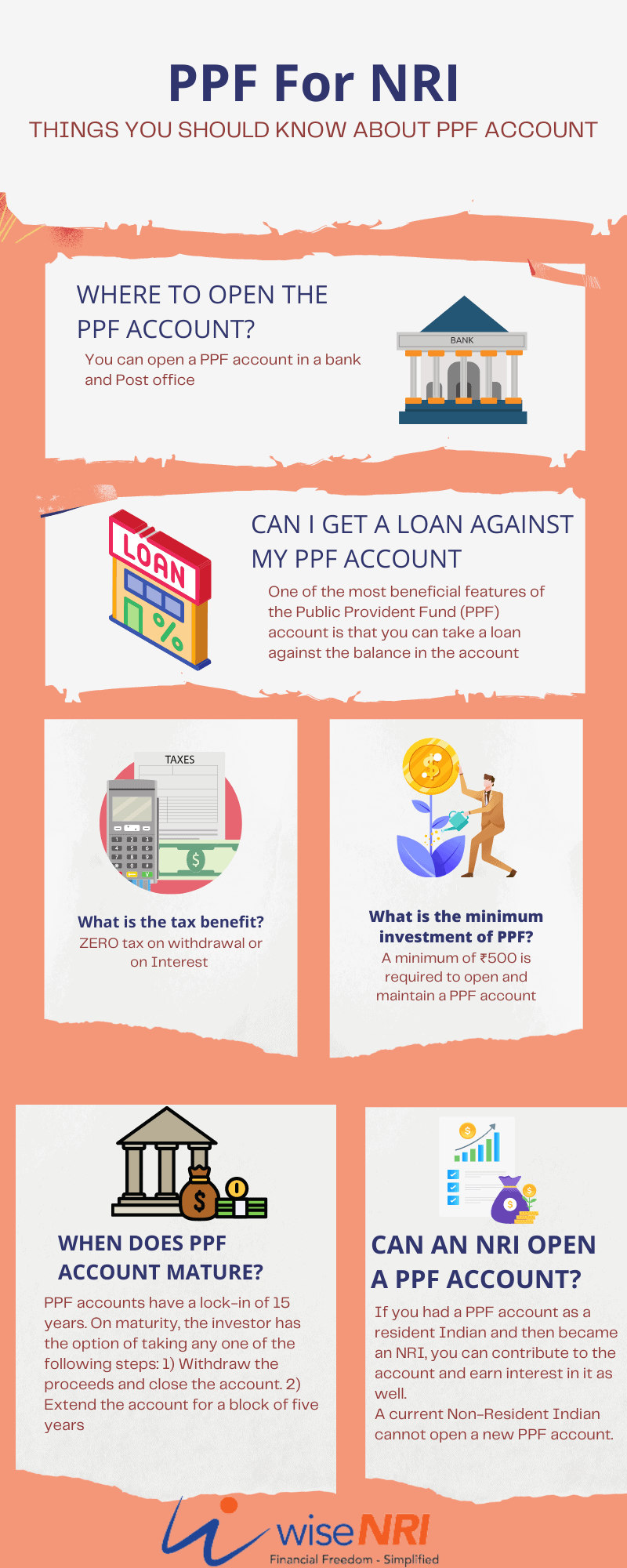
- Minimum Rs 500 to open and keep active; maximum Rs 1.5 lakh per financial year.
- Deposit as a lump sum or across up to 12 instalments a year.
- Section 80C deduction on contributions, up to Rs 1.5 lakh, tax-free interest, and tax-free withdrawal at maturity.
- Loan facility available from the 3rd to the 6th financial year after opening, one loan outstanding at a time.
- Partial withdrawal permitted after 6 years.
7.1%
Current PPF rate, unchanged for several consecutive quarters through 2026
Rs 1.5L
Maximum annual contribution, and Section 80C deduction ceiling
15 yrs
Standard maturity term from account opening
Must Read – Investment Restrictions for NRIs In India
What NRIs Can and Can’t Do
- You cannot open a fresh PPF account once you’re an NRI.
- If you already held a PPF account as a resident and later became an NRI, you can keep contributing and earning the standard rate until maturity.
- You cannot extend the account beyond maturity in 5-year blocks the way residents indefinitely can, this remains the one genuine restriction.
- Loans and partial withdrawals remain available on the same terms as for residents.
The 2017-2018 flip-flop, settled for good
A October 2017 notification said a PPF account would be deemed closed the moment the holder became an NRI. It caused genuine panic among NRI investors. The government reversed course in February 2018, putting that notice “in abeyance,” and existing NRI-held PPF accounts have continued earning the standard rate until maturity ever since. This reversal has held for years now and is the settled position, not a temporary relief measure.
NSC Is a Genuinely Different Story
National Savings Certificates get no such reprieve. If you become an NRI while holding NSC, the investment is deemed closed on the date your status changes, and the balance is paid out at the far lower post office savings account rate rather than the NSC rate you were earning. NRIs also cannot open new NSC investments at all. If you’re heading abroad and currently hold NSC, factor the rate drop into your planning rather than assuming it continues quietly at the original rate.
Must Read – A Few Hatke NRI Investment Rules in India
Where to Put New Money Instead
Since NRIs can’t open fresh PPF or NSC, worth directing new savings toward:
- NRE fixed deposits: low-risk, tax-free interest, rates broadly comparable to PPF and often higher currently.
- FCNR deposits: foreign-currency denominated, no currency risk, tax-exempt (barring RNOR status).
- Mutual funds: genuine diversification across asset classes with professional management, though with market risk PPF doesn’t carry.
- NPS: open to NRIs, with its own withdrawal and taxation rules worth understanding before committing.
Closing a PPF or NSC Account
PPF: complete Form C, gather KYC documents (ID, address proof, cancelled cheque), have everything attested by your NRE/NRO bank, and submit at the PSU bank holding your account for the proceeds to be credited to your NRE/NRO account.
NSC: submit the certificates, withdrawal form, identity slips, and ID proof to the issuing post office ideally, since cross-post-office verification via the CBS network can otherwise take one to three months, longer still without the identity slip.
Holding PPF or NSC and planning a move abroad?
We help NRIs figure out what to keep, what to close, and where the freed-up money should actually go.
Rules that flip-flop once can flip-flop again. Stay current, not just informed.
💬 Your Turn
Did the 2017 PPF closure scare affect you directly? How did you navigate it at the time?


Hello Hemant, Hope you are well I am Sachin and currently live in London. I seek your advice to deal with ICICI Bank. The bank manager misinformed me and based on that I closed my PPF account and the bank deducted my money and not returning it. The bank has not provided reference of the policy or the calculations of how the bank reached to the amount. I am talking to them since April 2023 but no resolution. Could you advise me on this matter? I want to understand where to escalate and what option I have? Thanks!
Do you help with PF withdrawal?
What happens to my PF amount when I become nri?
I’m resident Indian as of now with investment in SCSS account (Senior Citizens Savings Scheme).Soon I’m going abroad for work for a period 3-4 years.Can I continue with my SCSS investment after my resident status changes to NRI?Kindly advise. Thanks.
Interest on EPF after a person becomes an NRI and stops contributing
We have three PPF accounts when our kids were studding in India and now all are NRI and un able to visit. We approached concern Post Office and submitted Authority letters, but they insists to present owner of account. After 15 years of tenure we have closed account. How to proceed and which notification is available to show the authority. Pl. guide us.
In case of change of his residency status, an account holder shall also be allowed to close his ppf a/c with provisos that five years must should have elapsed from the end of the year in which the a/c was opened and also that in the event of such premature closure, interest in the a/c shall be allowed at a rate which shall be lower by one per cent than the rate at which interest has been credited in the a/c from time to time since the date of opening of the a/c,or the date of extension of the a/c, as the case may be.
Could you please explain tax for NRE FD Interest. Is there any cap for total interest to be exempt from tax? In case, if the total NRE FD interest exceeds 2,50,000 in a year, do I need to file ITR?