
You are sitting in Dubai, or Toronto, or London. Your salary is good. The India growth story keeps showing up on your phone. And some part of you knows you should be putting money to work back home. But between a demanding job, a time zone that fights you, and a dozen half-read forwards about where the market is headed, the decision keeps sliding to next month.
If that sounds familiar, you are not lazy. You are busy and far away. And that is exactly the situation a SIP is built for.
In my years advising NRI families, the ones who build real wealth in India are rarely the sharpest about markets. They are the ones who set up something simple, automatic, and hard to fidget with, and then let it run. A Systematic Investment Plan (SIP) is that setup. This guide walks you through how an NRI can start a SIP in India in 2026, what it costs in tax, and the one mistake that quietly undoes most people.
⚡ Quick Answer
An NRI can invest in Indian mutual funds through a SIP using an NRE, NRO or FCNR account, once KYC is done. You do not need RBI approval, only basic FEMA compliance. You invest a fixed amount every month, so you never have to guess the right day to enter. Gains are taxed the same way as for resident Indians, and for NRIs the fund house deducts TDS before paying you. If your country has a tax treaty (DTAA) with India, you can avoid paying tax twice.

Must Read – How Can NRI Invest in Mutual Fund in India?
Most NRI investors I speak with are stuck on three honest questions:
- How do I take part in India’s growth without betting everything on one lucky entry?
- Is there a way where market ups and downs actually work in my favour?
- And how do I do all this from another country, without it eating my weekends?
A SIP answers all three. Let me show you how.
What a SIP Actually Does for an NRI
A SIP is simply a standing instruction. On a fixed date each month, a fixed amount moves from your bank account into a mutual fund of your choice. That is the whole idea.
Think of it like watering a plant. You do not flood it once and walk away for a year. You give it a little, regularly, and let time do the growing. Investing works the same way. You put in small amounts, month after month, and let compounding quietly build the corpus.
Because the amount is fixed and automatic, a SIP takes the guesswork out. You are not sitting up at night wondering if today is the day to invest. The plan decides for you. And you can point it at whatever you are saving for, whether that is retirement in India, a child’s education, or a home you want to come back to.
Why the SIP Route Suits the NRI Life
You live far away and your days are full. That makes a few things about SIPs genuinely useful.
It builds discipline for you. The money is pulled on a fixed date, before you get a chance to spend it. You save first and spend what is left, instead of the other way round.
It averages out your cost. When markets fall, your fixed amount buys more units. When they rise, it buys fewer. Over years, this smooths out your average buying price. You stop needing to be right about timing, which is a relief, because almost nobody is.
It lets compounding work. Staying invested is where the real money is made. Not clever entries and exits. Just time in the market.
It flexes with your life. You can start small and step up later. A Top-up SIP lets you raise the amount every year, which pairs nicely with an annual bonus or hike. And if life throws a curveball, you can pause or stop without penalty (except tax-saving ELSS funds, which have a three-year lock-in).
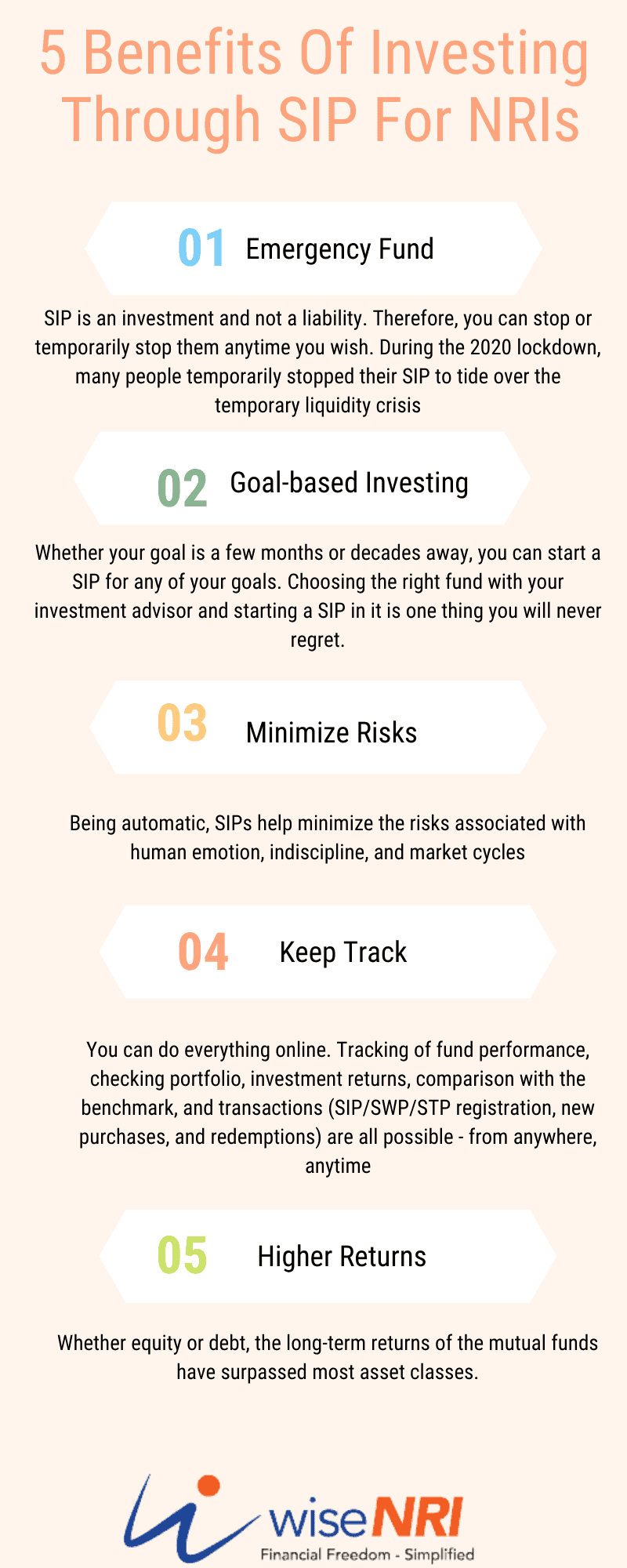
Must check – Best Mutual Fund to Invest in India
Equity, debt, or a mix?
That depends on your goals, how long you can stay invested, and how you actually behave when markets drop. As a rough guide, money you need within three years should not sit in equity. Money you will not touch for seven years or more usually belongs there. India’s fund houses offer schemes across equity, debt, hybrid and a few other SEBI-defined categories, so there is a fit for most goals. Getting this split right matters far more than picking the single best fund, and it is where a good advisor earns their keep.
Can NRIs Invest in SIPs in India?
Yes, and it is more straightforward than most people fear. You need to follow the rules under the Foreign Exchange Management Act (FEMA), but you do not need any special approval from the RBI to start a SIP.
What you do need is the right kind of bank account. This is where repatriation, the ability to take your money back out of India, is decided.
If you want to take the money back abroad
Invest through your NRE (Non-Resident External) or FCNR (Foreign Currency Non-Resident) account. Both the money you put in and the gains can be sent back to your country of residence freely. This is called a repatriable investment.
If the money will largely stay in India
Invest through your NRO (Non-Resident Ordinary) account, usually your Indian income like rent or dividends. The gains can be moved abroad, but the original amount can only be repatriated up to a set annual limit. This is a non-repatriable investment.

Check – How NRIs can complete KYC for NRI Mutual Fund
If you live in the USA or Canada
Here is the one real hurdle. Because of extra reporting rules under FATCA, only a limited set of fund houses accept investments from NRIs based in the USA and Canada. The good news is that this list has grown over the years, and several large names now welcome US and Canada NRIs, though some allow only lump-sum or offline transactions and each has its own paperwork.
Because these rules change from time to time, do not assume your preferred fund house is open to you. Check its current NRI policy, or ask an advisor who works with US and Canada clients, before you set your heart on a scheme.
The SIP instalment you least want to pay
Here is something I tell every NRI client. The SIP instalment that feels worst to pay, the one that goes through while the market is falling and your portfolio is red, is almost always the most valuable one you will ever make. That is the month your fixed amount buys the most units at the lowest prices. When the market recovers, those cheap units do the heavy lifting.
So the goal is not to invest more when you feel confident. It is to keep the instalment running when you feel scared.
How Can an NRI Start a SIP in India, Step by Step
1. Set up the right account
Open an NRE, NRO or FCNR account if you do not already have one. If you have just become an NRI, your old resident savings account should be re-designated as an NRO account. Choose based on where the money comes from and whether you want it repatriable.
2. Complete your KYC
The one-time KYC needs a few basic documents:
- Filled KYC form
- Passport
- PAN card
- Overseas address proof
- Indian address proof
- Recent photograph
- Bank statement
Being abroad, your documents usually need to be attested, by an overseas branch of an RBI-registered bank, a notary in your country, or the Indian embassy or consulate.
3. Finish the In-Person Verification (IPV)
SEBI requires an IPV. For NRIs this is now almost always done over a video call, with an Aadhaar-based OTP for verification. It takes a few minutes.
One note: if you plan to invest through a Power of Attorney holder in India, the PoA must be registered first, and both you and the PoA holder need to complete KYC.
4. Start the SIP
Once your KYC is active, link your bank account and make the first investment. Funds usually take two to three working days to reflect. After that, set up the SIP, the amount, the date and the scheme, and it runs on its own. You can hold everything under one folio or split across folios, whatever is easier to track from abroad.
Not sure which account, which split, or which fund fits your goals?
We help NRI families set up their India investments the right way, from account structure to a plan that actually survives the next market fall.
What Will You Pay in Tax in 2026?
This is where a lot of old articles will mislead you, because the rules changed. Here is where they stand now.
Like resident Indians, NRIs pay capital gains tax on mutual fund gains. The difference is that for NRIs, the fund house deducts TDS (tax at source) before the money reaches your account.
| Fund type | How long you hold | Tax on the gain |
|---|---|---|
| Equity funds | 12 months or less (short term) | 20% |
| Equity funds | More than 12 months (long term) | 12.5% on gains above Rs 1.25 lakh a year |
| Debt funds (bought on or after 1 April 2023) | Any period | Added to your income, taxed at your slab rate |
| Hybrid funds | Depends on equity holding | Taxed like equity if 65%+ in equity, otherwise like debt |
Two important points that trip NRIs up:
Debt funds lost their old advantage. Debt funds bought on or after 1 April 2023 no longer get the long-term rate or indexation. The gains simply get added to your income and taxed at your slab. The old “20% with indexation after three years” line you may have read is out of date.
A tax treaty can save you from being taxed twice. If your country of residence has a Double Taxation Avoidance Agreement (DTAA) with India, you can claim relief and often a refund of excess TDS by filing an income tax return in India. For many NRIs, that filing is worth the small effort.
📋 One thing to remember
Tax rules shift with almost every Budget. Treat the numbers above as your starting point for 2026, and confirm your own position with your advisor before a large redemption.
Why NRIs Quit SIPs at the Worst Possible Time
Here is the uncomfortable part. The biggest risk to your India portfolio is not the market. It is you.
There is a well-studied behaviour called myopic loss aversion. In plain terms, the pain of watching your money drop feels roughly twice as strong as the joy of seeing it grow. So when the market falls, every instinct screams at you to stop the bleeding. Many investors pause or cancel their SIP at exactly that moment, which is the moment the SIP was doing its best work.
For NRIs this pull is stronger, not weaker. You are far from your money, often reading scary headlines about India from an outside seat, and it feels easier to hit pause and “wait for things to settle.” They rarely settle on schedule. And the units you did not buy during the fall are the ones you will wish you owned when it recovers.
This is why I keep saying it is not a numbers game, it is a mind game. The maths of a SIP is simple. Sitting still while your portfolio is red is the hard part. That is the real job, and it is the one most people underestimate.
“The SIP instalment that feels worst to pay is almost always the most valuable one you will ever make.”
– Hemant Beniwal, CFP
The Bottom Line for NRIs
Starting a SIP from abroad is not hard. Open the right account, finish your KYC once, pick a sensible mix for your goals, and automate it. The paperwork is a weekend’s work at most.
Staying the course is the harder, more valuable skill. Set it up so it is boring, and then let it be boring. Boring, in investing, is a compliment.
You cannot be in India to watch your money every day. But you can build something that does not need watching. That is the quiet power of a SIP for an NRI.
Set it up well once. Then let time and patience do the rest.
Frequently Asked Questions (FAQs) – SIP for NRIs
Can NRIs invest in SIP in India?
Yes. NRIs can invest in SIPs through Indian mutual funds as long as they follow FEMA rules and complete KYC and In-Person Verification. No RBI approval is needed.
Which account should an NRI use for a SIP?
An NRE or FCNR account if you want the money to be repatriable, or an NRO account for your India-sourced income. NRE and FCNR investments can be freely sent abroad; NRO principal can be repatriated only up to an annual limit.
Is SIP taxable for NRIs in India?
Yes, on capital gains. Equity funds are taxed at 20% for short-term gains (held 12 months or less) and 12.5% for long-term gains above Rs 1.25 lakh a year. Debt funds bought on or after 1 April 2023 are added to your income and taxed at your slab rate. For NRIs, the fund house deducts TDS before paying out, and a DTAA can help you avoid double taxation.
Can NRIs in the USA and Canada invest in SIPs?
Yes, but only through the fund houses that accept US and Canada investors under FATCA rules. That list is limited though growing, and some allow only lump-sum or offline transactions. Check a fund house’s current NRI policy before you commit.
Can I pause or stop my SIP as an NRI?
Yes. SIPs are flexible. You can pause, change or stop them without penalty at any time, the only exception being tax-saving ELSS funds, which lock each instalment for three years.
💬 Your Turn
If you are an NRI running a SIP, did you ever pause it during a market fall? What made you stop, and what would you do differently now? Tell me in the comments.
Want your India investments handled properly from abroad?
Book a conversation with our team and get a plan built around your goals, your country of residence, and your tax situation.



Which FUND Houses can accept from NRI in Canada? I have just taken Canadian nationality.
as an NRI is it wise to invest in MF-SIPs through a NRO account or an NRE account
is sip taxable
I would like to the specific fund names in which a NRI can invest in. Among the 8 fund houses there is a host of funds available but only a few are open to NRIs. I want the list of the few
If I invest in SIPs, do I have to pay taxes annually even thought I do not sell
As an NRE, if you invest in SIPs (MFs), do I have to pay taxes on any capital gains annually even if I do not sell. If so, if there are losses can that be offset from gains ?