
Anand called after signing a sale agreement for his late father’s flat in Chennai, expecting the usual 20% tax on the gain. His CA had to break the news: the rules changed in 2024, and depending on when his father bought the flat, he might actually owe 12.5% instead, with no indexation benefit at all. That single change moved his tax bill by several lakhs. (name changed)
⚡ Quick Answer
NRIs can buy, inherit, or receive Indian property as a gift, though agricultural land and farmhouses cannot be directly purchased. Property held over 24 months qualifies for long term capital gains, taxed at 12.5% without indexation, or 20% with indexation if the property was acquired before 23 July 2024, whichever works out lower. Selling proceeds can generally be repatriated within RBI limits, and Sections 54, 54EC, and 54F remain the main ways to reduce the tax bill.

Check: NRI Investment in Commercial Property
Can an NRI Buy Property in India?
Yes. NRIs can acquire property in India in three main ways.
Direct Purchase
NRIs can invest in commercial or residential property. Plantation land, agricultural land, and farmhouses cannot be directly purchased while your status is NRI.
Inheritance
You may inherit movable or immovable property, including residential, commercial, or agricultural land, regardless of when you became an NRI.
There’s no legal restriction on who you can inherit from. It could be a parent, in law, close or distant relative, or someone with no blood relation at all. The person bequeathing the property can themselves be an NRI or a PIO (Person of Indian Origin).
Gift
Similarly, there’s no bar on receiving property as a gift, even from someone unrelated to you. But tax treatment differs meaningfully between inheritance and gifts. Gift tax provisions may apply depending on the specifics.
Read: Can NRIs buy Agriculture Land in India
Read: NRI Real Estate Investment Outside India
Estate Laws for NRIs Regarding Tax
While Acquiring
No income tax applies on property acquired through purchase or inheritance. Property received as a gift is different: its value gets added to your gross income under “income from other sources” and taxed at your marginal rate, when the value exceeds Rs 50,000.
You can receive a gift of any value, anytime, without tax implications, from:
- Your spouse
- Grandparents, parents, and parents in law
- Siblings
- Children or grandchildren
Gifts received on certain occasions, from anyone, of any amount, are also tax free. This includes marriage, transfers from an HUF to its members, transfers at divorce, or a share of joint family property.
The Two Numbers Every NRI Seller Forgets to Compare
If your property was acquired before 23 July 2024, you actually have a choice: pay 12.5% with no indexation, or 20% with indexation. Most sellers assume the newer, lower rate automatically wins. For property held many years, indexation can shrink the taxable gain enough that the 20% route actually costs less overall. Run both calculations before you file. Guessing here can genuinely cost lakhs.
The lower rate on paper isn’t always the lower bill.
On Continued Ownership
If you keep the property, any income arising from it, real or deemed, is taxable. Certain exceptions, deductions, and allowances reduce this liability, and they vary case by case.
For example, an unoccupied residential property kept vacant for your eventual return is exempt. But if you own multiple house properties, including inherited ones, only one can be declared self occupied even if the others sit vacant too. The rest attract deemed rental income added to your gross total.
Dividend and interest income from deposits are taxed per the prevailing rules, same as for any taxpayer.
While Selling or Gifting
You can sell or gift any property you hold clear title to, and remit sale proceeds abroad within limits set by the Income Tax Act and RBI.
Selling inherited property to another NRI or PIO needs RBI permission. Selling to a Resident Indian doesn’t. Agricultural land acquired by inheritance can only be sold to Resident Indians.
If you acquired or inherited the property while you were still a Resident Indian, you can sell, rent, transfer, or gift it freely.
Documents Needed
Depending on the case, NRIs typically need:
- Death certificate of the deceased
- A registered will and succession certificate, to execute transfer of the inherited property’s title
- Address proof of the deceased
- Property papers and registration certificate
- Address, age, and ID proof of the legal heirs
- Documentation showing relationship to the deceased, such as a ration card or Aadhaar based family linkage
- Bank statement of the legal heirs
Capital Gains on Sale
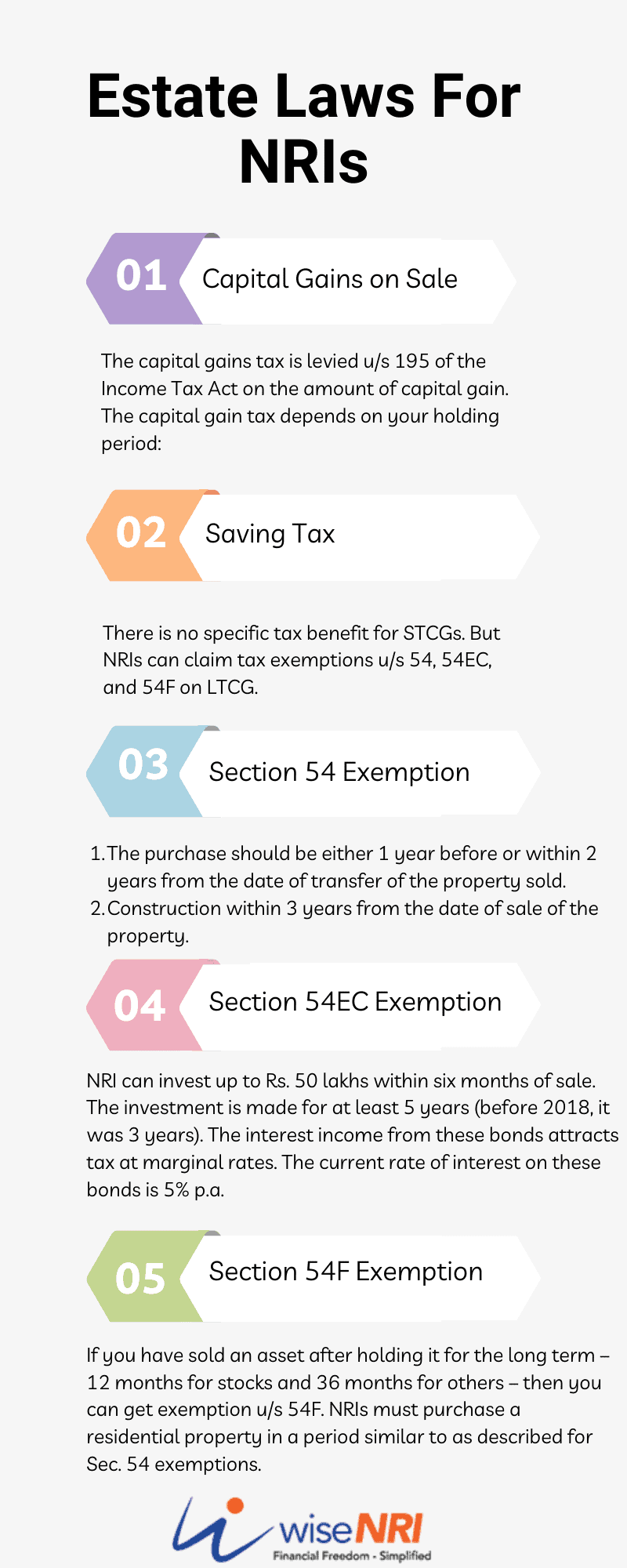
Capital gains tax is levied under Section 195 of the Income Tax Act, and the rate depends on your holding period.
- Short term capital gains: for property held under 24 months, included in your income and taxed at your slab rate.
- Long term capital gains: for property held 24 months or more. If acquired on or before 23 July 2024, you can choose between 12.5% without indexation or 20% with indexation, whichever is lower. If acquired after that date, only the 12.5% flat rate without indexation applies.
Saving Tax
There’s no specific relief for short term gains. But NRIs can claim exemptions under Sections 54, 54EC, and 54F on long term gains.
Section 54 Exemption
If you sell a house property and buy or construct another within a specific window, you can claim this exemption. The rules:
- Purchase must happen either 1 year before, or within 2 years after, the date of transfer.
- Construction must be completed within 3 years of the sale date.
You can claim this exemption only for one house property within India, purchased or constructed from the capital gains. If the property costs more than the gain itself, the entire gain can be claimed as exempt. Exemptions under Sections 54 and 54F are currently capped at Rs 10 crore of investment.
While waiting for the right property, deposit the funds in a special account under the Capital Gains Account Scheme, 1988.
Section 54EC Exemption
If you’d rather not buy another property but still want to save tax on the gain, invest it in specified bonds issued by NHAI or REC. You can invest up to Rs 50 lakh within six months of the sale, locked in for at least 5 years. Interest from these bonds is taxed at your marginal rate; check the current coupon rate directly with the issuer at the time of investment, since it’s revised periodically.
Making this investment before the sale closes lets you show proof to the buyer so they skip TDS deduction. Otherwise, claim the refund when filing your ITR.
Section 54F Exemption
If you’ve sold a long held asset, over 12 months for listed shares, 24 months for most other assets like property, you may qualify for this exemption by purchasing a residential property within the same timeframe as Section 54.
The key difference: if you don’t reinvest the entire sale proceeds, the exemption applies only proportionately to what you did reinvest.
Repatriation of Sale Proceeds
Under the RBI’s Liberalised Remittance Scheme, NRIs can repatriate up to $1 million annually without special permission, once applicable taxes are paid.
Keep these conditions in mind:
- The property must have complied with FEMA regulations in force at the time of sale.
- Sale proceeds from up to two residential properties can be repatriated.
- NRE account funds have no repatriation limit; NRO account funds are capped at $1 million per year.
Check: Good Time to Buy Property in India?
Frequently Asked Questions
What’s the current LTCG tax rate on property for NRIs?
12.5% without indexation for property acquired after 23 July 2024. For property acquired on or before that date, you can choose between 12.5% without indexation or 20% with indexation, whichever gives a lower tax bill.
How long must an NRI hold property to qualify for long term capital gains?
24 months, reduced from the earlier 36 month threshold under the 2024 tax changes.
Can NRIs repatriate the full sale proceeds of inherited property?
Yes, up to $1 million a year under the Liberalised Remittance Scheme, after taxes, and limited to proceeds from up to two residential properties.
The Indian property market offers real opportunity, to buy and to sell. The estate laws around it are genuinely complex, but staying current on the rules, rather than relying on what used to be true, is what protects you from an expensive surprise at filing time.
Anand’s tax bill changed by lakhs because the rule changed and nobody told him in time.
Selling or inheriting property in India soon?
We help NRIs run the actual numbers before filing, not after.
💬 Your Turn
Have you sold or inherited property in India as an NRI recently? Share your experience with the process in the comments.


Is this LRS for RI still legal to transact UpTo 250000$/anually to NRI/oci/PIO abroad from India.And is this true that amount exceeding 7 lacs RS/anually. TCS will be implicated at the rate of 5%??Thanks in advance.
If I sell unlisted shares of a company which I am holding for the last 10 years, being an nri what is the tax implications ,Without indexation is it 10 % plus surcharge?Is there any upper limit like say 5 crime before any other tax implication applies
I live in USA andI own two flats in India. Do I need to file tax in India also
I want to sell my property and bring the money overseas
US citizen having OCI and is also having ancestral Agril. land in India and presently Resident status in India as living in India for more than 6 months every year.so can he buy Agril.land as being farmer by ancestral aquired agril.land?Pl. guide.ThanksD K Patel
Educative
Thanks
Very informative and helpful articals for NRI.
Thanks
Good article
Thanks