
A few years back we were working with a new NRI client on his financial plan. He had a very well-diversified portfolio including international equity and debt. Prima facie, this was one of the best allocations we had seen in a long time.
Our first observation: this portfolio must be performing very well.
Then we went into the details and tried to understand how he had made these decisions. He mentioned he built this portfolio after looking at the great performance of these funds the year before. That was the problem.
Buying recently outperforming asset classes or funds is one of the most common mistakes investors make. But there was an even bigger mistake in his case: he had invested heavily in long-term debt funds of developed countries, right near the bottom of a multi-decade rate cycle.
Quick Answer
Interest rates move in long cycles, and they affect nearly every asset class NRIs hold: NRE and NRO fixed deposits, long-term debt funds, bonds, floating-rate home loans, and even equity and real estate valuations indirectly. Falling rates make long-term debt funds look brilliant temporarily, but that performance reverses hard once rates rise again. This is exactly what happened between 2021 and 2026: rates fell close to zero, then climbed sharply, then eased again, and each phase rewarded a completely different portfolio.
Must Read: How NRIs can earn more by investing in themselves
Impact of Falling Interest Rates on NRIs
Interest rates impact nearly everything in the financial world. Looking at the chart below, you can see how interest rates in the USA, broadly similar in pattern to other developed economies, fell for four decades before hitting near zero around 2021.
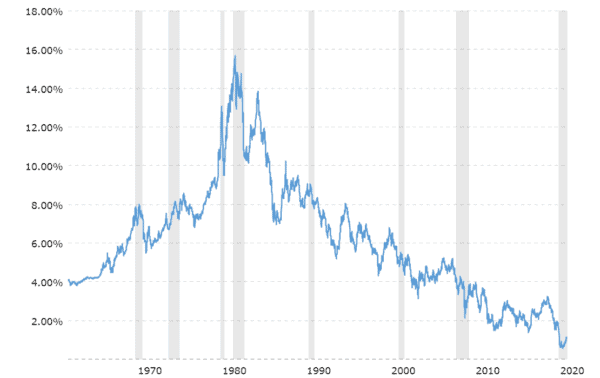
That near-zero period did not last. By 2023, the US Federal Reserve had hiked rates aggressively to fight inflation. As of 2026, the Fed funds rate sits in the 3.5% to 3.75% range, held steady since a December 2025 cut. This is exactly the kind of reversal this post warned about years ago, and it is worth remembering the next time a debt fund’s recent performance looks unusually attractive.
Must Read: Status of NRE FD after Returning to India
Direct Impact
Interest rates are inversely related to bond and debt fund returns. When rates fall, existing long-term debt funds generate excellent returns, because their older, higher-coupon bonds become more valuable. When rates rise, the same funds generate lower or even negative returns, because newer bonds pay more and the older ones look less attractive by comparison.
Between 2020 and 2021, US long-term debt funds delivered phenomenal returns, in some periods well into double digits, plus additional gains for NRIs from dollar appreciation. That performance was real, but it was also a direct product of rates falling toward zero, not a sustainable baseline.
But what happens when interest rates increase, as they did through 2022 and 2023?
In the client’s portfolio we mentioned earlier, there was major exposure to long-term debt funds where the expense ratio was actually higher than the underlying portfolio yield. This can look fine when the fund is riding a falling-rate tailwind, but it hurts significantly once returns compress or turn negative.
We suggested he trim that exposure. You do not have to follow this advice directly. Talk to your own financial planner about your specific portfolio.
Note: Many NRIs, whether they realise it or not, hold long-term debt funds inside their pension plans, such as 401(k) or QROPS structures. Floating rate home loans are affected by the same rate cycle in the opposite direction, since your EMI moves with the benchmark rate.
Must Read: 401k moving to India
Indirect Impact
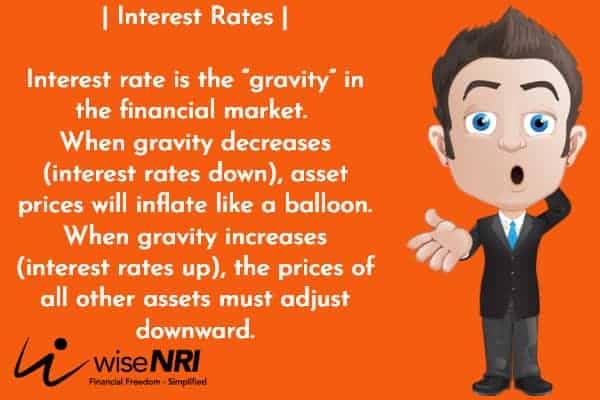
Interest rates act like a gravitational force on nearly every asset class. When rates are low, equity, real estate, and even commodities tend to get a lift, partly because investors are pushed out of low-yielding debt into riskier assets in search of return. When rates rise, there is broad pressure across all these asset classes at once.
We rarely know exactly when a reversal will happen. The 2021-to-2023 shift caught a lot of portfolios off guard precisely because it happened faster than most people expected.
NRIs and Falling Interest Rates in India
The graph below shows the movement of India’s repo rate through the years leading up to 2021, when it had been falling steadily since around 2015.
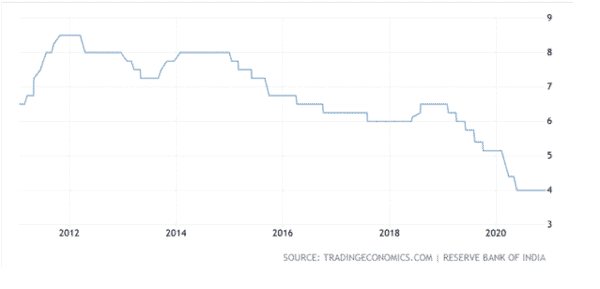
That decline did not continue in a straight line. The repo rate subsequently rose to a peak of 6.50% through 2025 and early 2026, before easing back down to its current level of 5.25%, where the RBI has held it steady through most of 2026 as it balances growth support against inflation risk. This is the same cyclical pattern the chart above hints at, simply continuing past the point where the original data ends.
The repo rate remains one of the most important figures for NRIs to track, because it has a direct bearing on the deposit rates you earn and the loan rates you pay. When the repo rate falls, commercial banks can borrow from the central bank more cheaply, which typically means lower deposit rates for you and lower loan rates for borrowers. When it rises, both move in the opposite direction.
Read: How can NRIs Manage financial uncertainty?
“Rates fell for forty years, then reversed sharply within eighteen months. If your portfolio was only built for the falling half of that cycle, the rising half will find you.”
The movement of interest rates affects the personal finances of NRIs directly. NRIs have to track interest rates not just in India, but in their country of residence as well.
- Falling interest rates lead to lower returns on NRO and NRE fixed deposits. NRIs need to periodically decide whether to stay invested in these FDs or shift to more attractive products as rates change.
- NRIs also need to compare rates between their country of residence and India. With the US Fed funds rate around 3.5% to 3.75% and India’s repo rate at 5.25% as of 2026, a meaningful gap still exists, though it has narrowed compared to the zero-rate years. Depending on this gap and the effort involved in moving money, NRIs need to make an active call on their FDs and where their money sits, rather than leaving it on autopilot. See our piece on NRI investment options in India for a broader view of where that money could go.
- In a falling interest regime, bond yields are lower. NRIs holding long-duration bonds will see capital gains as rates fall, but lower running yields, and the reverse when rates rise again.
- NRIs in Gulf countries have historically taken advantage of the interest rate gap between India and the Gulf, where local rates remain considerably lower. Some borrow locally and invest in India to capture this spread. We do not recommend this arbitrage strategy, since currency movement and rate reversals can erase the gain quickly, and the borrowed money still needs to be repaid regardless of how the arbitrage performs.
Read: Home Loan Checklist For NRIs
What Changed Since This Post Was First Written: Debt Fund Taxation
One material change that did not exist when this topic was first written about is a shift in how debt mutual funds are taxed in India. Under the Finance Act 2023, any debt mutual fund investment made after 1st April 2023 no longer qualifies for long-term capital gains treatment or indexation benefit at all, regardless of how long you hold it. All gains on these post-April-2023 investments are now taxed at your slab rate, exactly like short-term gains always were.
Investments made before that date still retain the older treatment. This distinction matters enormously for the “buy long-term debt funds when rates are falling” strategy discussed throughout this post: the tax drag on any new debt fund purchase is now materially higher than it was during the period this post’s original examples were drawn from. Before adding fresh money to a long-duration debt fund purely on a rate-cycle bet, it is worth running the after-tax return, not just the headline number.
Deciding What to Do With This Information
It is genuinely difficult to predict the exact movement of rates. But you can decide on a sensible course of action regardless of which way the cycle turns next.
- When interest rates are falling, your returns from debt instruments will compress. This does not mean you should exit bonds, FDs, and other debt investments altogether. Your portfolio should hold a balance of assets based on your actual risk capacity and risk tolerance, not on whichever asset class performed best last year.
- Consider the risk-reward relationship honestly. If you want lower volatility and more stable returns, be prepared to accept a lower expected return in exchange.
- You have probably heard some version of “if you can stomach volatility, equity offers the potential for higher returns.” That is true, but our advice remains to stick to your plan and your target asset allocation, rather than chasing whichever asset class is currently in favour.
- Floating interest rates on loans move in sync with the benchmark rate. When the benchmark rises, your floating home loan rate rises with it, and when it falls, your rate falls too. Fixed-rate loans are usually priced slightly higher than floating-rate loans precisely because the bank is taking on the interest rate risk instead of you. If you expect rates to fall further, a floating rate can work in your favour, but you must be genuinely comfortable with your EMI rising if the cycle turns, as it did sharply between 2022 and 2023.
- Floater funds are debt funds that invest at least 65% of their assets in floating-rate bonds, where the coupon resets periodically in line with market rates. These are worth considering specifically when you expect rates to rise, since they capture higher coupons faster than fixed-rate bond funds do.
Not sure if your portfolio is built for the current rate cycle?
Many NRI portfolios are still positioned for the zero-rate years and have not been reviewed since. We help NRI clients check whether their fixed income, home loan structure, and asset allocation actually match today’s rate environment.
It is not easy to invest in the markets today with so many local and international factors affecting them. When you design your investment portfolio, think carefully about which asset classes to hold, such as real estate and equity, your timeframe for each investment, and the genuine risk-versus-reward trade-off involved. You will also need to review your portfolio periodically, specifically to account for interest rate movements like the ones this post has walked through.
The client we opened with did trim his long-duration debt exposure. By the time rates peaked in 2025, his portfolio held up considerably better than it would have otherwise, not because he predicted the exact top, but because he stopped building a portfolio around one recent trend.
Want a second opinion on your fixed income allocation?
We help NRI clients across the Middle East, UK, US, Singapore, and Australia build portfolios that hold up across full rate cycles, not just the current one.
Frequently Asked Questions
How does the RBI repo rate affect NRI fixed deposits?
When the repo rate falls, banks can borrow more cheaply from the RBI, and they typically pass this on by reducing the interest rates offered on NRE and NRO fixed deposits. When the repo rate rises, FD rates generally rise too. As of 2026, the repo rate stands at 5.25%, down from a peak of 6.50% reached through 2025 and early 2026.
Are debt mutual funds still tax efficient for NRIs after the Finance Act 2023 changes?
Debt mutual fund investments made after 1st April 2023 no longer qualify for long-term capital gains treatment or indexation, regardless of holding period, and are taxed entirely at slab rate. Investments made before that date retain the older, more favourable treatment. This makes new debt fund purchases significantly less tax efficient than they were when this cycle first began.
Should NRIs choose a fixed or floating rate for their home loan given the current rate cycle?
This depends on your view of where rates are headed and your comfort with EMI variability. Floating rates are typically priced lower than fixed rates because the borrower bears the interest rate risk. With the RBI holding rates steady through most of 2026 after a period of cuts, some borrowers may prefer floating, but anyone who lived through the 2022 to 2023 rate hikes knows this can reverse faster than expected.
Is the interest rate arbitrage between Gulf countries and India still worth pursuing?
We do not recommend this strategy. While a rate gap between Gulf countries and India does exist, currency movements and rate reversals can erase the expected gain, and the borrowed money still needs to be repaid in full regardless of how the arbitrage trade performs. It converts a savings decision into a leveraged currency bet.
If you would like to discuss your personal finance with us, check this.
Have a question about how the current rate cycle affects your specific portfolio? Feel free to add it in the comment section.


Which form do I need to submit under FEMA and when to inform to bank permanently coming to India?