
Rajesh, an NRI in the US, spent months on a call center run by a “consultant” back home who kept telling him his LLP needed RBI approval before he could even start. Turns out that requirement was scrapped a decade ago. He’d lost real time and money to advice nobody had bothered to update. (name changed)
⚡ Quick Answer
NRIs and foreign nationals can register a Private Limited Company, Public Limited Company, or LLP in India, but not a sole proprietorship or one-person company. Since a 2015 reform, 100% FDI into LLPs is allowed via the automatic route in sectors where it’s permitted, so RBI pre-approval generally isn’t required anymore, a real change from older guidance still floating around. Registration runs through the MCA portal with a Digital Signature Certificate, Director Identification Number, and standard incorporation documents.
India remains one of the world’s fastest-growing economies, and sectors like financial services, IT, pharmaceuticals, auto, FMCG, and engineering keep drawing both foreign and Indian investors. Competent, affordable talent, a genuinely conducive policy environment, and improving connectivity all support that growth, with India’s own consumption demand adding further pull.

Must Read: NRI Checklist
NRIs and foreign investors can invest and start businesses in India under FEMA regulations, and the government continues working to make India a genuinely preferred investment destination for both groups. A large share of that investment comes from NRIs with real ties here, alongside foreign nationals and companies drawn by NRI entrepreneurial talent specifically.
Here are the essentials worth knowing if you’re planning to register a company in India.
Identify the Right Sector First
Since the 1991 liberalization reforms, most sectors are genuinely open to NRI and foreign investment. That said, some sectors cap the foreign capital share, require prior RBI or ministry approval, or restrict foreign investment entirely. Check the Invest India website for the current, comprehensive list of sectoral caps and restrictions before you commit to a structure.
Types of Companies NRIs and Foreign Nationals Can Register
Sole proprietorship, partnership, and one-person company structures aren’t available to NRI and foreign investors. The Companies Act 2013 does allow for:
- Limited Liability Partnership (LLP)
- Private Limited Company
- Public Limited Company
Must Read: NRI Investment Options in India
Prerequisites Before You Register
Partners, Shareholders, and Directors
An LLP needs a minimum of two partners, and at least one must be a Resident Indian. It needs at least two Designated Partners too, functionally similar to company directors.
A Private Limited Company needs a minimum of two shareholders, a maximum of 200, and at least two directors on its board.
A Public Limited Company needs at least seven shareholders, with no upper cap, and at least seven directors.
Incorporated bodies can invest as partners or shareholders too, nominating a representative to serve as designated partner or director.
Workplace Address
The proposed company or LLP needs a genuine physical presence in India before incorporation. The application requires office address proof, a sale deed or rental agreement, and for leased space, a No Objection Certificate from the property owner.
The RBI Approval Requirement for LLPs Is Gone
A common piece of outdated advice still circulating: that FDI into an LLP requires prior RBI approval. That was true before November 2015. Since then, 100% FDI into LLPs is allowed via the automatic route in sectors where 100% FDI is permitted, with no FDI-linked performance conditions, meaning no prior government or RBI approval is required for most LLP structures today. Confirm your specific sector’s status directly, since this simplification doesn’t apply universally, but don’t assume the old rule still stands.
Investment Approvals
For a Private or Public Limited Company, approval is only required where specifically mandated for that sector. In most sectors, and up to specified limits, FDI flows in via the automatic route without prior approval.
Required Documents
- Tax Identification Number: from your country of residence for foreign nationals, or PAN card for Indian citizen partners and shareholders, NRIs and residents alike.
- Passport.
- Valid visa: from your country of residence for NRIs, or from the Indian Embassy for foreign nationals visiting India.
- A certificate confirming your NRI status.
- Indian address proof (for NRIs and residents): a utility bill or bank statement no older than two months, driver’s license, Aadhaar, or Voter ID.
- Foreign address proof (for NRIs and foreign nationals): a utility bill, employer certificate, bank statement, or driver’s license, duly attested by the local Indian High Commission and notarized.
- For nominees of incorporated bodies: certificate of incorporation, tax information number, and a certificate nominating the individual as director or designated partner.
- Shareholding pattern or partnership agreement: authorized and paid-up capital, shareholding percentage.
- Bank statements of partners, shareholders, or directors.
Documents submitted by foreign nationals or nominees of foreign incorporated bodies need attestation from the Consulate of the Foreign Embassy in India.

Must Read: NRIs’ Contribution to the Indian Economy
The Registration Process
The process is largely comparable to registration for Indian shareholders, partners, and directors:
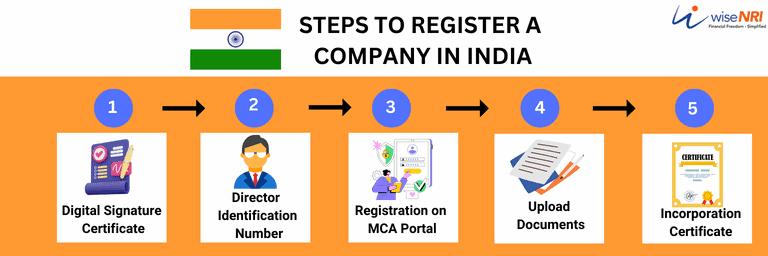
- Apply for and obtain a Digital Signature Certificate (DSC) for all directors and designated partners on the Ministry of Corporate Affairs (MCA) website.
- Obtain a Director Identification Number (DIN), or Designated Partner Identification Number (DPIN) for LLPs, from the MCA. Both follow a similar application process.
- Complete the necessary applications on the MCA website to register the company.
- Upload the required documents: e-MoA and e-AoA for a company, or a Registered Partnership Deed for an LLP.
Once the Registrar of Companies reviews the application and documentation, they issue the incorporation certificate.
Working With an Advisor
An advisor’s value genuinely compounds when you’re operating from a different country and a different timezone. A good one can handle document collection, DSC and DIN/DPIN filings, incorporation, opening the business bank account, and even early hiring.
Registration cost depends on several factors: number of shareholders and partners, document volume, business structural complexity, additional services like leasing office space or opening a bank account, and the advisor’s own experience and reputation. These fees are borne by the investors and can be capitalized in the newly incorporated business’s books.
One practical note: hiring a consultant based in your country of residence typically costs meaningfully more, sometimes several times over, than working with an India-based advisor for the same registration work.
Frequently Asked Questions
Does an LLP still need RBI approval for foreign investment?
Generally no, not since November 2015. 100% FDI into LLPs now flows through the automatic route in sectors where it’s permitted. Confirm your specific sector’s current status before assuming this applies universally.
Can an NRI register a sole proprietorship in India?
No. Sole proprietorship, partnership, and one-person company structures aren’t available to NRI or foreign investors. LLP, Private Limited, and Public Limited are the available options.
Is it cheaper to hire an India-based advisor or one in my country of residence?
India-based advisors are typically significantly cheaper for the same registration work, sometimes by several multiples, since local advisors’ costs reflect Indian market rates rather than costs in your country of residence.
India remains a genuinely strong destination to launch a business, with real scale and opportunity on offer. There’s rarely been a better window for NRIs and foreign nationals to register a company here.
Outdated advice costs more than no advice at all. Verify the rule before you build a plan around it.
Thinking about registering a company in India?
Let’s walk through the current requirements for your specific structure and sector.
💬 Your Turn
Have you gone through the process of registering a company in India as an NRI? Share your experience in the comments.


I am an NRI; can I open a company in India?
Need guidance for setting up company by NRI !!!!
Provide advisory regarding setup a new company in India as an NRI.
I am working outside India and want to start small startup in India. What are the options.
As a nri can i open the company in India?
If an NRI want to inverst in india what are the tax they have to bear, how much they can invest initially, how long is the government processing time on these formalities.
As a foreigner can I own export import company in india
I want to know the process of opening a private limited company in INdia as NRI. I have got virtual office but the address they have mentioned is my India’s address. Is that fine?
I need more details on NRI investment in real estate as fractional investment, crowd pool or AIF
NRI India me Company kholne ka prosis
I need to start a trading company online, what should I do?
Can a NrI start a sole proprietorship in India
I read that “In the case of a Private limited company, the minimum number of shareholders is two, while the maximum is 200. ” so question is is it necessary that in this case one of share holders must be a resident Indian ?
Can i submit my nro bank statement as a proof while registering pvt. Ltd. Co.
we are four friends – two resident Indians and two NRIs. Four of us together wish to start up something in partnership (consultancy firm). Is it possible?