
Indians have been going to the farthest corners of the world since time immemorial. Even before steam engine-driven ships, Indians traded with the Middle East, Africa, Southeast Asia, Central Asia, and Europe. The industrial revolution hastened that movement, and the latest chapter, which began after independence, is still being written.
Persons of Indian Origin now make up one of the largest immigrant populations of any single country globally. Over time, the role of global Indians in their local economies, in the world economy, and in India’s own economy and society has only grown.
Must Read: NRIs Plan to Increase Investments in India
⚡ Quick Answer
NRIs contribute far more than remittances alone: India remains the world’s largest remittance recipient, with inflows of $135.4 billion in FY25, supporting foreign exchange reserves that crossed $700 billion in early 2026. Beyond money, NRIs drive tourism, global soft power, and hold prominent leadership positions worldwide, from heads of major multinational companies to senior government roles across several countries.
The Unmatched NRI Contribution to the Indian Economy
Globalization in the 1970s and 1980s, and India’s 1991 economic liberalization, sent more Indians abroad to study, work, and explore. Many built “Little Indias” wherever they settled, while those who returned brought back world-class practices, knowledge, and access.
Those still overseas maintain deep familial, cultural, and financial ties to India, ties that push them to keep contributing in ways money alone doesn’t capture.
More Than Dollars
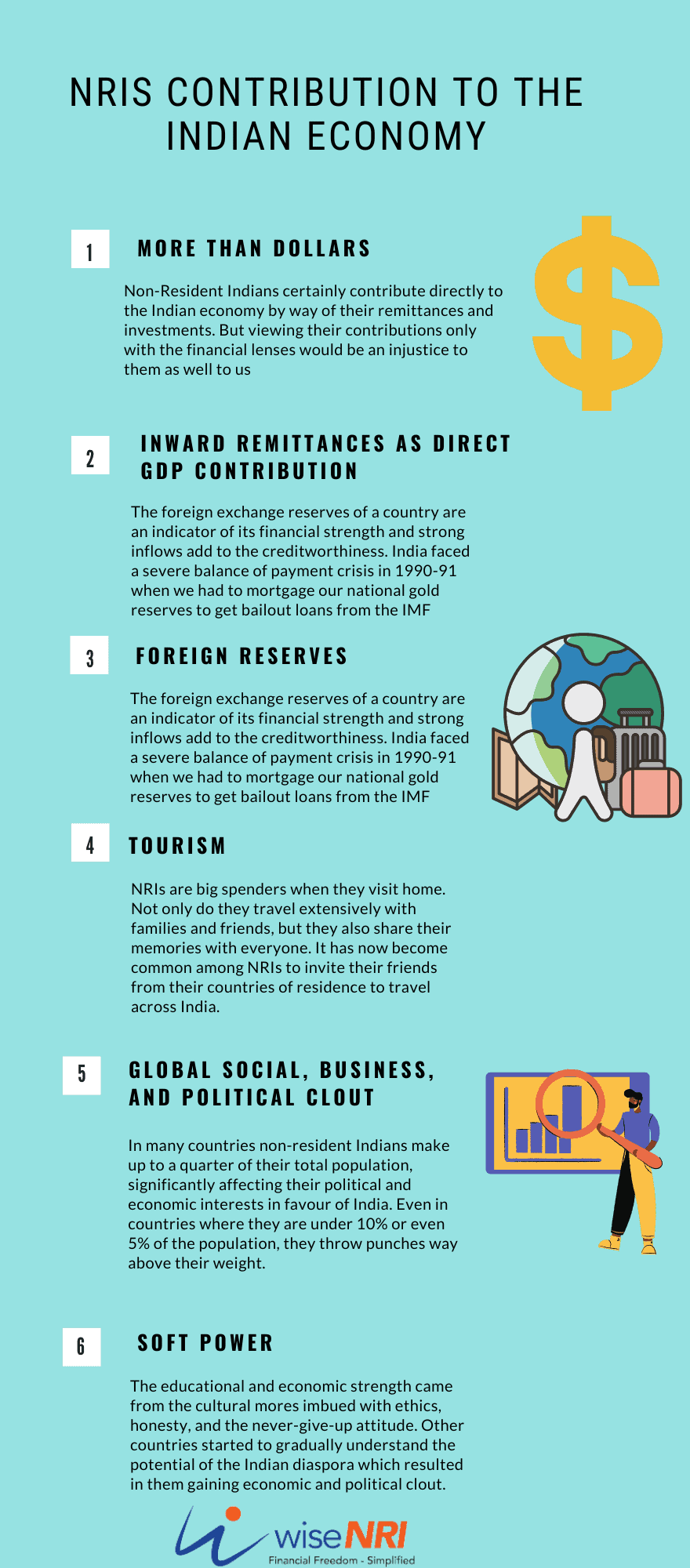
NRIs contribute directly to the Indian economy through remittances and investments, but viewing their contribution purely through a financial lens does them, and India, a genuine disservice. Their non-monetary contributions carry far broader reach than direct remittances alone.
Must Check: Outward Remittance
Inward Remittances as a Direct Economic Contribution
India has remained the world’s largest recipient of remittances for well over a decade. Inflows reached $135.4 billion in FY25, driven increasingly by skilled professionals in advanced economies rather than purely Gulf-based labor, a genuine shift in the composition of who’s sending money home.
That flow of remittances funds a genuinely wide range of things:
- Day-to-day household expenses
- Consumer durables and fixed assets like appliances, tractors, and vehicles
- Building or buying property
- Investing in equity, mutual funds, deposits, PPF, and bonds
Foreign Exchange Reserves
A country’s foreign exchange reserves reflect its financial strength, and strong inflows genuinely add to creditworthiness. India faced a severe balance of payments crisis in 1990-91, having to mortgage national gold reserves to secure IMF bailout loans. NRI remittances are one of the most reliable sources of foreign exchange inflows since, and India’s reserves have grown to over $700 billion as of early 2026, providing roughly 11 months of import cover.
Tourism
NRIs spend genuinely well when visiting home, traveling extensively with family and friends, and increasingly inviting friends from their country of residence to explore India too. Destination weddings, family functions, and religious ceremonies with international guests have grown into a real trend, giving a meaningful boost to India’s travel, tourism, and wedding economy alongside foreign exchange inflows.
Must Read: 6 Best Places to Retire in India, for NRIs
Global Social, Business, and Political Clout
In some countries, non-resident Indians make up a genuinely large share of the population, meaningfully shaping political and economic interests in India’s favor. Even where the diaspora is a small percentage of the population, its influence often punches well above its weight.
People of Indian origin have held some of the most senior political roles globally in recent years, from Kamala Harris as the first female US Vice President, to Rishi Sunak as the UK’s first British Asian Prime Minister, to Anita Anand currently serving as Canada’s Minister of Foreign Affairs. Indian-origin representation in parliaments across Canada, the UK, the US, and elsewhere has grown steadily.
Check: How Can NRIs Impact Social Development in India
Indians and people of Indian origin have led, and continue to lead, some of the world’s largest multinational companies, Satya Nadella at Microsoft and Sundar Pichai at Alphabet among the most visible examples, alongside a genuinely long list of others across technology, consumer goods, and finance.
Must Check: NRI Checklist
Soft Power
The educational and economic strength driving this influence traces back to cultural values around ethics, honesty, and persistence. Other countries have gradually come to recognize the depth of talent in the Indian diaspora, which has translated into real economic and political standing.
Indian soft power has genuinely deepened as NRIs celebrate festivals with enthusiasm in their local communities worldwide. Bollywood and Indian music enjoy a global audience, Indian cuisine now appears at Michelin-starred restaurants, and Ayurveda, yoga, and Indian spiritual traditions have found a genuinely wide global following.
Giving Back
NRIs give back beyond investments and remittances, supporting causes close to their hearts through charities, trusts, direct action, and financial intervention. The Dakshana Foundation, established by NRI investor Mohnish Pabrai, focuses on educational opportunity for meritorious students from financially weaker backgrounds, modeled on educator Anand Kumar’s celebrated Super 30 program.
NRIs have also mobilized during genuine national crises, from conflicts to humanitarian emergencies, most visibly during the COVID-19 pandemic, when thousands coordinated aid in the form of oxygen supplies, concentrators, and medicines during India’s severe second wave.
Thank You, NRIs
Indian Prime Minister Narendra Modi has said the world’s keenness to engage with India has risen, and that the diaspora can play a genuinely vital role in furthering that engagement. Successive Indian governments have recognized this, offering more tangible benefits to NRIs as a token of that gratitude.
NRIs have been, are, and will remain the sons and daughters of the homeland. They may leave India for many reasons, but they carry it with them regardless, showing that connection not through lip service, but through concrete, material contribution.
Frequently Asked Questions
Is India still the largest recipient of remittances globally?
Yes. India has held this position for well over a decade, with FY25 inflows reaching $135.4 billion, well ahead of the next largest recipients.
Has the source of India’s remittances shifted over time?
Yes, meaningfully. Gulf countries historically dominated inflows, but advanced economies like the US, UK, and Singapore now contribute a growing share, reflecting a shift toward skilled and professional migration.
Do NRIs have real political influence in their countries of residence?
In several countries, yes, genuinely. Indian-origin representation in parliaments and senior government roles across Canada, the UK, the US, and elsewhere has grown substantially over the past decade.
We cannot thank our NRIs enough for everything they continue to contribute to India, in ways that go well beyond what any single number can capture.
Distance changes an address. It rarely changes where the heart actually lives.
💬 Your Turn
How do you personally give back to India, financially or otherwise? Share in the comments.


If i move india what will happen to my NRI status Is there any RNOR status What is this
I am resident of Dubai since 1980. Now retired, want to move back to India. What happens to my investments and income abroad. Will the be taxable in India qnd what will be implactions
Dear Hemant,
I lost my father when I was only 14 years old. He had stomach Cancer. He sold a land to educate his first born who wanted to be an Architect. My elder brother who was is in a hostel came to his funeral and found out that there was “No pot of gold” for him so he told our mother who was only 39 years old – ” Poverty is a curse” and he had no responsibility towards other siblings and left us in the cold. I had to take a “Succession Certificate” for my mother and 4 brothers as my father didn’t make any Will in his lifetime. He only had a meagre Life insurance worth Rs. 4000/- it was meant for my elder sister’s dowry. I became defacto head of the Family and I went to my close relatives for advise how to survive and put food on the table. My mother’s older brother was a Chief Medical Officer in a Municipal Hospital & patients
who were rich so he was affluent. He told me to sweep floors in my father’s business premises subduing myself to his partner and write ledgers which my father was doing all his working life. When he passed his Master’s Degree from Calcutta University in 1927, he was offered a job as Asstt. manager in Imperial Bank but he refused to wear suits as he was a Bengali in ‘heart & soul’
I had to recover my father’s business from his partner ( that is a
complicated story) and ran the Building Materials business with the other servants who were very loyal & trustworthy. I managed to study and collected the “sales book” after school and entered
them in the ledgers and hen did my home work. Next morning left the sales book in the office then went to my school. Through hard work I finished my B.Sc Degree and secured a passport and went to British Consulate looking for “Job Voucher” so that I can become an Economic Migrant. I was lucky to pass “viva voce” and got my Visa. I left India in August 1962 and became a
NRI within 4 years after working in Schools as a Lab.Technician.
I sent money home within a month as I worked temporarily in a “Burger Joint” called “Wimpy” before “McDonald or Burger King”.
In my absence, my two younger brothers sold all our properties with an excuse they couldn’t collect the rental income so they sold them all with the help of my Brother-in-law whom I trusted with a Power of Attorney just in case of hardship in our family.
I was heart broken as I was sending my regularly, half starving
working whole day and attending “night school” to study other subjects to enhance my chances to get better job experiences.
My luck changed and I found a job in “New Scientist” and got a job in the Scientific Civil Service and promotion in 15 months.
My brothers leased two floors ( 6421 Sft.) State Bank of India @ 35 paisa per Sq.ft in Feb.1973 without doing market research !
I bought my house in Harrow in Nov.1973 for only £12000/- where Neheru went to The public School) there and raised a family. But still sent money home to my widowed mother until she passed away in 1985. I may be a NRI but a Bengali in heart & soul but when consulted a High Court Advocate in Kolkata, he advised me not waste my money against my brothers in Court as it is now the norm. In a civil case it could take 10 years. So
I had to appeal to the Chairman so that I get my share of rents.
Kind regards,
Suprakash