
Anil (name changed) inherited a 4,000 square foot plot outside Nashik from his father in 2009. He was in Sharjah. His cousin lived twenty minutes away and offered to keep an eye on it. Anil was grateful. He said yes, and he did not think about the plot again for a long time.
The cousin fenced it. Then he parked equipment on it. Then he paid the property tax, from his own account, because it was easier than asking Anil for the money each year. By the time Anil went to sell in 2024, the receipts, the electricity connection, the boundary wall and fifteen years of visible, uninterrupted use all pointed at one person, and it was not Anil.
Nobody in that story set out to steal anything. That is what makes it the most dangerous version.
⚡ Quick Answer
Indian law runs a clock against absent owners. Under Article 65 of the Limitation Act, 1963, someone in continuous, open, hostile possession of private immovable property for 12 years can claim ownership, and Section 27 extinguishes your right to recover it after that. For government land the period is 30 years. Protection is not complicated, but it is unglamorous: clear mutation and title records, property tax paid from your own account, a registered agreement with anyone occupying the land, physical evidence of your own possession, and a dated record of visits. Prevention costs a few thousand rupees a year. Litigation costs a decade.

Must Read – NRI Investments in Commercial Property
The Clock Nobody Tells You About
Most articles on this subject list precautions without explaining why they matter. Here is why.
Article 65 of the Limitation Act, 1963 gives you 12 years to sue for possession of immovable property based on your title. The clock starts not when someone enters your land but from the point their possession becomes adverse to you, meaning open, continuous, exclusive and hostile to your ownership. Article 112 stretches the same period to 30 years where government property is concerned. And Section 27 of the Act does something most owners find hard to believe when they first hear it: once the limitation period expires, your right to the property is not merely unenforceable. It is extinguished.
In 2019, in Ravinder Kaur Grewal v. Manjit Kaur, the Supreme Court went further and held that adverse possession is not only a defence. A person who has completed the period can file a suit to be declared the owner. What was a shield became a sword.
Read that again as an NRI. You do not lose land because you were cheated. You lose it because a clock ran while you were away, and nobody was required to tell you it had started.
⚠ The One Fact That Saves Most Cases
Possession with your permission is permissive, not adverse, and permissive possession never ripens into ownership on its own. A tenant paying rent, a caretaker under a signed agreement, a relative with a written arrangement: none of them are running the clock against you. The clock only starts when possession turns hostile, which means they openly deny your title. This is precisely why a one-page registered agreement with the person watching your land is worth more than a boundary wall.
Why NRI Property Is Targeted Specifically
The vulnerability is structural, not personal. You are not physically present. Your visits are predictable and infrequent. Local records are updated in an office you cannot walk into on a Tuesday afternoon. And crucially, your absence is visible to everyone in the neighbourhood long before it becomes visible to you.
Four situations account for almost every case I have seen. Vacant land with no boundary and no caretaker. Property left in a deceased parent’s name because mutation was never completed. A tenant who stopped paying and stayed. And a family member or friend given informal, open-ended control with nothing in writing.
That last one is the most common and the least discussed, because discussing it feels like an accusation.
Must read – How can an NRI Transfer Inherited Property Titles in India
How Property Actually Gets Taken
Tenants who overstay. Rent control and tenancy law were written to stop landlords from throwing families onto the street, and they do that job. The same protections shelter a tenant who has stopped paying and will not leave. An unregistered rent agreement makes your position dramatically weaker, because you may end up having to prove the tenancy existed at all.
Forged paperwork. Fabricated sale deeds, backdated agreements, and affidavits carrying a signature you never gave. Once a forged document is used to raise a loan or effect a sale to a third party, you are no longer arguing with one person. You are arguing with a bank, a buyer and a registrar.
Settlement pressure. The encroacher does not always want your land. Sometimes they want you to buy your own property back, or to sell it to them at a distress price to end the matter. It is extortion, and it works because a court date in Nashik is expensive when you live in Sharjah.
Check – NRI Legal Challenges
The Cheapest Protection Is a Receipt in Your Own Name
Here is the test I put to every client holding vacant Indian land. Ask yourself: for the last five years, whose bank account paid the property tax, and whose name is on the electricity connection?
Property tax receipts, utility bills and municipal records are the evidence a court weighs when deciding who has been in possession. If a caretaker or relative has been paying from their own account “to save the trouble”, they have been quietly building the exact documentary trail that supports a claim against you. Reimbursing them afterwards does not fix it, because the receipt carries their name, not yours.
Paying Rs 8,000 of property tax a year yourself, online, from your NRO account, is the single highest-return act of estate protection available to you. It takes four minutes.
Convenience is how ownership leaks. Not fraud.
The Protection Checklist
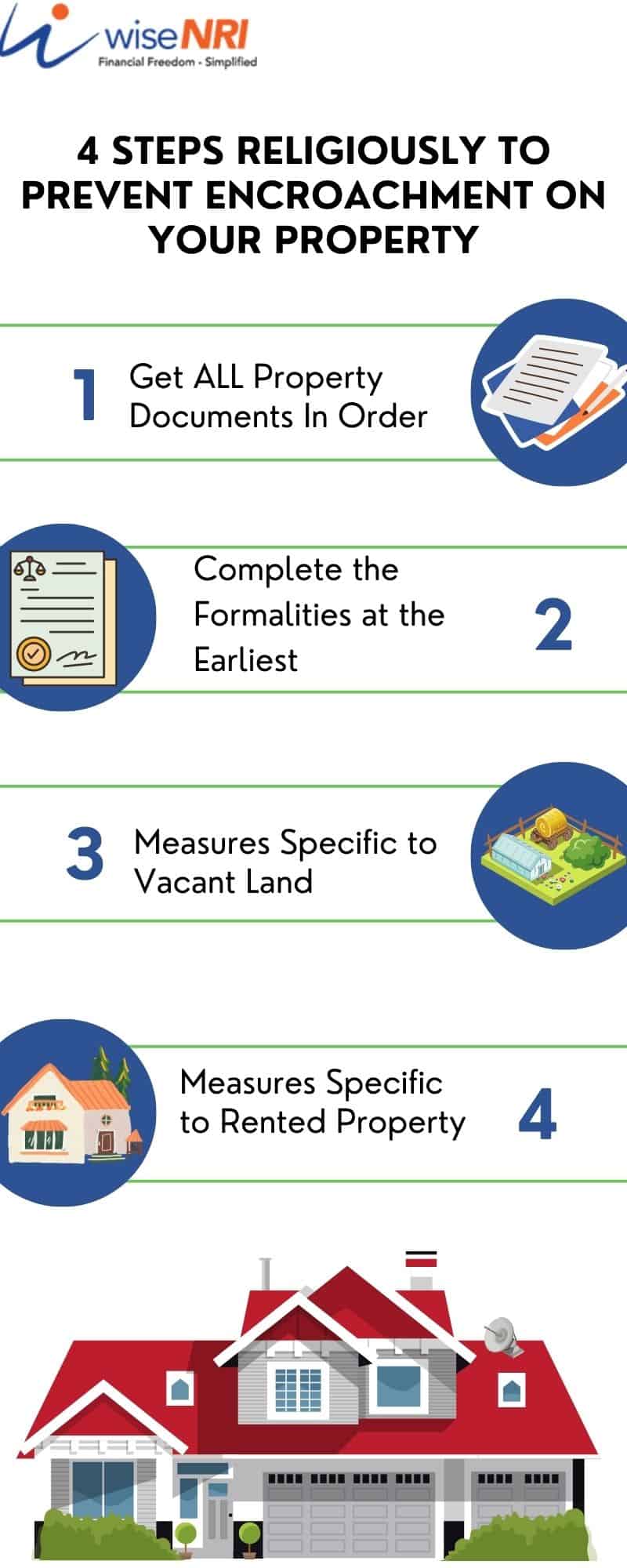
Get the records right, first. Complete mutation in your name at the revenue or municipal office the moment you acquire property by purchase, gift, will or inheritance. Hold the title deed, and if it is lost, file an FIR immediately. Obtain certified copies from the registrar and revenue office of the sale deed, the will and relationship documents where inherited, tax receipts, and the record of rights (jamabandi in the northern states, the 7/12 extract in Maharashtra and Gujarat). Keep scanned copies with your advisor as well as with family.
For vacant land. Build a boundary wall and put up a signboard with your name on it, because visible assertion of ownership is legally meaningful, not decorative. Hire a caretaker through an agency, on a written and registered agreement, with police verification. Visit and photograph the plot each time you are in India, and keep the dated photographs. Check the satellite view periodically for construction you did not authorise. And issue only a Special Power of Attorney, limited to one transaction and one property, never a general one.
For rented property. Register the lease, or at minimum have it notarised, and renew it on time rather than letting it drift into a month-to-month understanding. Get police verification of the tenant even when you know the family. Issue receipts for every payment. Treat delayed rent as a signal rather than an inconvenience, and get the reason in writing. If a prospective tenant resists a written agreement because you “know each other”, that is your answer.

Must check – Why NRIs Should Consider Buying a House in India
Holding Indian property you have not physically seen in years?
We help NRI families audit what they actually own, what is documented, and what is quietly at risk, before it becomes a court matter.
If It Has Already Happened
Move quickly, because every month of inaction feeds the other side’s case.
File a police complaint or FIR straight away. Criminal trespass and related offences now sit under the Bharatiya Nyaya Sanhita, 2023, which replaced the Indian Penal Code from July 2024, so make sure your advocate is citing the current provisions. Alongside the criminal complaint, your civil remedies run through the Specific Relief Act, 1963: a suit for possession, and where you were dispossessed within the last six months without due process, the faster summary route under Section 6.
Send a written legal notice, so that the date on which you asserted your title is recorded. Do not negotiate alone or over the phone. Every conversation with an occupier should happen through your advocate, because informal settlement talk is routinely produced later as evidence that you acknowledged their position.
Why Sensible People Skip All of This
Anil is not naive. He runs a logistics operation in the Gulf and would never let a contract go unsigned there. So why no agreement with his own cousin?
Because of what behavioural researchers call in-group trust bias, the tendency to extend far higher trust, and far lower verification, to people inside our own circle. In Indian families this is amplified by something sharper. Asking a relative to sign a caretaking agreement does not feel like prudence. It feels like an insult. So the paperwork is skipped, not out of laziness, but to avoid a moment of awkwardness that would have lasted ninety seconds.
The awkwardness you avoid is small and immediate. The consequence you accept is large and twelve years away. That asymmetry is why this particular mistake repeats across every generation of NRI families I have worked with.
Frequently Asked Questions
Can someone really take my land just by occupying it?
Yes, in law. Twelve years of continuous, open, hostile possession of private property can extinguish your right to recover it under the Limitation Act, 1963. The occupation must be adverse, not permissive.
My tenant has been there fifteen years. Can he claim ownership?
Not merely by staying. A tenant occupies with permission, so the clock does not run. It only starts if he openly denies your title and stops acknowledging you as owner, which is one more reason to keep the lease renewed and the receipts issued.
Should I give my brother a general power of attorney?
Avoid it. Use a Special Power of Attorney limited to one specific transaction, one property, and a defined period. A general POA hands over authority you will find difficult to withdraw from another country.
Is a boundary wall enough for vacant land?
It helps, but records matter more than bricks. Mutation in your name, property tax receipts in your name, and a registered caretaker agreement carry far more weight in court than a wall does.
Does a public notice in a newspaper actually protect me?
It is useful supporting evidence that you asserted your title publicly on a given date. It is not a substitute for clean revenue records, and it will not by itself defeat a well-documented possession claim.
Can I sell property that is currently encroached?
Practically, no. Buyers and their lawyers will not clear a title with an occupant on it. Clearing possession comes first, which is why prevention is not a nice-to-have but the entire strategy.
Land is not lost in a single dramatic moment. It is lost in the ninety seconds you decided not to ask a relative for a signature.
Distance is not the risk. Silence is.
💬 Your Turn
Whose bank account paid the property tax on your Indian land last year? If you had to check, that is worth telling us about below.



I would like to secure my property in India as being an NRI their are locals and local authorities who are troubling me in illegal way
My father died and my brother get the land and house on his name.I am now citizen of Australia.Please guide.
Hello dear Sir/ Mam Please let me know about the process to complaint about property in India as NRI which is illegally occupied.
I have a caretaker on my agricultural land. Can he register as a farmer?