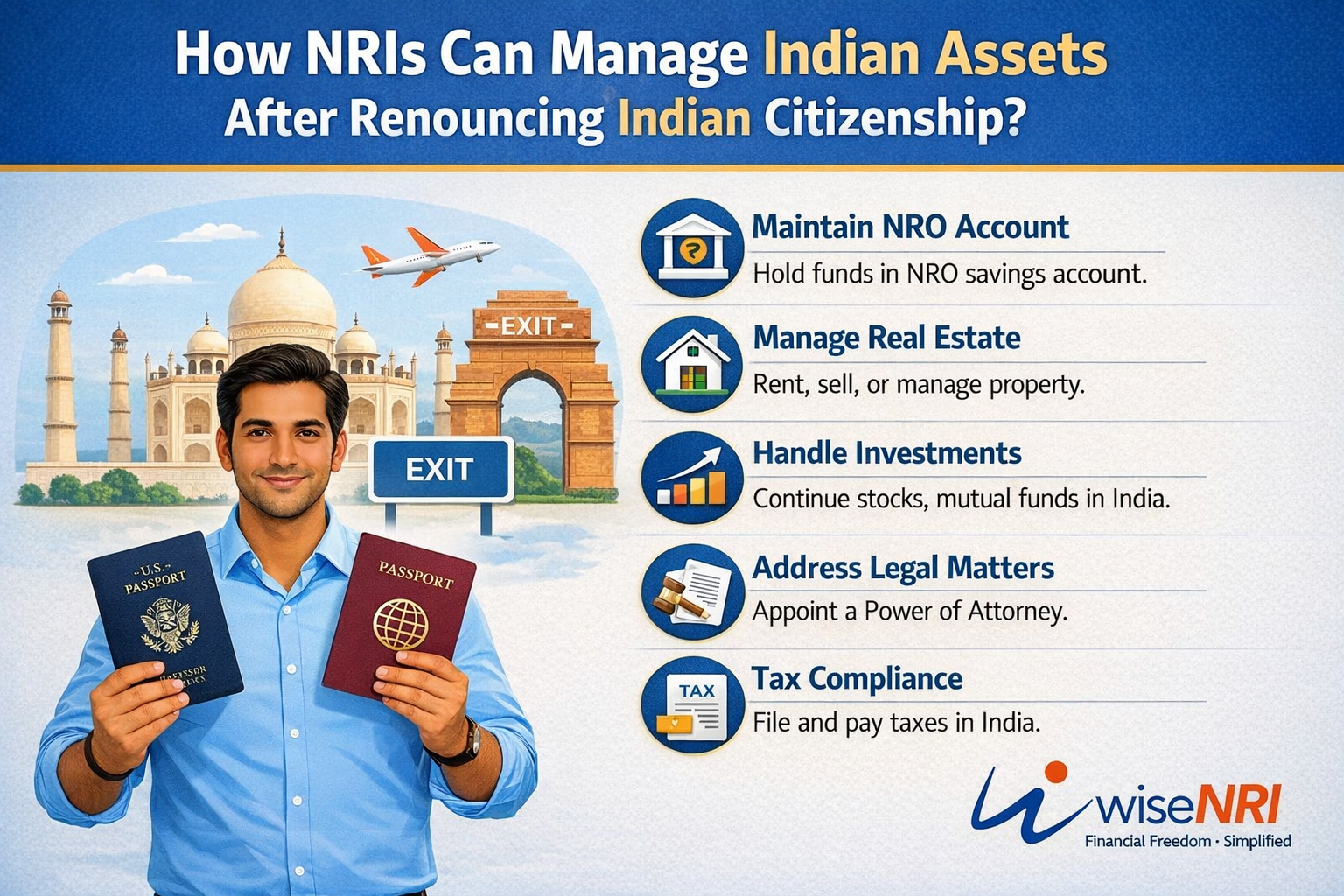
Arjun (name changed), a Bangalore-born engineer who took Canadian citizenship in 2019, called me last year in a mild panic. He had just renounced his Indian passport, and nobody had told him what happens to the NPS account he had been contributing to since 2014. “Is that money just gone?” he asked. It was not gone. But it was sitting in limbo, and he had no idea how to move it.
Arjun’s confusion is common. Giving up Indian citizenship is often an emotional decision made for practical reasons, a second passport, easier travel, a child’s future. What people rarely plan for is the paperwork that follows: what happens to the property, the bank accounts, the NPS corpus, and the demat account you built as a resident.
⚡ Quick Answer
Once you renounce Indian citizenship without holding an OCI card, you become a foreign national under Indian law. Your NPS account is closed and the corpus moves to your NRO account. Your resident savings account must convert to NRO, and any Demat account needs to move to a PIS structure for further trading. You can keep property acquired while resident, but cannot buy fresh property unless you hold an OCI card and follow its specific rules, and agricultural land stays out of reach either way. Since April 2026, the OCI registration, renunciation, and cancellation process has moved fully online under the Citizenship (Amendment) Rules, 2026, which genuinely speeds up what used to be a slow, paper-heavy process.
Must Read: NRIs Working Remotely for Indian Companies
What Renunciation Actually Changes
Renunciation of Indian citizenship is the voluntary act of giving up your Indian nationality, almost always after acquiring citizenship elsewhere. Once it happens, Indian law is unambiguous: you lose voting rights, you cannot hold an Indian passport, you lose certain government privileges, and you are treated as a foreign national on Indian soil.
For NRIs, the financial consequences are where this gets complicated, touching property, taxation, investments, and banking all at once.
1. Your NPS Account Gets Closed, Not Frozen
If you have renounced Indian citizenship and do not hold an OCI card, PFRDA rules require your NPS account to be closed the day you cease to be an Indian citizen. The accumulated corpus moves to your NRO account, subject to the FEMA guidelines the RBI has laid out. You will need to submit an undertaking confirming the renunciation and the absence of an OCI card, along with valid proof, your surrender certificate or a cancelled Indian passport. The NPS Trust and the Central Recordkeeping Agencies verify the documents before releasing the corpus, and once it lands in your NRO account, the credited amount and any interest earned are taxed at your applicable slab rate.
PFRDA tightened this process in 2025 specifically for subscribers who renounce citizenship without an OCI card, so if you are planning this transition, start the paperwork before you actually renounce, not after.
2. Real Estate: What You Keep, What You Cannot Buy
Once you renounce, you are a foreign national resident outside India, and as one, you cannot purchase fresh immovable property in India unless it comes to you by inheritance from someone who was resident in India.
Property you already owned as a resident is different. You can sell it to a resident Indian, provided you comply with foreign exchange rules in both countries, and you hold a valid visa and proof of identity and ownership. If travelling to India is not practical, a Power of Attorney handles the transaction on your behalf. Sale proceeds can be repatriated to your current country of residence, but check the tax rules on both ends before you move the money.
Must Check: Can an NRI buy agricultural land in India?
Holding an OCI card changes the picture meaningfully, and this is where the 2026 rule update matters directly. If you are an OCI cardholder and not a citizen of Pakistan, Bangladesh, Sri Lanka, Afghanistan, China, Iran, Nepal, Bhutan, Macau, Hong Kong, or North Korea, you can buy residential and commercial property (agricultural land, farmland, and plantations remain off-limits), gift property to a resident Indian or another OCI holder, and retain inherited property including agricultural land, which can be sold to a resident Indian with proceeds credited to your NRO account.
The paperwork has actually gotten faster this year
Since 30 April 2026, the Citizenship (Amendment) Rules, 2026 have moved OCI registration, renunciation, and cancellation entirely online through the government’s e-OCI portal. Applicants no longer need to submit physical forms for most of this process, and existing OCI cardholders renouncing that status can now file a declaration and complete most of the surrender digitally rather than through a Foreigners Regional Registration Office visit. This does not remove the underlying tax and FEMA obligations discussed above, but it does mean the administrative half of the process, which used to take months, is now considerably faster for clients who were previously stuck waiting on paperwork.
Faster paperwork is not the same as fewer decisions. Sort out your NPS, banking, and property status before you file, not while you are waiting for the portal to process it.
3. Bank Accounts Need Reclassifying
Once renunciation is complete, resident savings accounts must convert to NRO accounts, and you may open or retain an NRE account if you remain eligible. Interest earned in the NRO account stays taxable in India. Skip this step and you risk FEMA non-compliance, which is a genuinely avoidable headache.
4. Investments: The PIS Route Becomes Mandatory
A resident Demat account cannot be used for trading on the Indian stock market once your status changes. You will need a Portfolio Investment Scheme (PIS) account instead, which permits delivery-based trades only, with restrictions on intraday trading and currency derivatives. Gains and repatriation route through your NRE or NRO accounts depending on the original funding source, and the income is taxable based on the holding period and instrument type.
Do not assume Indian tax treatment is the whole story. Check your country of residence’s rules too. Residents of Australia, for instance, are taxed on worldwide income including capital gains realised anywhere, and relief for tax already paid in India is generally claimed under the applicable DTAA, with proper documentation.
Renouncing citizenship soon and unsure what happens to your Indian assets?
We help NRIs sequence their NPS closure, account conversion, and PIS setup correctly, before the paperwork forces a rushed decision.
Why People Delay This Paperwork (And Why It Costs Them)
There is a specific behavioural pattern behind why so many NRIs, like Arjun, wait until after renunciation to think about the NPS account or the Demat conversion. Psychologists call it the ostrich effect, the tendency to avoid information about a decision once it feels final and irreversible. Renunciation feels emotionally closed, so the financial admin that should follow it gets pushed to “later,” and later often means months of an NPS account sitting closed with the corpus stuck, or a Demat account that cannot legally transact.
The fix is almost mechanical: treat the renunciation date as the start of a checklist, not the end of one. NPS closure, account conversion, and PIS setup are not optional add-ons. They are the second half of the same decision.
A Practical Sequence, Not a Random Checklist
- File the NPS closure undertaking and documents before, or immediately after, renunciation, not months later.
- Convert resident bank accounts to NRO the same week your status changes.
- Open a PIS account before attempting any further stock market transaction.
- Confirm which of your Indian properties you can sell, retain, or gift under your new status, especially if you hold an OCI card.
- Check your country of residence’s tax treatment of Indian income and gains before you assume DTAA relief will simply apply.
Giving up an Indian passport is, for most people, an emotional decision wrapped around a practical one. It does not have to mean losing your connection to India, or losing control of what you built here. It means staying informed, keeping the paperwork current, and getting proper advice before, not after, the fact.
The passport changes. What you built in India does not have to be at risk because of it.
💬 Your Turn
If you have renounced Indian citizenship, or are considering it, what part of the financial transition worries you most: the NPS corpus, the property, or the tax filing? Tell us where you are stuck.