
A reader once told me her retirement number in her early 30s: Rs 5 crore, no hesitation. By her mid-40s, with more clarity on lifestyle and inflation, that number had drifted to Rs 15 crore. Neither answer was wrong. It’s simply that “how much is enough” changes with you, which is exactly why waiting for certainty before you start saving is the one mistake that’s genuinely hard to undo.
Retirement planning throws up real dilemmas for everyone. For NRIs, there’s an extra layer on top.

Must Check – Retirement planning for NRIs
The Questions Everyone Wrestles With
- What is retirement, really? For some, it’s the natural slowdown after 30-40 years of work. For others, it’s simply the point where you no longer work for money, only for pleasure, and that point can arrive far earlier than a fixed age.
- When is the right time? A specific age, the point you can no longer find work, or whenever mind and body genuinely allow you to keep going?
- Where do you retire? The city you built your career in, or your hometown, and what does each choice actually cost you in adjustment?
- How long does retirement actually last? Better healthcare means genuinely more people living into their 90s and beyond, retirement is a break from the 9-to-5, not from life itself, and the corpus needs to reflect that.
Check – Best Places To Retire In India
The NRI-Specific Layer
On top of all this sits the defining NRI dilemma: retire in your country of work, or come home to India? Developed economies typically offer superior lifestyle, education, career runway, and healthcare, but genuinely lack the family and friend support network many people want in their later years, and the cost of living runs considerably higher too.
The purchasing power arithmetic that makes India the great equalizer
A middle-class NRI couple in the US or UAE can genuinely retire among India’s top earners, purely because of the currency gap. At current levels, the nominal exchange rate sits around Rs 88-90 to the dollar, but on a purchasing power parity basis, the effective conversion is closer to Rs 20 per international dollar, meaning a dollar buys roughly four times more in everyday Indian goods and services than the nominal rate alone suggests. The gap narrows considerably on imported and luxury goods due to duties, but for daily living, healthcare, and hired help, it holds up strongly.
Must Read – How much is enough to retire?
Why Time Genuinely Beats Everything Else
Your retirement outcome depends on your present habits and choices far more than on luck, though luck plays some role too. The one factor that consistently minimizes volatility and bad timing, more reliably than any single investment decision, is time.

Must Read – Why Should NRIs Save For Early Retirement
What Time Actually Buys You
Rising income
Appraisals, job switches, business growth, consulting, even inheritance, income tends to grow over a career, an advantage no single rate of return can replicate.
A wider saving window
Fewer responsibilities early in a career mean more room to save first and spend later, precisely when compounding has the most years left to work.
Genuine compounding
Earning returns on your returns, not just your principal, is what Einstein reportedly called the world’s eighth wonder, and it needs years, not months, to show up.
Volatility that smooths out
Equity is genuinely volatile short-term, but held in quality funds or stocks over the long run, that volatility tends to flatten into a real upward curve.
Must Read – NRIs should consider before buying a gadget abroad
What the Numbers Actually Show
Time in the market consistently beats timing the market. Using a simple 8% long-term return assumption (before taxation and inflation, to keep the comparison clean), three patterns show up clearly:
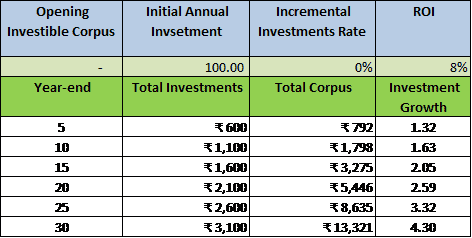
Rs 100 annual investment @ 8%, no initial corpus, no incremental increase
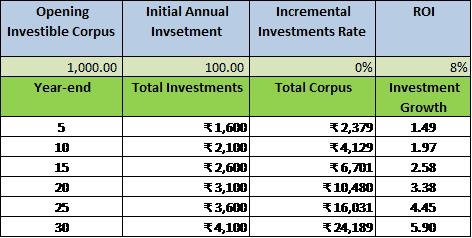
Rs 100 annual investment @ 8%, Rs 1,000 initial corpus, no incremental increase
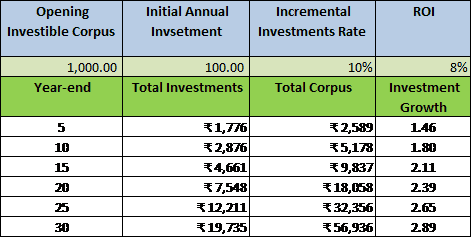
Rs 100 annual investment @ 8%, Rs 1,000 initial corpus, 10% annual incremental increase
In every case, the real gains show up in the back half of the investment period, not evenly across it. Waiting even a few extra years to start doesn’t just delay the outcome, it removes precisely the years compounding needed most.
As Warren Buffett put it, “Our favorite holding period is forever.” There’s real reward waiting at the far end of this, provided you have the patience to sit through the ups and downs along the way.
If you’re looking for proper retirement planning to live the life you deserve – TALK TO US
Not sure how much time is actually on your side?
We help NRIs turn “how much is enough” into a specific number, and a specific plan to get there.
Time is the one retirement asset you can never buy back once it’s gone.
💬 Your Turn
Has your own retirement number shifted over the years the way it did for the reader in this post? Share how and why.


how many years i can keep the NRI Deposit under RNOR status