
Deepak asked me last month why his LIC agent kept pushing “Amulya Jeevan” for his term cover. Amulya Jeevan was discontinued back in 2019. His agent was either working from a stale script or steering him toward something else entirely. Either way, it’s a good reminder to verify plan names before buying, not after. (name changed)
⚡ Quick Answer
NRIs can buy life insurance in India, both new policies and continuing existing ones from before their NRI status changed. Term insurance, pure protection with no maturity payout, is generally the best value, at some of the cheapest rates globally. Section 80C gives a deduction of up to Rs 1.5 lakh on premiums, but only under the old tax regime. Death benefits are tax free and payable worldwide, though repatriation abroad is capped at the portion of premium originally paid in foreign currency.
As financial advisors, we regularly see NRIs with diversified investments who never got around to insurance in their country of residence, often because insurance abroad, in the USA, UK, Singapore, or the Middle East, comes with stricter underwriting and higher costs.
Buying solid life insurance in India remains a genuine option for NRIs. Policies taken out before your status changed to NRI stay in force, and you can also buy new or additional cover afterward.

Must Read: Health Insurance For NRI
Benefits of Buying Life Insurance as an NRI in India
NRIs get real advantages buying from an Indian insurer:
- Among the cheapest premium rates globally, developed or developing markets.
- Multiple policy structures to fit different financial plans.
- A proactive IRDAI and a reasonably strong institutional framework that favors policyholders.
- The backing of well established, reputable Indian brands.
- A real way to secure your family’s financial interests, in India or wherever they are with you, through inheritance planning.
Types of Life Insurance Available to NRIs in India
| Type of Insurance | Objective |
| Endowment Policy | Builds a fund for you and your dependents, payable on maturity or death. |
| Money Back Policy | Periodic payouts plus insurance cover. |
| Retirement Plans | Builds a retirement corpus for an annuity or lump sum. |
| Investment Plans | Focused on long term investment returns. |
| Term Life Insurance | Pure protection, the largest cover for the lowest cost, but no payout if you outlive the term. |
| Unit Linked Insurance Plans | Combine equity or debt investment exposure with insurance. |
| Whole Life Insurance | Cover until death, with optional periodic payouts and a maturity benefit if you live past 100. |
Our consistent advice: at minimum, buy a solid term insurance plan, pure protection at some of the cheapest premiums anywhere in the world. We generally don’t recommend mixing insurance with investment through the other policy types above.
Must Check: Beware of Rampant Mis-selling of Expensive Insurance to NRIs
Buying Life Insurance as an NRI
You can buy on your next visit to India, or work with a financial advisor to compare and buy online from an Indian insurer. The online route usually needs verification through the Indian Embassy.
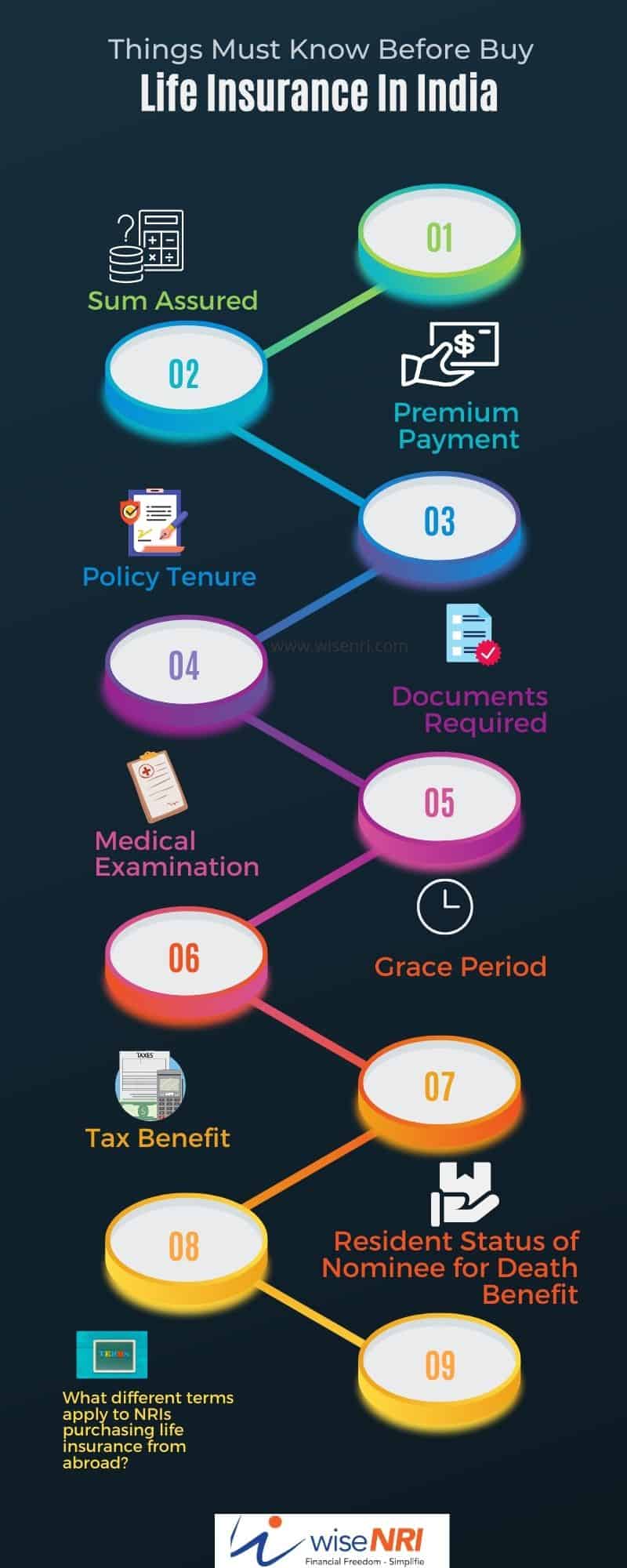
Here’s what you need to know before taking out a policy.
1. Sum Assured
LIC’s minimum sum assured is Rs 10 lakh, though many private insurers start lower, around Rs 2 lakh. The maximum depends on multiple factors and can run into several crores.
2. Premium Payment
Premium depends on your age and health at entry, payment frequency, sum assured, and any riders. Term insurance carries the lowest premiums, since it’s pure protection with minimal administrative overhead.
Policies are denominated in INR, but you can pay premiums in foreign currency, or through online banking or an ECS mandate linked to your NRE or NRO account.
Family members or your financial advisor in India can also handle timely premium payments on your behalf if that helps keep things simple.
3. Policy Tenure
Tenure ranges from 12 months to 25 years depending on the policy type. Entry age is generally between 18 and 60.
Must Check: How NRIs can complete KYC for Mutual Funds
4. Documents Required
NRIs typically need some additional documentation beyond what resident Indians provide:
- If applying in India: self attested passport copy, medical check up report, income proof, OCI or PIO card if applicable, foreign address proof such as a recent utility bill, residence permit, or bank statement, and any other document requested.
- If applying from abroad: the above documents, endorsed or attested by the Indian Embassy or Consulate.

Check: 10 Best NRI Investment Options in India
5. Medical Examination
Depending on lifestyle, health history, and age, a medical check up may be required. NRIs visiting India can typically complete this at a doctor or diagnostic center at no additional cost.
If you’re abroad when applying, many insurers accept a standardized medical report from a registered health practitioner, following prescribed formats. The report usually needs Indian Embassy attestation, and you’ll bear the cost of the examination yourself.
6. Grace Period
For 6 or 12 month premium frequencies, the grace period is typically 15 days past the due date before the policy lapses. Confirm the exact grace period on your specific policy, as it can vary.
7. Tax Benefit
The 80C Deduction Only Works Under One Regime
Section 80C offers up to Rs 1.5 lakh in deductions on life insurance premiums, same as for resident Indians. But this only applies if you’re filing under the old tax regime. Since the new regime is now the default, don’t assume this saving into your tax planning until you’ve confirmed which regime you’re actually filing under.
The deduction is real. Whether it applies to you depends on a choice you may have made without realizing it.
Under the old regime, this deduction can meaningfully reduce your tax liability on income earned in your NRO account. Maturity and death benefit payouts are tax free in India regardless of regime, though you should separately check the tax rules in your country of residence.
8. Nominee Residency and the Death Benefit
NRI life insurance covers death anywhere in the world, with standard exceptions for war zones or high risk activities. The nominee’s residency status doesn’t affect payout eligibility. The death benefit gets credited to the beneficiary’s NRO account, in the currency specified in the policy.
Repatriation abroad, though, is capped at the portion of the premium that was originally paid in foreign currency, not the full benefit amount.
Must Read: Gift by NRI to Resident Indian
9. Additional Steps for NRIs Buying From Abroad
NRIs visiting India when they buy are treated the same as resident Indians. Buying from abroad involves a few extra steps:
- Get a medical examination report from a registered healthcare provider, in the required format.
- Purchase the policy through the insurer’s NRI or “mail order business” channel.
- Get the policy document notarized at the Indian Embassy.
Many insurers now offer fully online purchase, which simplifies this considerably. Some also work with local partners who sell India linked policies denominated in local currency.
Term Insurance Options for NRIs
NRIs are eligible for standard Indian term insurance plans. A few current options worth comparing:
- ICICI Pru iProtect Smart
- HDFC Life Click 2 Protect Super
- Max Life Smart Secure Plus
- LIC New Tech Term (online) or LIC New Jeevan Amar (offline), which replaced the discontinued Amulya Jeevan and Anmol Jeevan plans
Compare premiums and claim settlement ratios directly with each insurer before deciding, since these change periodically.
Frequently Asked Questions
Can NRIs claim Section 80C on life insurance premiums under the new tax regime?
No. Section 80C, like Section 80D, isn’t available under the new regime. It only applies if you’re filing under the old regime.
Is the full death benefit repatriable to my country of residence?
No. Only the portion equal to premiums paid in foreign currency can be repatriated; the rest stays in the beneficiary’s NRO account.
Is LIC Amulya Jeevan still available for NRIs to buy?
No, it was discontinued in 2019. LIC’s current term offerings are New Tech Term (online) and New Jeevan Amar (offline).
One of the biggest lessons in recent years has been that misfortune strikes without warning. You can never be fully prepared, especially when it comes to your family’s financial security. Adequate life insurance, at least for the primary earner, remains one of the simplest ways to protect against that.
With decent cover in place, you can genuinely tell your family you’ve handled this, even for the day you’re not around to say it yourself.
Want to talk through your family’s financial security?
Let’s review your current cover and whether it’s actually enough.
💬 Your Turn
Still have questions about NRI life insurance? Add them in the comments and we’ll answer directly.


Please let me know about employer employee scheme if LIC and partnership insurance! Thanks
If I understood right when you say ” …. NRIs have assorted investments, but they fail to take out an insurance policy in the country of their residence.” you mean the country of Residence (i.e outside India in case of NRIs) and not country of Origin (India). And you are suggesting that NRIs can buy life insurance cover in India , if insurance cover overseas is costly. Am I right?