
A client once told me, with total confidence, that he didn’t need to plan for retirement because his Bangalore flat would generate enough rent to live on. It wouldn’t. Rental yields in most Indian cities run 2-3% a year, well below inflation, and “the flat will cover it” is one of the most common, and most costly, retirement misconceptions I hear from NRIs.
Retirement planning gets genuinely harder from a distance. Losing daily touch with India’s real cost of living, expense patterns, and economic shifts makes it easy to plan against a version of the country that no longer exists. Here’s a structured way through it.

Check – NRI retire early using the FIRE Method
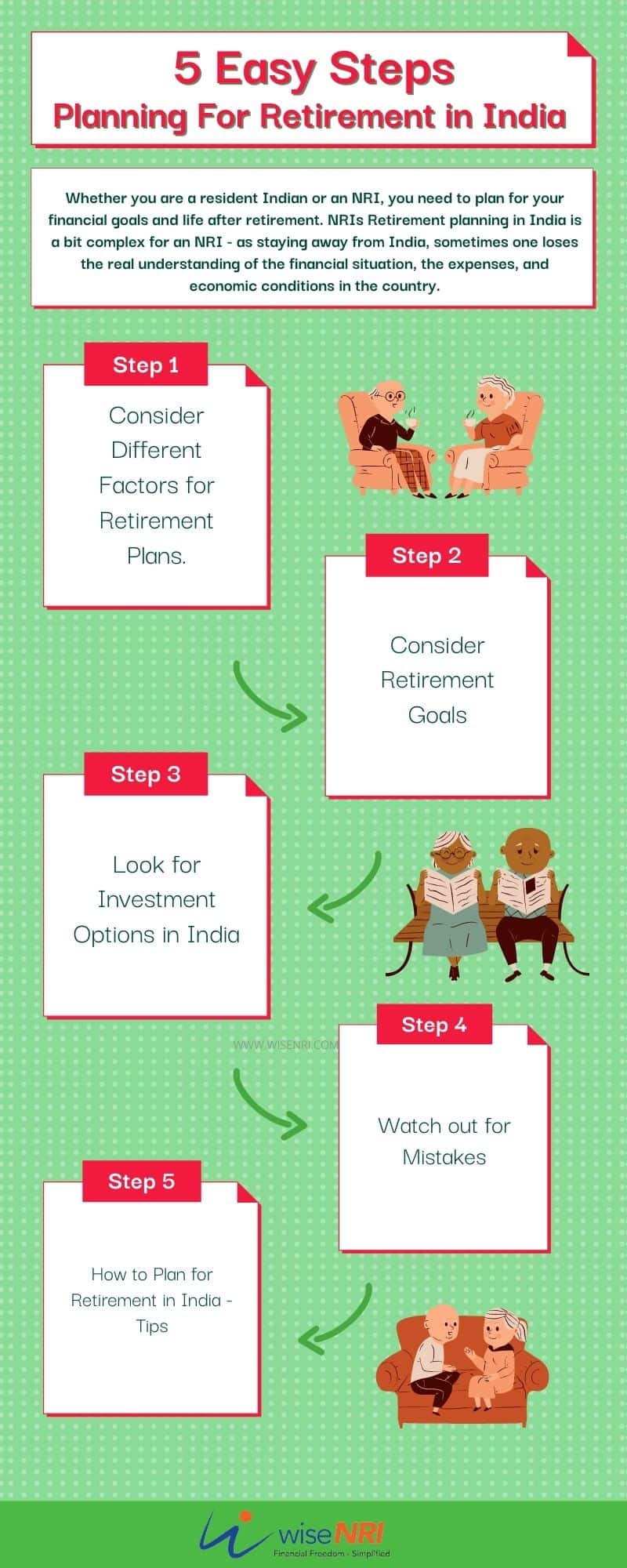
Answer When, Where, and How Honestly
When: some NRIs take an assignment for a fixed few years, others plan to work until formal retirement age, and either is fine, provided the corpus target matches the actual timeline, not an assumed one. If your children are studying abroad, factor their genuinely higher education costs into the plan separately from a return-to-India scenario.
Where: a metro like Mumbai or Bangalore costs meaningfully more to live in than a Tier-2 city or your native village, but also offers better medical access and modern conveniences. The right answer depends on your priorities, not a default.
How: part-time work, social or community involvement, or caring for aging parents all shape where you should actually live, sometimes more than cost does.
Check – Mr. NRI – How Much Retirement Corpus Is Enough
Get Specific About Retirement Goals
A palatial house with staff and a simple life spent reading and doing yoga require genuinely different corpus sizes. Finalise your actual plans, not a vague sense of “comfortable,” before deciding where to retire, since the goal should drive the location choice, not the reverse.
Check – Should NRIs Retire In Dubai
Know What You Can Actually Invest In
| Avenue | What to Know |
|---|---|
| Mutual Funds | Open to most NRIs; NRIs in the US and Canada face restrictions at several AMCs due to FATCA compliance, though a number, including ICICI Prudential and SBI Mutual Fund, still accept US/Canada investors, typically via offline processes. |
| Direct Equity | Via a Demat account linked to your NRE or NRO account. Suits investors comfortable doing their own research; otherwise, the mutual fund route with professional management is the simpler path. |
| Fixed Deposits | NRE and FCNR deposits offer tax-free interest, low risk, and genuine predictability. |
| NPS | Open to NRIs and OCIs, with its own contribution and withdrawal rules worth understanding fully before committing. |
| Real Estate | Residential and commercial property allowed; agricultural land, farms, and plantations are not. Managing property from abroad is genuinely hard; a trusted power of attorney holder is close to essential. |
⚠ The “My Flat Will Cover It” Trap
Rental yields on Indian residential property typically run 2-3% annually, well below long-run inflation. Treating a rental property as a full retirement plan, rather than one component of a diversified portfolio, is one of the most common and most expensive misconceptions NRIs carry into retirement.
Must Read- Why Should NRIs Save For Early Retirement
Watch for These Three Mistakes
- Waiting for a bonus or a target amount before investing. Every delay costs compounding time you can’t get back; invest at every real opportunity, not just the big ones.
- Ignoring the inflation rate where you’ll actually retire. Inflation dynamics differ meaningfully by country; plan against the rate where you’ll actually be spending, not a generic assumption.
- Misjudging investment risk. India’s growth story is real, but so are currency risk, global-factor spillover, and cyclical volatility. A genuinely diversified portfolio protects against all three at once.

Must Check – Importance of pension plan for NRIs
Three Habits Worth Building Now
- Budget generously, not optimistically. Retirement typically brings new expense categories you don’t carry today; underestimating the kitty needed is a common, avoidable error.
- Keep documentation current. KYC, bank accounts, PIS accounts, Demat, and trading accounts all need to stay updated for genuinely hassle-free investing.
- Don’t rely solely on your bank for advice. A wealth manager or independent financial planner gives you an unbiased second opinion your bank has no incentive to provide.
“NRIs have to pay attention to currency movements, legal aspects of investing in India and abroad, and taxation in both India and their country of residence, to have a smooth transition to retirement and actually achieve retirement goals.”
Ready to move past assumptions and into an actual plan?
We help NRIs build a retirement plan grounded in India’s current cost of living, not a version of the country they left years ago.
Whether resident or NRI, financial planning matters. Distance just makes it easier to skip.
💬 Your Turn
Have you fallen into the “my property will fund retirement” assumption, or caught it in time? Share your experience.


If I live about 9 months in India do I have to file tax returns in India or my home country filing (Canada) is good enough?
Can an NRI open a new saving account in India if he already has an NRI acct ?
Very useful content….pls keep sharing…
Thanks Satish Ji
I have an EPF which is not having any Credit for last 5 years and it may be in dormant status. I would like to withdraw it and need some assitance
what are process / steps to become NRE to PNOR to maintain the NRE FDS status quo
i have become an RNOR three weeks ago. i have NRE FDs. 1.can i continue to hold them – for how long. 2. is the interest on thesse from date of RNOR taxable?
Hi Sangameswar . Can you write me the process / steps to become RNOR ?
I retired in Nov’2020. I might move abroad permanently this year, unless I don’t get a visa. I am 54 years old. The interest is good, should I try and get the interest or should I withdraw and close the account. Can I start the withdrawal process after I get the visa, since it is said that it takes 2 weeks to get the amout transferred?
Taxation in USA for Indian recently moved from India
can an nri kyc be done online
Hi Rohan,
Check this https://www.wisenri.com/nri-kyc-for-mutual-fund/
I am regular reader of your articles. It is very informative and useful. I am doing my financial planning personally but I am not very much satisfied. I think that financial planning by professionals are better but may not be cost effective.
Thanks Dr Anil for appreciating our effort.
Don’t you think the same cost applies to any other profession – be it architect to doctor? It’s important to see cost Vs Value.
Very informative
Thanks Radhika
Great article, specially understanding RNOR status. Shall get back to you later for retirement planning.
Thanks for appreciating 🙂
Hi Dipankar,
In my suggestion, you need to keep balance allocation of equity and debt and reallocate it when reaches retirement. You must consult your financial planner regarding this.
I am an NRI from Middle East. I am already 51 . What is the best investment ( low risk and guaranteed ) instruments and how much needs to be invested to get 1 lakh per month as return after 9 years ? I have my own house at Vadodara after retirement. Thanks
Dear Hemant,
Thank you so much for your highly balanced article on NRI retirement and investment. I truly appreciate you / wisenri for the efforts to bring in quality information when in need. I am a NRI living in Middle East, never planned finance properly, now decided to return to India. With my family of 5, I believe I need at least 50k per month to manage, apart from other medical, education expenses. Any specific govt bonds where i can invest or any other suggestions ? It would be nice if there is an app or calculator to find out best way to generate this monthly income and lead a peaceful life. I am not going to work anymore. Just FYI, Thanks.
It is highly suggested to consult a financial planner regarding your retirement planning.
Can NRI with OCI card open pension account/pension policy in India .aged 59 and 60
Hi kuldeep,
Yes you are eligible to open an account in National Pension Scheme(NPS). Account opening age is 18 to 65yrs
Thanks . Can you mention relevant link / details for NPS
Dear Kuldeep,
I will soon write a post on that.
I am 44. Currently I don’t have any job but will surely get into it. How much should I have to invest to get 50000 rs per month (in my retirement) in next 7 yrs ..
You must contact financial planner regarding your retirement plan.
You can add one useful section, with links for details on:
RETIREENT HOUSING PLANS. SOCITIES, ETC. May collaborate with some NGO or real estate association (NOT individual company, though!)
Dear Seetharama,
It’s a good idea – will explore.
1. Thank you for your invitational statement:
Please share how you are planning for retirement in India. If you have any questions feel free to add in the comment section”.
2. You may like to keep in mind a section of people who are now/or in near future will be NRIs (such as need to live with Children & grandchildren), BUT HAVE NOT YET DECIDED WHERE THEY WILL SETTLE FINALLY! This is the group that needs maximum advise, and planning (though dynamic!)
Regards
Dear Seetharama,
Can you share more details on the 2nd point?
Mutual Funds – NRIs from all countries except US and Canada can invest in equity funds, balanced funds, debt funds, liquid funds and MIPs. NRIs from U.S and Canada can invest in selected Mutual Fund Schemes.
Incomplete or misleading, so suggest> rewritten below:
NRIs from all most all countries can invest in equity funds, balanced funds, debt funds, liquid funds, MIPs and NPS. They need to be fully aware of tax rules in their country of residence. Refer to FATCA here….. NRIs are not allowed to contribute to PPF and certain saving schemes of GOI where interest rates are fixed by the govt (such as Sr. Citizen Saving Certificate, VVY, post office schemes, etc). NRIs cannot also take the benefit of ELSS, and many tax-saving provisions are also denied to them. (Produce a table somewhere else…) Only few Mutual fund houses entertain investments from NRIs based in USA and Canada; in many cases, they can only subscribe to selected schemes only when NRIs visit India (ICICI Pru, Motilal Oswal), and in fewer cases certain fund houses insist on paper applications whilst in India (Motilal). Generally investment in LLPs is not allowed. One needs to declare all Indian assets and income on yearly basis to resident country (such as the USA).
Dear Mr Seetharama,
I would like to thank you from bottom of my heart for your comments, suggestion & feedback in last few days.
I can clearly sense that you have good knowledge about NRI issues – your comments will definitely help other readers.
I am not making any change in the post right now as I will cover these points in future posts – but I have pinned this comment to the top so others can read this important information. 🙂
Thanks a lot for sharing.