
Every few weeks an NRI asks me the same question in a slightly different way. “I have been in Dubai for eleven years. I am obviously an NRI, na?”
Usually yes. Sometimes no. And the year they get it wrong is almost always the year they spent a long stretch in India for a parent’s illness, a wedding, or a project posting.
Residential status is not about where you live. It is about how many days you were physically in India, and how much you earned here. The passport does not decide it. The calendar does.
⚡ Quick Answer
You are a non-resident for tax if you spend less than 182 days in India in the financial year, and you do not trigger the 60-plus-365 rule. If your Indian income crosses Rs 15 lakh, the threshold drops to 120 days. Indian citizens earning above Rs 15 lakh from India and paying tax nowhere in the world are deemed resident. FEMA uses a different test, which is why your bank and your CA can disagree about you in the same week.

Must check – The NRI Checklist
Two Laws, Two Answers
India runs two parallel definitions and they are not the same thing. Think of it like a driving licence and a passport. Both identify you. Neither replaces the other.
FEMA decides what you can own, invest in and repatriate. It looks at intention. If you leave India for employment, business, or an open-ended stay abroad, you become a person resident outside India almost immediately. Come back permanently and you flip to resident from day one.
The Income Tax Act decides what you pay. It counts days, and only days, over the full financial year.
So you can be a resident under tax law and a non-resident under FEMA in the very same year. That is not a contradiction. It is the design.
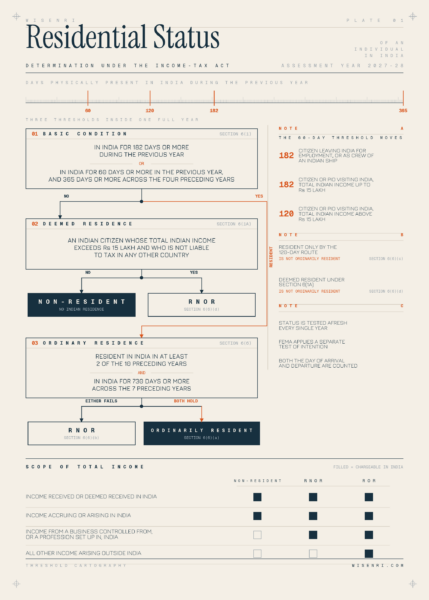
The Day-Count Tests for FY 2026-27
The Income Tax Act 2025 came into force on 1 April 2026. It renumbered a lot. It did not change these thresholds.
| Test | You become resident if |
|---|---|
| Basic test | 182 days or more in India this year |
| Second test | 60 days or more this year AND 365 days or more across the four preceding years |
| Relaxed test for citizens leaving for work, crew, or visiting PIOs | Only the 182-day test applies |
| The 120-day rule | Indian income above Rs 15 lakh AND 120 days or more here AND 365 days across four preceding years |
That last row is the one that catches people. The 120-day rule is where high-earning NRIs get caught. If your Indian income crosses Rs 15 lakh, your safe visiting window shrinks from six months to four. Someone who used to spend the winter in India can quietly become resident without changing anything about their life.
Deemed Residency: The Nowhere Man Rule
Section 6(1A) of the old Act, carried into the new one, targets one specific person: an Indian citizen with more than Rs 15 lakh of Indian income who is not liable to tax in any other country.
That person is deemed resident in India regardless of how few days they spent here. Zero days still counts.
This lands hardest on Indians in the UAE, Saudi Arabia, Bahrain, Kuwait and Oman. The one saving grace: a deemed resident is treated as RNOR, so only Indian income is taxed, not global income. Getting a Tax Residency Certificate from your host country is the cleanest way to show you are liable to tax somewhere.
RNOR: The Status Worth Planning For
Resident but Not Ordinarily Resident sits between the two extremes. You are RNOR if either of these is true:
- You were a non-resident in 9 out of the 10 preceding financial years, or
- You were in India for 729 days or less across the 7 preceding financial years.
Note the “or”. Many articles print “and”, which makes the test look far harder to meet than it is.
An RNOR pays Indian tax only on Indian income. Your overseas pension, foreign rental income and foreign interest stay outside the net. For someone returning after two decades abroad, RNOR can be worth two or three years of shelter, and it is entirely lost if you land back in India in April instead of October.
Read – How RNOR Status Works and How Long It Lasts
Four Situations I See Most Often
The Gulf engineer. Nine years in Doha, Indian rental income of Rs 8 lakh. He visits for 100 days. Non-resident, comfortably. If that rent were Rs 18 lakh, those same 100 days would still be safe, but a 125-day trip would not.
The consultant who came back for a project. Left India in June, returned in October for a six-month posting. He crosses 182 days. Resident for that year, taxable on global income, including the Singapore salary he thought was untouched.
The retiree who split her year. Six months in Toronto with her son, six months in Pune. She has been doing this for years. She is a resident, and has always been one, because she is not leaving India for employment and the 182-day threshold applies to her stay here.
The returning NRI. Twenty-two years in the US, comes home in November. He becomes resident that year on days, but qualifies as RNOR for two more years, sheltering his 401(k) growth and US rental income.
The nine days that cost Rs 11 lakh
A client in Muscat stayed 191 days in India one year because his father was in hospital. His Indian rent and NRO interest came to about Rs 22 lakh. Nine extra days made him resident, which pulled his tax-free Oman salary of roughly Rs 48 lakh into the Indian net. The additional liability worked out to a little over Rs 11 lakh. Nothing about his life had changed. Only the arithmetic had.
I now ask every NRI client to keep a simple spreadsheet of arrival and departure dates. It is the cheapest insurance in Indian tax.
Who Qualifies as an OCI
OCI is an immigration status, not a tax status. You qualify if you were a citizen of India on or after 26 January 1950, or were eligible to be one on that date, or belonged to a territory that became part of India after 15 August 1947, or are the child, grandchild or great-grandchild of such a person. Spouses of Indian citizens or OCI cardholders qualify after two years of registered marriage. Anyone who has ever been a citizen of Pakistan or Bangladesh is excluded.
An OCI card gives you lifelong visa-free entry. It does not make you a resident, and it does not let you open a PPF account or buy agricultural land.
Read more – Everything About the OCI Card
Optimism Bias and the Return Ticket
Psychologists call it optimism bias: our steady belief that the bad outcome happens to other people, not to us.
In NRI life it sounds like this. “I will not cross 182 days.” “The trip will be short.” “I will count later.” Then a father falls ill, a project stretches, a school year gets messy, and the count that felt theoretical becomes very real in July when the return is due.
Nobody plans to become resident. They just plan optimistically. The fix costs nothing: count as you go, not in hindsight.
Unsure which side of the 182-day line you are on this year?
Getting this one answer right shapes every other financial decision you make in India.
Questions That Come Up Again and Again
Do arrival and departure days both count?
Yes. Any part of a day spent in India counts as a full day. Keep your boarding passes and immigration stamps.
Does an OCI card make me an NRI?
No. Immigration status and tax residency are separate systems. Your day count decides your tax status.
Is the financial year the same as the calendar year?
No. India counts 1 April to 31 March. Many NRIs mistakenly count January to December and get a very different number.
What happens the year I move abroad?
You will usually be resident for that year unless you leave early enough. Convert your bank accounts and inform your investments straight away. Here is the changeover checklist.
Does becoming resident change how my Indian income is taxed?
The Indian income is taxed the same way, but your foreign income also becomes taxable, and you gain access to reliefs like the 87A rebate. The rate detail is here.
I pay no income tax in the UAE. Am I automatically deemed resident?
Only if your Indian income exceeds Rs 15 lakh and you are an Indian citizen. Below that threshold the rule does not touch you.
The strange thing about residential status is how little it has to do with belonging. You can carry India in your name, your language and your Sunday phone calls, and still be a non-resident on paper.
The law counts days. You count something else entirely.
💬 Your Turn
Have you ever come close to crossing the day limit without realising it? Tell me what happened and how you found out.


Can you help with tax?
(I am an OCI)
I am a non-resident for financial year 2023-24. I returned to India on Nov 5, 2023, after living many years in abroad continuously.
I have stayed in India since then. Pl let me know what my status for financial year is 2024-25.
Thanks!!!
My daughter working uk as nurse, opened bank accounts, her statutes as NRE or NRI?
Last financial year I was 120 days out of india in last finciacal year was out for more than 365 days
Hey Anil,
To provide you with accurate information, please provide additional details about your specific situation.
Dear Hemant,
Thanks so much for the excellent article!
Is there any clear definition of an “Indian ship”?
Deeply appreciate your generosity in sharing your precious time and vast knowledge; may God bless you abundantly ?
Hi Akbar Omar,
“Indian ship” is defined as a ship carrying Indian-flagged vessels & that is registered in India under the provisions of the Merchant Shipping Act, 1958, in India.
I am to live in another country as a retiree and will be staying out of India for more than 183 days this financial year, will I become a nri?
Hello Sanjay,
Yes, if you are staying outside of India for more than 183 days in a financial year (April to March), you are likely to be considered a Non-Resident Indian (NRI) for tax purposes.
I am taking a job in UAE wef 15.9.22 . Will this income be taxed in India . I was an NRI for 15 years for the period 2003 to 2018 . Please advice me on my tax status.
Hi Rajesh,
Please consult with your CA.
I am a NRI (PIO and Citizen of Singapore). I am tax assessee in India as I get income from my properties and interests on deposits. Now I have started investing in Treasury bills. I want to know how the discounts I get in the treasury bills will be taxed?
I am an OCI a British citizen and a defence pensioner receiving pension in India. During FY 2021-22 I have no stayed in India for a single day but stayed in India for 391 days in previous 4 years . Is my Statius for tax purposes NRI for AY 2022/33
Hi Harish,
As per my concern, your status should be NRI.
I try so many Bank in India I don’t get loan I am a nri
I am an Indian. 2 months back I got married in abroad with a foreigner.what should I do with my money in savings account in India. At the moment I can not change the account to nro account as I do not have the right documents yet and my surname is also changed. I tried to contact bank to close my account in India but they said I have to be present in person at the bank to. Close account. What should I do. Is there any time limit to close the savings bank account
Hi Pitu,
You can convert your resident a/c online by visiting the bank’s official website.
And you should convert your resident bank account as soon as possible.
I am an NRI and had no information on NRI rules and regulations until now. So I have done a few things which are not so legal and now want to correct
Hi Abhishek,
Yes, You will have to do things correctly as soon as possible.
You can drop your contacts here, we can connect and guide you accordingly.
Hi Latika,
We can connect over the email which is linked to the profile.
Thanks!
If I get PR status in Canada what are my legal and financial obligations in india
Hi Rewasharan,
You need to do nothing in that case.
I am an NRI living in Australia fore the last 6 years, I am a permanent resident of Australia but not a citizen. I understand that I currently dont qualify to buy agricultural land in India,however if I return to India and work there how long would I have to wait before purchasing an agricultural land.?
Hi Nikesh,
If you reside in India for more than 182 days then you will be considered as Resident Indian and then you can buy agricultural land.
Is it mandatory for a person to have residence permit of a country outside India in order to qualify to become NRI
Hi Saranjit,
Yes it is necessary to have residence permission of a country outside India.
Thanks for your response. Even if I live outside India on a visit visa for more than six months in a year.
If I am going to be a US citizen….am I still a NRI
Hi,
If you become a US citizen, you will be a NRI for the other countries.
I am in Germany since last 2 year’s but my job is not fixed here I am still a Indian employees so should I consider myself as a NRI.
what is the number of days for a person to be designated as NRI, I heard it is increase from 183 days
Hii Umair
You are considered an Indian resident for a financial year:
When you are in India for at least 182 days during the financial year
or,
You are in India for 60 days for the year in the previous year and have lived for one whole year (365 days) in the last four years
FD’S before becoming nri can be continued till matuirity or have to premature the same as becoming nri and what about savings account to do?
Hi Jatin,
You can convert your resident FD’s & Saving account into NRE FD’s & Saving account.
What changes are required to be carried out for a person’s bank accounts and other areas, who has recently acquired a PR status abroad?
Hi Rohit,
You need to change your KYC from resident to NRI as well as open or convert your resident bank accounts into NRE/NRO account.
Hi, I wanted to know what will be my resident status as per FEMA and Income Tax Act? I was in India till Nov 2020 and after that, my company, which is an Indian Company, has sent me for a foreign assignment outside India. The tenure of my assignment will be of 4 years. In such a case, what will be my resident status?
Hi Prakash,
As per FEMA act your resident status will become NRI immediately after leaving India. And As per Income Tax act if you spend less than 182 days in India in any FY your resident status will become NRI.
This is a general query for FILING the ITR.
1. I am NRI for past 10 years.
2. I have 5 years FCNR FDs and say get USD 5000 per year, that is say and interest of INR 3.5 lacs.
3. I have 5 NRE FDs. I earn interest of INR 4 lacs per year. And I earn INR 2 lacs per year on NRE Saving Account.
4. I have NRO FD and Saving account. I earn total interest of 1 lac per year.
5. I have NO other income in India (rent or shares etc.)
Is it mandatory to file ITR?
My taxable income is 1 lac per year from NRO FDs and NRO Saving accounts, which is less than the limit 2.5 lac per year.
But my total income from FCNR + NRE + NRO which is 10.5 lacs per year.
What happens if I was required to file ITR and I did not?
As such my Taxable income was always less than 2.5 lacs per year for all the time I am a NRI.
Hi Rakesh,
Interest on FCNR & NRE accounts /FD’s are tax free. But there is a TDS on NRO Account/FD. So you have to file ITR to claim refund of TDS if your total income in India is less than 2.5 lakh.
For 19-20 taxation purposes, my query is, from April to mid-June 2019, I was an India employee and since June I am in UK and UK employee. Will my income be global taxable in India. I have already paid my taxes in the UK.
Hi Abinash,
You don’t need to pay tax in India.
I was abroad during the current financial year from 01 April 2020 to 30 October 2020. What would be my Status in India. I am confused by the 240 days test. I do not have any resident income exceeding 15 lacs. I did not visit India during the Financial Year 19-20 i.e., 01 April 2019 to 31 March 2020.
Hi Shyam,
As you stayed less than 182 days in India so your status is now NRI.
Currently I am NRI and plan to return in two months .I stayed more than 10 years abroad.When I return what happens to my NRE FDs. Does it become taxable? I will be RNOR for two FY atleast.
Hi Natarajan,
You have to convert your NRE account to RFC account. In that case your NRE FD will be exempt.
I came to India in end March and got stuck till early September due to lockdown. How will this be treated in calculating residency? What will be the number of days required to be outside India in this year? Will it be proportionately reduced from 182 days?
Hi Nirjhar,
If you stayed less than 182 days in India your status will remain as an NRI.
I am NRI for the last 25 years and work outside. On 25th February 2020 I went on vacation to India and stuck up in India due to lockdown and no commercial flights were not operating. I left India on 18th Sept 2020. My job will be terminated on 31st December 2020 and go back to India on 15th January 2021. My question a) what will be the status for FY 2020-21 NRI? b) if I continue to stay abroad till 31st March 2021. I will be considered as NRI?
Hi Sunil,
You status will be RNOR.
click on below link to know more detail.
https://www.wisenri.com/rnor-status/
I work in Kenya and NRI but I have an income in India through a pension. Do I have to file an IT return?
Hi Sanjeev
Yes, you have to file Income tax return back in India
I came to NL on Sep14, 2019 to join my job here. I went back to India to bring my family (24 Oct 2019 – 15 Nov 2019). What will be my status for Income Tax dept India? Note: I was on holiday in Singapore for 15 days in April 2019, not sure if that matters. Regards
Hi Partha,
As you stayed more than 182 days in India your status will be considered as Indian Resident.
Hi
I have a query.NRIs are not allowed to submit form 15G. For 15G submission, we should consider NRI status as per FEMA or Income Tax.
Hi Suresh
As per my knowledge, NRI are not allowed to submit either 15G or 15H.
Hi Hemant,
I came to work outside India (NL) in Sep 14, 2019. I went back to India for 15 days in Nov 2019 to bring my family. I continue to work in NL.
What will be my status as per Income Tax department of India?
Note: I was on a holiday outside India for 15 days in April 2019, not sure if that’s relevant.
Regards
PS Dash