
Every few weeks, someone living in Dubai or New Jersey asks me the same question in three different ways. “Do I even need an Aadhaar now that I am an NRI?” “My PAN has gone inoperative, is Aadhaar the fix?” “Can I apply from here, or do I have to fly down?”
Three questions, one root cause. Most NRIs are not confused about Aadhaar. They are confused about which rules from five years ago still apply to them. And in 2026, quite a few of them do not.
⚡ Quick Answer
An NRI with a valid Indian passport can enrol for Aadhaar at any Aadhaar Kendra in India. The old 182-day waiting period is gone, you can walk in on arrival. Aadhaar is not mandatory for NRIs, and it is not proof of citizenship. Enrolment is free. Since the Aadhaar (Enrolment and Update) First Amendment Regulations came into force in May 2026, NRIs with an Indian address use Form 1 and NRIs with only a foreign address use Form 2. The one thing that actually costs money is this: if you already hold an Aadhaar, your PAN must be linked to it or your PAN goes inoperative.
Read – NRI Checklist: 8 Important Things To Do before you Become an NRI
What an Aadhaar actually is (and what it is not)
Aadhaar is a 12-digit number issued by UIDAI. It links your fingerprints, iris scan and photograph to your name, date of birth and address in a government database. That is it. It is an identity number, nothing more.
Think of it like a hotel keycard. It proves you are the person the system expects at that door. It does not tell anyone who owns the hotel.
So Aadhaar is not proof that you are an Indian citizen. It does not give you the right to stay in India. And it does not change your residential status for tax purposes by even one day. I have had clients genuinely believe that holding an Aadhaar makes them “half resident” again. It does not work that way.
Can an NRI get an Aadhaar card?
Yes. If you hold a valid Indian passport, you can enrol. Minor or adult, it does not matter.
The rule that used to trip people up was the 182-day condition, you had to have physically lived in India for 182 days or more in the preceding twelve months. That condition no longer applies to NRIs. You can land in Mumbai on Tuesday and walk into an Aadhaar Kendra on Wednesday.
Your Indian passport does most of the heavy lifting here. Under UIDAI’s rules it works as proof of identity, proof of address, proof of date of birth and even proof of relationship. One document, four jobs.
What changed in 2026: Form 1 and Form 2
The Aadhaar (Enrolment and Update) First Amendment Regulations, 2026, notified in May 2026, redid the entire list of acceptable documents and split the enrolment form by situation. This is the part most older articles on the internet still get wrong.
| Your situation | Form to use | What you carry |
|---|---|---|
| NRI, adult, with an address proof in India | Form 1 | Valid Indian passport |
| NRI, adult, only a foreign address | Form 2 | Valid Indian passport |
| NRI child under 18 | Form 1 or 2, signed by a parent | Child’s valid Indian passport |
Two practical notes that catch people out. An email address is compulsory for NRI enrolment, while for resident Indians it is optional. And the Aadhaar system still does not accept international mobile numbers or foreign correspondence addresses for delivery. If you want the physical card to reach someone, it has to reach an Indian address.
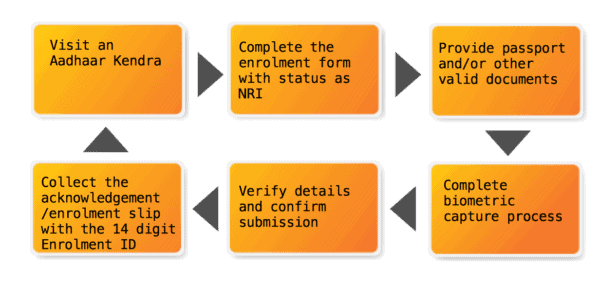
How to apply: the actual steps
- Walk into any Aadhaar Kendra in India. You do not need an appointment at most centres, though booking one on the UIDAI site saves you a wait.
- Carry your original valid Indian passport. Not a photocopy, not an expired one.
- Tell the operator clearly that you are enrolling as an NRI. Say it at the start, not after the form is filled. The declaration on the NRI form is worded differently from the resident one.
- Fill Form 1 or Form 2 depending on whether you have an Indian address proof.
- Give your email address. This is mandatory for NRIs.
- Complete the biometrics: ten fingerprints, both irises, photograph.
- Keep the acknowledgement slip. It carries your Enrolment ID.
Enrolment is free. If anyone at a centre asks you for money to enrol for the first time, walk out and find another Kendra.
You can then track the status on the UIDAI portal using the Enrolment ID. Generation usually takes a few days to a few weeks, and UIDAI’s outer timeline is around 90 days. Once generated, download the e-Aadhaar as a PDF. That downloaded copy is legally as valid as the plastic-looking card that arrives by post, so do not sit around waiting for the courier.
What about my children?
A parent or guardian signs the enrolment form for any child under 18, and the child needs their own valid Indian passport. Remember that biometrics have to be updated at ages 5 and 15. If your child was enrolled at three and is now sixteen and living in Toronto, that Aadhaar is almost certainly stale.
Must Read- How to Apply For NRI Credit Cards
The PAN and Aadhaar trap that actually costs money
Here is where the real damage happens, and it has nothing to do with the Aadhaar enrolment queue.
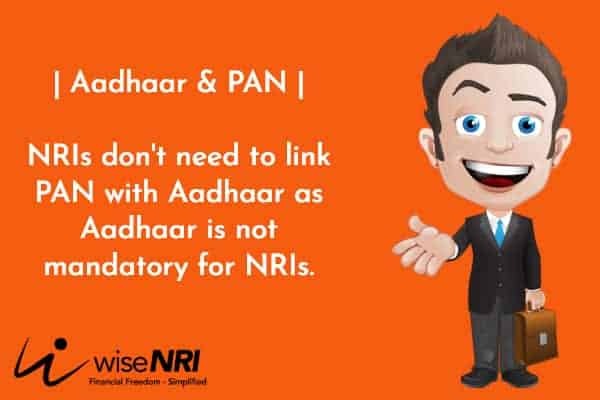
If you do not hold an Aadhaar, you are exempt from PAN-Aadhaar linking. But that exemption is not automatic. It only holds if your residential status is recorded as Non-Resident in the Income Tax department’s records. If the department still thinks you are a resident, the portal treats you like one, and your PAN quietly goes inoperative.
If you do hold an Aadhaar, the exemption does not apply at all. You have to link it. PANs left unlinked have been turning inoperative from 1 January 2026.
The question I ask every NRI client before we discuss anything else
Not “do you have an Aadhaar”. It is: “what does the income tax portal say your residential status is?” Almost nobody knows. And that single field is what decides whether your PAN works.
An inoperative PAN is not a paperwork nuisance. TDS gets deducted at the penal rate of 20% under Section 206AA instead of your treaty rate, which on a Rs 40 lakh property sale means roughly Rs 8 lakh withheld instead of a fraction of that. Refunds stop being processed. No interest accrues on money the government is holding. Mutual fund redemptions and demat transactions get blocked. And you find out at the worst possible moment, usually mid-transaction, with a buyer waiting.
Fixing it takes one intimation to your Jurisdictional Assessing Officer with proof of NRI status, and about 30 days. Discovering it takes two minutes. Almost nobody spends the two minutes.
Why careful people still get caught
The NRIs who get burned by this are not careless. They are usually the most organised people I deal with, senior professionals who run large teams and never miss a work deadline.
What gets them is status quo bias, the well-documented human preference for leaving things exactly as they are when no immediate consequence is visible. Updating your residential status on the tax portal has no deadline, no reminder email, no penalty notice. Nothing bad happens on day one. Or day four hundred. So it stays permanently at the bottom of the list, below things that make noise.
The cost is invisible right up until it is enormous. Yeh kaam kabhi bhi ho jayega is the most expensive sentence in NRI financial life. The consequence does not arrive when you ignore the task. It arrives years later, when a property sale is closing and Rs 8 lakh gets withheld instead of Rs 80,000.
Not sure whether your PAN, Aadhaar and residential status actually agree with each other?
We check all three together for NRI clients, before a transaction forces the issue.
So should you actually get one?
Honest answer: it depends on how much of your life still runs through India.
You do not need Aadhaar to open an NRE or NRO account, to complete mutual fund KYC, or to invest through a SEBI-registered intermediary. Your passport and PAN handle all of it. Aadhaar-based KYC is one route, not the only route.
✅ Aadhaar genuinely helps if
You visit India often, you are managing property or ageing parents’ affairs here, you plan to return within a few years, or you keep running into offline verification counters that only know one system. It makes routine friction disappear.
If India is now a place you visit for two weeks a year and nothing more, you can comfortably skip it. Just make sure your residential status on the tax portal says Non-Resident, because that is what protects your PAN.
Frequently asked questions
Is Aadhaar mandatory for NRIs?
No. It is voluntary. Nothing in NRI banking, investing or taxation breaks because you do not have one.
Can I apply for Aadhaar online from abroad?
No. Enrolment needs your biometrics, which means physically visiting an Aadhaar Kendra in India. You can book the appointment online, but the visit is unavoidable.
Does holding an Aadhaar make me a resident of India?
No. Residential status is decided purely by the number of days you spend in India under the Income Tax Act. Aadhaar has no bearing on it.
Can OCI cardholders get an Aadhaar?
Only if they have lived in India for 182 days or more in the preceding twelve months, under the Resident Foreign National category. The relaxed NRI rule applies to Indian passport holders, not to foreign passport holders with an OCI card.
I already have an Aadhaar from before I moved abroad. Do I need to do anything?
Two things. Link it to your PAN, and update your address if the old one is no longer valid. And separately, make sure your residential status is corrected on the income tax portal.
How much does it cost?
Fresh enrolment is free. Updates such as address or biometric changes carry a small fee at the Kendra.
Aadhaar is a twenty-minute errand. The residential status sitting wrong in a government database behind it is what quietly costs lakhs.
Check the boring field. It is the one that pays.
💬 Your Turn
Have you checked what your residential status says on the income tax portal? If you found it wrong, how did you discover it, and what did it cost you to fix? Tell us below.


does NRI have to stay in India for 182 days to get Adhar?
Hi Eldho Chettiyamkudiyil Poulose,
No, Non-Resident Indians (NRIs) are not required to stay in India for 182 days to get an Aadhaar card. However, there are specific rules and guidelines that NRIs should follow to obtain an Aadhaar card.
For NRI to apply for Adhar card, do they need to have indian passport or OCI?
Hi Karan,
For Non-Resident Indians (NRIs) to apply for an Aadhaar card, they generally need to have an Indian passport. The Indian passport serves as one of the primary documents for identity verification in the Aadhaar application process.
If we deposit our currency from foreign country why we don’t get in foreign currency and only in Indian currency.
Hi Rajan,
When you deposit foreign currency into a bank account in India, the amount is converted into Indian Rupees (INR) rather than being held in the original foreign currency. This is because Indian banks generally do not maintain accounts in foreign currencies for individual depositors, and the Indian banking system operates primarily in INR.
Do NRI get Adhar Card
Hi Sammerri,
YES. An NRI with a valid Indian Passport can apply for an Aadhaar card from any Aadhaar Kendra.
I am an NRI and need to apply for aadhar card
Hi Shilpi,
Can you please elaborate your question?
If a Resident Indian becomes NRI and subsequently OCI, then does the Aadhaar card held by Resident Indian need changes
Hi C Jairath
No the Aadhaar Card does not change.
I am an OCI resident abroad with agricultural land in India. Can I apply for an adharcard
Hello Harish
Yes, as an OCI (Overseas Citizen of India) resident abroad, you can apply for an Aadhaar card in India if you have any valid Indian identity and address proofs. Since you have agricultural land in India, you can use that as your address proof.
does OCI card holder who is staying in UK can still apply for NRI Aadhar card?
Hello jay
No, an OCI (Overseas Citizen of India) card holder who is staying in the UK cannot apply for an NRI (Non-Resident Indian) Aadhaar card. NRI Aadhaar card is only available for Indian citizens who are living abroad and hold a valid Indian passport.
Hi Jay,
OCI holders can apply for aadhar card but they have to be present in india physically for that.
In which cases is it mandatory for an NRI to have an Aadhaar Card ?
Hello
As per the latest guidelines issued by the Indian government, it is not mandatory for an NRI (Non-Resident Indian) to have an Aadhaar card. However, an NRI may need to obtain an Aadhaar card for certain purposes, such as:
1.To file income tax returns
2.To link bank accounts and PAN card
3.To avail of certain government schemes and services
It is important to note that an NRI who does not have an Aadhaar card can use other documents such as passport, PAN card, and driving license as proof of identity and address in India. However, it is advisable to consult with a financial or legal expert to understand the specific requirements and implications related to Aadhaar card for NRIs.
Hi Encore,
Aadhar card is not compulsory for NRIs
Can NRI get Adhar card
Hi Bharat,
Yes, Non-Residential Indians (NRIs) are eligible to apply for an Aadhaar card, which is the Indian government’s official identity document for citizens and residents of India. NRIs who have been living in India for more than 182 days in the preceding 12 months can apply for an Aadhaar card. They need to provide proof of identity and address in India, along with biometric data (photograph, fingerprints, and iris scan).
It’s important to note that, while Aadhaar is widely used as a proof of identity in India, it may not be accepted as such outside of India. NRIs may still need to carry a passport or other government-issued ID for international travel and other purposes.
We are us citizen but have income and bank account in india and have pan number. Do we need adharcard?
Hi Balbir,
No. You do not need Adharcard.
Do I have to be in India to apply for an aadhar card
Hi Surjeet
Yes, you have to because there is no online process for now.
Hi Hemant, if an OCI has pan linked with adhar, is the withholding on property sale, still 21%? How is a buyer supposed to know that a seller is NRI?
Hi Vinay
As per my knowledge yes it is same and the seller needs to be true about his identity while selling.
Informative article, thanks. May I request a couple of things –
(a) the use of the word “outsider” is confusing, could you consider revising it, and
(b) an OCI card holder is considered “Indian” for almost all practical purposes, so, can an OCI card be submitted in lieu of the Indian Passport to apply for the Aadhar card ??
Appreciate your indulgence, thanks in advance.
Hi Umesh
Yes, he can use his OCI Card to apply for the Aadhar card.
Hi,
Can Resident Aadhar Card holder change to NRI Aadhar Card?
Hi Jatin,
No.
I’m an NRI, holding US Passport living in NY. Would I be able to apply for the Aadhar card? Have the PAN Card.
Hi Rajesh,
Yes, you are able to apply for Aadhar Card.
What are the requirements? How you provide consulting.
Can OCI apply for aadhar?
Hi Sree,
Yes, OCI cardholders can get an Aadhaar card if they have resided in India for a period of 182 days or more in one year immediately preceding the date of application for enrolment.
I am an Australian citizen with OCI. Can I have an Aadhaar card?
Hi Manoj,
Yes, you can apply for aadhaar card.
Excellent article and very useful information.Request you to clarify that in case the NRI has already obtained an Aadhar Card ,before he became an NRI,can he continue holding the same after he becomes a NRI, especially now,since now a NRI has been allowed to apply for an Aadhar Card
Hi Sanjay,
Yes NRI Can hold Adhar Card.
The Indian Citizen holding Aadhar Card subsequently becomes NRI. Is there any requirement to change status and procedure?
Hi Virendra
As far as I know, currently there is no such requirement to Change the status.
NRI who is a citizen of USA, can he get Aadhaar? He doesn’t have Indian passport.
Hi Sanjay.
Currently, there is a need of Indian Passport to apply for an Aadhar.
I am a NRI since last 3 years. The registered add in my aadhar and pan are not valid anymore, since we have changed the residence in India. Since I am not in India and not planning to go anytime soon, how do I change the registered address on my aadhar and pan?
Hi Mudit
Yes, You can update the Address in Aadhar using the UIDAI portal online and after updating it in Aadhar, it can be done in Pan also through online.
Hi, what if someone already have Aadhar card and then later his status changes to NRI?
Hi Jatin
You can hold the Aadhar Card. Currently there is no provision for such.
Thanks very much Hemant for clarifying the rules around Aadhar for NRIs. There has been so much confusion on this. I and my family members got Aadhar cards issued on one of our visits to India, and afterwards we were told it was a “crime” to hold Aadhar cards as NRIs! Yet, all government processes now accept it as ID (rightly so)… This article will help many NRI friends. Really very useful.
Thanks for sharing your views Nandani.
Is any provision for OCI to obtain Adhar Card?