
Vikas assumed his RNOR status meant three years of an automatic pass on Indian tax questions. It doesn’t work that way, and he found out only when his CA asked for his exact days-in-India count going back seven years. He didn’t have it. (name changed)
⚡ Quick Answer
Three questions every NRI should be able to answer today: have I completed the mandatory account and status changes required when becoming an NRI, do I actually owe tax on my Indian income, and can I genuinely maintain my lifestyle if I return to India? Getting honest answers now avoids compliance penalties, unexpected tax bills, and a jarring lifestyle shock later.
Moving abroad is genuinely common for Indians. But an NRI needs a real financial plan in place, one that actually covers short, medium, and long-term goals. Asking yourself the right questions is a solid way to keep a regular check on your financial life.

Must Read: NRI Frequently Asked Questions And Answers
Asking these questions helps you avoid genuine money mistakes, and avoid landing on the wrong side of FEMA or tax law. It also helps you decide whether working with a professional financial planner makes sense. If you’re short on time, or not confident handling this yourself, a financial planner with real NRI-specific expertise is worth considering.
Here are three questions worth asking yourself, if you haven’t already.
1. Have I Made the Mandatory Financial Changes That Come With NRI Status?
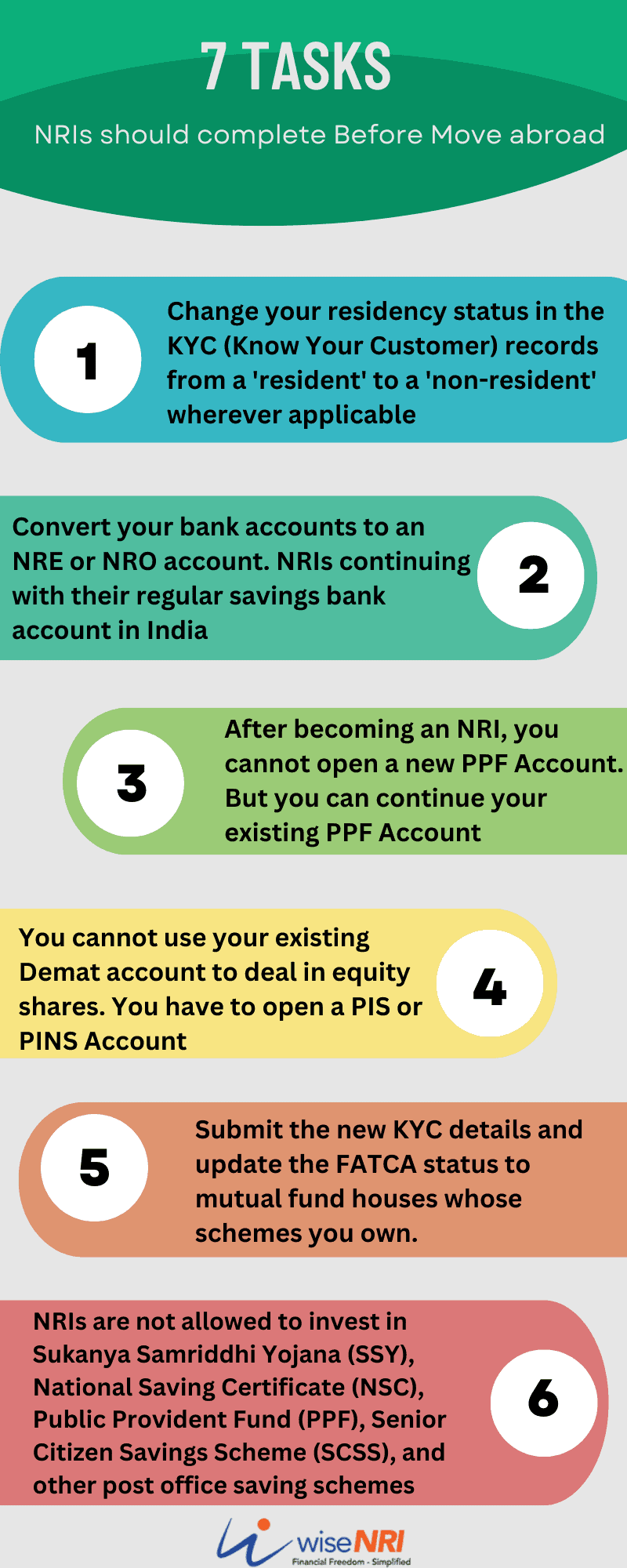
When you move abroad, several tasks genuinely need completing to keep your financial records clean:
- Update your residency status in KYC records from resident to non-resident, wherever applicable.
- Convert your bank accounts to an NRE or NRO account. Continuing to operate a regular resident savings account after becoming an NRI genuinely violates FEMA.
- You can’t open a new PPF account as an NRI, but you can continue an existing one opened while you were a resident, contributing through your NRE or NRO account.
- You can’t use an existing resident Demat account to trade equity shares. You’ll need a PIS or PINS account, transferring existing holdings into it, or opening one fresh if you don’t already hold a Demat account.
- Submit updated KYC and FATCA status to every mutual fund house whose schemes you hold. Your updated residential status needs to reflect in each folio, and linking your NRO account to them keeps recurring transactions like SIPs and STPs running smoothly.
- NRIs can’t invest in Sukanya Samriddhi Yojana, National Savings Certificate, new PPF accounts, Senior Citizen Savings Scheme, or other post office savings schemes.
Must Check: Checklist, Things to Do Before You Become an NRI
2. Do I Actually Owe Tax on Income Earned in India?
An NRI’s Indian income filing threshold depends on the tax regime: Rs 2.5 lakh under the old regime, or Rs 4 lakh under the new regime.
NRIs need to file Indian tax returns in several common scenarios:
- Salary received directly into an Indian account, or income for services rendered in India, is taxable per your applicable slab.
- Capital gains from selling shares or securities are taxable.
- Selling house property triggers TDS on the sale, with the rate depending on whether the gain is long-term or short-term, and current capital gains rules (post the 2024 changes: generally 12.5% without indexation, or 20% with indexation for assets acquired before July 2024, whichever works out lower). Excess TDS withheld can be claimed back through a TDS refund.
- Interest on NRO fixed deposits and savings accounts is taxable.
- Rental income is taxable, and the tenant paying an NRI landlord must deduct TDS at 30% before paying rent.
- If your Indian income exceeds Rs 15 lakh in a year, the deemed residency rules tighten the day-count thresholds that determine your status, adding real complexity. Read Who Is an NRI for the specifics.

Must Read: Early Retirement Guide for NRIs
3. Can I Genuinely Maintain My Lifestyle If I Return to India?
Many NRIs carry this question quietly, since higher disposable income abroad often supports a genuinely comfortable lifestyle. On return, income levels frequently drop, and maintaining that same lifestyle can get genuinely hard.
RNOR Isn’t a Flat 3-Year Grace Period
A common assumption is that RNOR status simply lasts three years after returning. It doesn’t work that way. You requalify each year against two tests: whether you were NRI in at least 9 of the preceding 10 financial years, or whether your total stay in India across the preceding 7 years was 729 days or less. Meet either test, and you’re RNOR for that year, generally translating to something in the 2-3 year range in practice, but never a guaranteed flat number. Get your exact residency history calculated precisely rather than assuming a round figure.
If you’re planning early retirement and a return to India, start retirement planning now if you haven’t already. Get concrete about the lifestyle you actually want in India, check its feasibility against your real numbers, and build a plan to reach it. Others return for better job opportunities or to be closer to family, but either way, planning the return against your actual financial situation and long-term goals is what prevents a sustainable lifestyle from turning into a source of regret.
Check: How Can NRIs Avoid Lifestyle Inflation
A few practical reminders for the return itself:
- Change the residency status on every Indian bank account.
- Use your RNOR window (calculated properly, not assumed) for real tax management.
- Confirm health insurance valid in India, and life insurance too, if you have dependents.
Plan the return well and execute it deliberately, so your finances aren’t left to chance and your decisions stay genuinely well-informed.
Frequently Asked Questions
What happens if I skip converting my resident account to NRO after becoming an NRI?
It’s a real FEMA violation, and can trigger penalties including a fine of up to three times the account balance, plus daily penalties until resolved. Convert it as soon as you notice.
Do I owe Indian tax on income I never actually remit back to India?
Yes, if the income is sourced in India (rent, capital gains, interest on NRO deposits), it’s taxable regardless of whether you bring it back or leave it in India.
How do I calculate my exact RNOR window before returning to India?
You’ll need your precise days-in-India count for each of the preceding 7-10 financial years. A CA or financial planner familiar with returning NRI cases can calculate this accurately rather than relying on a rough assumption.
Three honest answers today are worth more than three assumptions discovered the hard way later.
How would you rate yourself on these three questions?
Let’s work through whichever one you’re least sure about.
💬 Your Turn
How would you rate yourself on these three questions? Share your honest answer in the comments.


I am a foreign National (NRI) and Like to see a video on how to fill out ITR-2 to get some refund on my Capital Gains I received on my Mutual Funds and also TDS on NRO interest earned? I do not wish to go thru CA for this.
If the NRI friend is transfer money to Indian friend.. Can Indian friend pay charges to agent before the received money in bank account?
I am an NRI with NRE and NRO accounts both. Do I have to pay Income Tax in India? I am a foreign national.
Very good questions and suggestions
Thanks Ravi 🙂