
Many people take stock of their wealth, assets, and liabilities as an annual ritual, usually around tax filing time at the end of the financial year. Though wealth is technically a static number, the value of all your assets minus total liabilities at a given point, its actual value shifts daily with market dynamics.
Certain black-swan events can move your wealth substantially within days: a sudden global stock market crash, a sharp oil price shock, a sudden currency devaluation, or on a more personal level, a health scare or the loss of a loved one. Many NRI families have found themselves genuinely caught off guard when events like these unfolded quickly and across borders at once.
Quick Answer
A complete NRI wealth planning checklist covers six areas: the right mix of NRE, NRO, and FCNR accounts, a disciplined investment portfolio with no leverage, a debt checklist that caps borrowing at 25-35% of net worth, wealth protection through adequate insurance and an updated will, and cross-border tax planning that uses every legitimate deduction available. NRIs need this more than most, since their income, assets, and tax exposure are typically spread across more than one country at once.
If you haven’t done a genuine wealth check-up until now, it’s not too late to get a clear status report and put things in perspective. NRIs need wealth planning more than most, with attention, assets, income sources, and interests spread across multiple tax jurisdictions at once.
This comprehensive checklist can help you start drawing up your own personal balance sheet and income statement.
Must Read: NRI Checklist: Going To Be An NRI? Check Your To-Do List
NRI Wealth Planning Checklist
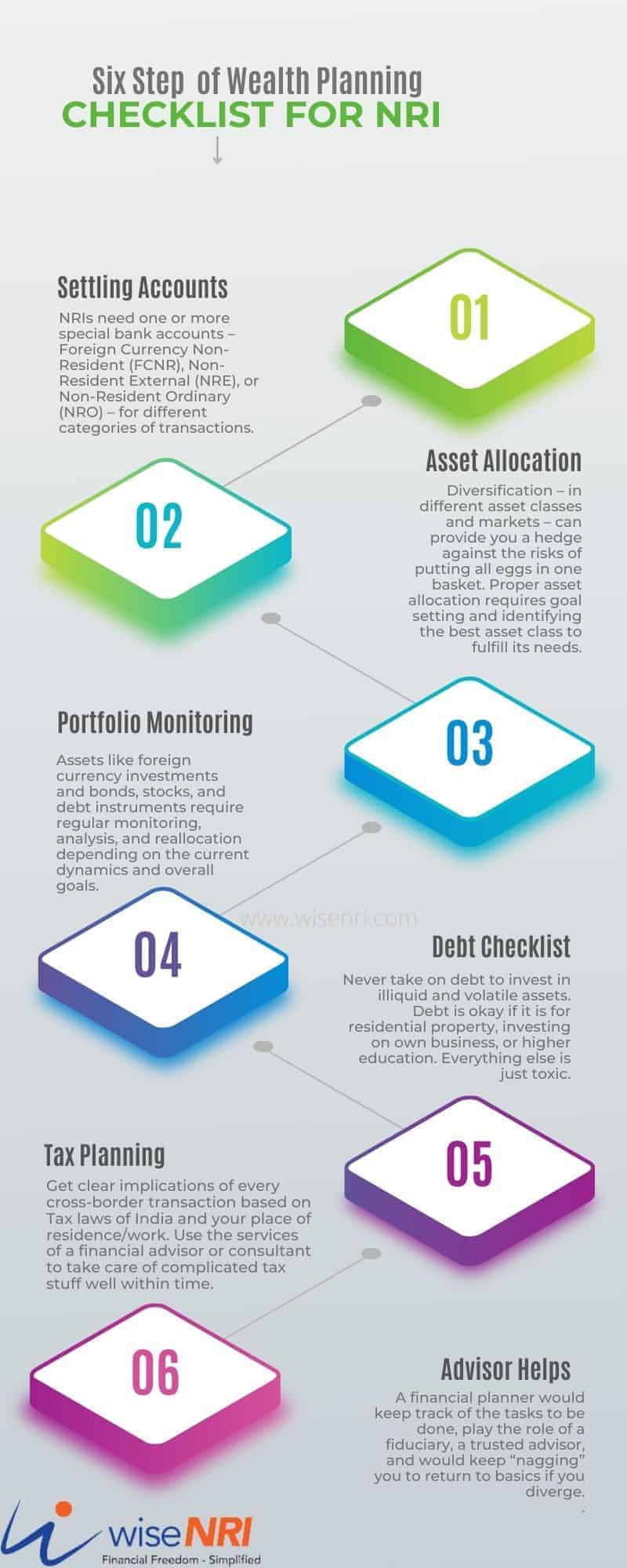
Settling Accounts
NRIs typically need one or more specific bank accounts, Foreign Currency Non-Resident (FCNR), Non-Resident External (NRE), or Non-Resident Ordinary (NRO), for different categories of transactions.
For making or receiving payments in India. Repatriable up to USD 1 million per year.
NRE Account
Deposit overseas funds in a rupee-denominated account. Fully repatriable, tax-free in India, can also fund Indian market investments.
Foreign currency term deposits in an Indian bank. Relatively higher rates, tax-free, no currency risk.
Investment Portfolio Checklist
Never Leverage
Everyone, NRIs included, should hold onto one rule: never leverage for investments. Many NRIs have made the mistake of borrowing foreign currency and investing it in India without fully accounting for the underlying currency risk.
Assess Your Risk Tolerance
Sharp volatility across share, commodity, and debt markets has, at various points, tested even the most experienced investors. People who were doing well when markets were rising have found themselves genuinely rattled once conditions turned.
Assessing your real risk tolerance early is the best defence against the next black-swan event, whenever it arrives.
Must Read: Issues NRIs Face With Their Banks
Asset Allocation
Diversifying across asset classes and markets hedges against the risk of putting all your eggs in one basket. Proper allocation starts with setting goals and matching each to the right asset class. Diversification also smooths overall portfolio volatility, since losses in one class can be offset by gains in another.
Emergency Funds
Up to 12 months of expenses, held in cash or cash equivalents.
Short-Term Needs
1 to 3 years, in secure term deposits.
Mid-Term Funds
3 to 7 years, in hybrid funds, gold, or stock options.
Long-Term Funds
7+ years, in growth stocks and property.
Never speculate with money earmarked for a specific goal. If you want the occasional thrill, keep it to genuinely spare change.
Portfolio Monitoring
Foreign currency investments, bonds, stocks, and debt instruments all need regular monitoring, analysis, and reallocation as conditions and goals evolve. This lets you divest from positions that have drifted off course and reinvest in the ones actually proving their worth.

Must Check: Gift by NRI to Resident Indian or Vice Versa
Debt Checklist
- ✓Pay off credit card bills in full regularly. Never roll them over.
- ✓Never take on more than roughly 25-35% of your net worth as debt.
- ✓Never borrow to invest in illiquid, volatile assets. Debt makes sense for residential property, your own business, or higher education. Almost everything else is genuinely toxic debt.
- ✓Get your residential or other properties evaluated for a Home Equity Line of Credit or overdraft facility, purely as an emergency backstop.
- ✓Always push for the best rate and terms on any debt. Your credit history genuinely matters here.
- ✓Avoid refinancing debt unless it’s a genuine emergency. It can dent your credit history.
Must Read: Can NRIs Get a Car Loan in India?
Wealth Protection and Estate Planning
Protecting wealth matters as much as creating it. If you can’t protect what you’ve built, the whole exercise loses much of its point.
As the main earner in a family, you carry responsibility for them even if something happens to you. Genuine risk coverage means looking squarely at life’s uncertainties: job loss, an accident, a serious medical event, or death.
- ✓Keep emergency funds equal to 6 to 12 months of expenses, including EMIs and premiums.
- ✓Get adequate health insurance for the whole family. If a return to India is likely, add coverage from an Indian insurer too.
- ✓Add disability benefits or critical illness riders if your job involves significant travel.
- ✓Carry term insurance sufficient to cover liabilities and leave a genuine corpus for dependents.
- ✓Keep all asset titles clean and unencumbered, and update the list every six months or after any major transaction.
- ✓Maintain sufficient home, auto, and umbrella insurance coverage.
- ✓Keep your will genuinely up to date, with clearly named legal heirs, executors, trustees, healthcare proxy, nominees, and power of attorney holders, along with their specific roles.
Must Check: Best NRI Investment Options in India
Tax Planning Is a Critical Piece of NRI Wealth Planning
Get a clear read on the cross-border implications of every transaction, based on the tax laws of both India and your country of residence or work.
Keep investing through allowed avenues to maximise the tax benefit on your Indian earnings, and file returns properly to actually claim DTAA advantages. Using a financial advisor or consultant for the more complicated tax pieces, well ahead of any deadline, tends to pay for itself.
A few common tax-saving habits worth building:
- ✓Try to avoid short-term capital gains where you have a choice.
- ✓Keep portfolio turnover minimal, adjusting only when genuinely needed, since every transaction carries a tax consequence.
- ✓Max out contributions to pension funds or retirement plans where eligible.
- ✓Use available tax-advantaged investments fully, whether that’s an IRA, 401(k), or PPF, depending on your eligibility.
- ✓Buy adequate health insurance and get regular check-ups where these are eligible for deductions.
- ✓Donate to eligible charities and trusts where this genuinely aligns with your values, not purely for the deduction.
- ✓If you’re carrying capital losses in taxable accounts, realise them deliberately so they can offset future capital gains.
Where an Advisor Genuinely Helps
Building and maintaining an NRI wealth planning checklist is never going to be simple or effortless. Many people start the process and abandon it midway, since life stays busy and the urgency of wealth planning tends to fade over time.
A good financial planner keeps track of what needs doing, acts as a trusted advisor, and gently keeps nudging you back to the basics if you drift. Sharing this responsibility with someone who can hand-hold both you and your family means the work actually gets done, not just started.
Ready to build your own wealth plan?
We help NRI clients work through exactly this checklist, so you can spend your time on what actually matters: your health, your family, and building the memories that count.
If you have any questions about NRI wealth management, feel free to add them in the comment section.


How do I know that whether my bank account is link with NRI account or not and how can I cancel it
Hi Vyshp,
Please consult with your Bank.
I am a US based NRI with OCI card and US citizenship can I start a brokerage account in India ?
Yes, you can open a PIS account.
I am Raghunatha reddy. I didnt get a chance to ask my question. My query is my nephew is from india and now US citizen. He has two flats in india purchased when he was working in india and they ate being sold. How he can repatriate this money to US. Money will be more than a crore
As far as I know the NRI has to fill up and submit Form 15CA Format (online application form) and Form 15CB (Chartered Accountant Application) to the bank branch to transfer money from India to a foreign country.USD 1 million per financial year from the NRO account to the NRE account.
myself and my wife both are senior citizens above 70 years of age and stay in USA on green card since last two years. We will shortly visit India for the first time after getting card. We will open NRO account there. (not NRE since we do not earn here and we do not have dollars to transfer to India ) We want to know how can we transfer INR from our bank to USA? What is the limit of money transfer?
Hii Mr Amarsingh
As per my knowledge,USD 1 million per financial year from the NRO account to the NRE account.